

FacultyLeaks.com is an anonymous dispatch from inside higher education. Some identifying details have been changed. The dysfunction has not.
A 2026 study published in Theory and Society analyzed 600,000 social science abstracts published between 1960 and 2024. It found that 90% of politically relevant research leaned left. Every discipline shifted leftward between 1990 and 2024. Fields with greater ideological homogeneity showed greater leftward orientation. The trend accelerated through the 2020s.
The study has been circulating widely on X this week — and for good reason.
This came as no surprise to any academic still tethered to reality. The field has drifted so far left that colleagues who would have been considered liberals a generation ago now think of themselves as moderates — and anyone to the right of a David Brooks as center-right at best, dangerous extremist at worst.
The study confirmed what anyone paying attention already knew: most of what passes for scholarship in these fields is a lengthy left-wing op-ed dressed in the costume of academic research — with APA citations linking to research that may not even support their proposition.
I wanted to see how deep it goes. I had long suspected this was the case in my own field. Early in my career, still on the tenure track, I deliberately chose a research area I knew was acceptable in my field — a policy topic that academia and media had coded as left-wing, even though polling consistently showed strong support across the political spectrum. Conservative voters wanted it. Conservative politicians opposed it, likely due to regulatory capture and campaign donations from industry. The nuance didn’t matter. The label did. My conclusions aligned with the approved narrative. It won an award that carries real weight in my field, and that effectively anchored my tenure portfolio. Subsequent research — same methodology, same rigor, same commitment to following the data wherever it led — produced findings that were neutral or, in the culture war vocabulary my field now speaks fluently, coded right. No award. I didn’t change my methodology. I didn’t change my conclusions — the data did. That was enough.
A chart making the rounds on X, based on decades of faculty ideology survey data, shows what that pressure produces over time: Far Left/Liberal faculty went from 45% in 1969 to 74% by 2021-22. Middle-of-the-road collapsed to 15%. Conservative/Far Right: 11%. The center didn’t hold. It got pushed out. I wrote about what that looks like on the ground in a recent dispatch. The data here shows where it comes from.
A 2018 study by Brooklyn College’s Mitchell Langbert found that among sampled communications faculty, there were 108 registered Democrats and zero registered Republicans — the most lopsided ratio of any discipline studied. By 2022, just 3.4% of working journalists identified as Republican, down from 18% in 2002. The pipeline is working.
So I ran an AI analysis of the 2025 programs of the two largest annual gatherings of communication scholars: the Association for Education in Journalism and Mass Communication (AEJMC) and the National Communication Association (NCA).
What came back confirmed everything I suspected.
The Numbers
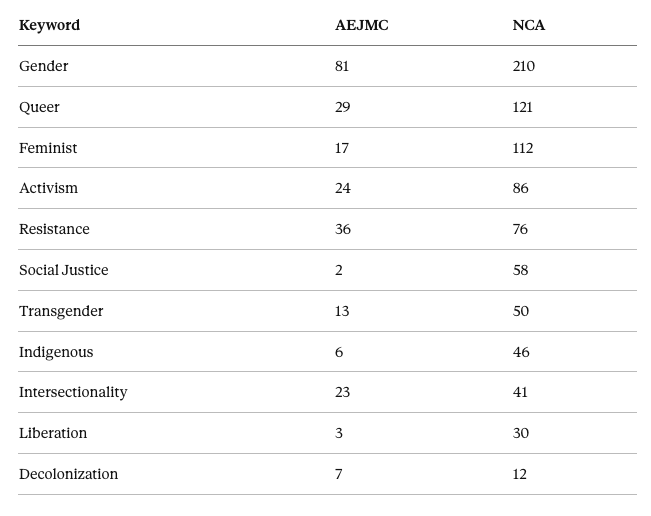
In the AEJMC conference program — the flagship gathering of the academics who train the next generation of journalists — the word “resistance” appears 36 times. “Queer” appears 29 times. “Feminist” 17 times. “Activism” 24 times. “Intersect” 23 times. “Decoloni” 7 times.
The word “impartial” appears zero times.
“Accuracy” appears 4 times.
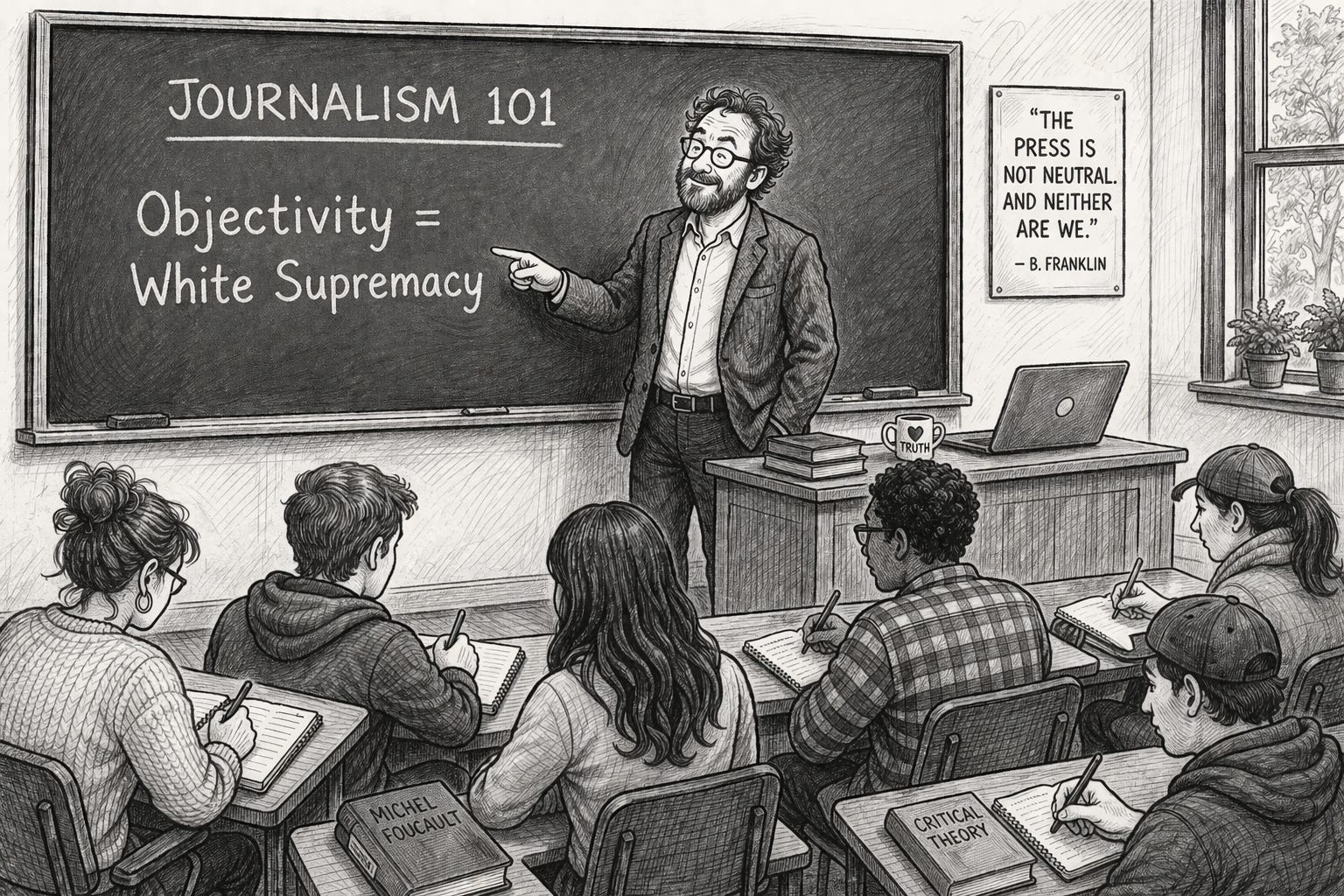
The word “objectivity” shows up. Just not the way you’d hope. The dissertation award went to a paper arguing that objectivity itself is a tool of white supremacy: Racializing Objectivity: How The White Southern Press Used Journalism Standards to Defend Jim Crow.
At NCA — the larger conference, covering communication broadly — the numbers are worse. “Resistance” appears 76 times. “Queer” 121 times. “Feminist” 112 times. “Activism” 86 times. “Social justice” 58 times. “Liberation” 30 times. “Decoloni” 12 times.
“Impartial” appears zero times at NCA as well.
“Objectivity” appears zero times.
“Accuracy” appears once.
Here is what the full picture looks like.
Ideological keywords across both conferences:
Professional/neutral keywords across both conferences:
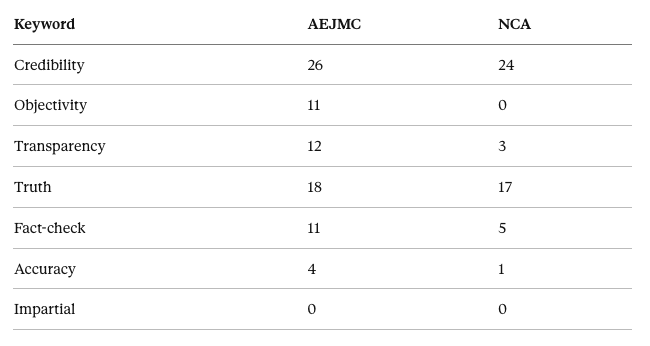
“Resistance” outpaces “accuracy” by a factor of 28 to 1 across both programs. Combined across both conferences, “resistance” appears 112 times. “Accuracy” appears 5 times.
For context on what the field considers worth studying: “Trump” appears 34 times across both programs. “Fascism” appears 8 times. “Impartial” appears zero times.
To be clear: these are keyword counts. Context varies. The paper titles speak for themselves.
The Papers
The numbers are striking. The titles are something else.
A sampling from AEJMC:
“Joy as Resistance: Finding Happiness and Purpose in Academia When DEI is Under Fire”
“Algorithmic Decolonization: AI-Mediated Resistance to Cultural Hegemony in China’s Science Fiction Cinema”
“Practicing Everyday Resistance Against Intersectional Oppression in U.S. Higher Education”
“From Episodic Coverage to Active Resistance”
“Feminist Resistance in the Game Industry: Female Players Exiting Genshin Impact”
“Racializing Objectivity: How The White Southern Press Used Journalism Standards to Defend Jim Crow” — this one won the dissertation award
“Decolonizing Journalism Education: Integrating Indigenous Knowledge Systems”
From NCA:
“Rest as Resistance to the Ideal Worker Norm” — taking time off is now resistance
“Teaching While Black: Abolitionist Critical Communication Pedagogy”
“Didn’t Earn It: Decolonizing the Rhetoric of the Letters D.E.I.”
“Breaking Compliance: Communicating to Elevate Asian American Resistance to Rightward Shifts”
“Destruction as creation: Slag Wars and Queer Worldmaking”
“I’m Not a Monster Stephen, I’m a Mother: A Queer Theoretical Reading of Marvel’s Wanda Maximoff”
“Elevating Palestine: Intersectionality, Solidarity, and Resistance” — a named session, not just a paper
The deeper you dig, the worse it gets. At AEJMC, the panel description for ‘From Episodic Coverage to Active Resistance’ called for “rejecting ritualistic objectivity” in favor of a “social justice lens.” This was not a panel about covering resistance movements. It was about training journalists to practice resistance themselves. The assumption that journalists should be activists, not reporters, was the premise, not the conclusion.
This is not a fringe view. Ted Glasser, a former AEJMC president and Stanford journalism professor emeritus, put it plainly: “Journalists need to be overt and candid advocates for social justice, and it’s hard to do that under the constraints of objectivity.”
The Graduates
Communication departments and schools are the academic home of journalism, public relations, film, advertising, and strategic communication — essentially every profession that shapes what the public sees, reads, and hears.
People sometimes ask why the media leans left. They ask why Hollywood leans left. They ask why advertisements feature an oddly specific demographic mix, or why the white dad in every commercial is the bumbling one who can’t figure out the dishwasher. They ask why corporate communications and public relations departments have been taken over by activists.
This is why.
The people entering those fields were trained by the professors who attended these conferences, brought the framework back to the classroom, and presented it as the state of the field. They sat in classrooms where “objectivity” was taught as a suspect concept — a tool of hegemony, a relic of white Southern journalism, something to be decolonized. They wrote papers on feminist resistance and intersectional oppression.
Then they graduated and went to work at newspapers, TV networks, PR firms, advertising agencies, and studios. And they brought the framework with them.
A recent entry-level job application from Diffusion PR, a New York and Los Angeles firm, illustrates exactly how far the framework has traveled. Of two required essay questions, one asked applicants to assess the “backlash” against American Eagle’s Sydney Sweeney partnership — a campaign allegedly misinterpreted as promoting “good genes” rather than “great jeans” — and prescribe steps the brand should take to “repair its image with consumers.”
The premise of the question is that the backlash was legitimate and the brand was damaged. The market disagrees. American Eagle’s stock more than doubled in the months following the campaign’s launch. The ad worked. Consumers responded. The “backlash” was a social media pile-on that did not reflect actual consumer sentiment in any measurable way.
But a PR firm training its next generation of professionals has absorbed the lesson its employees learned in school: that backlash from the right constituencies is always real, always requires a response, and always demands that brands demonstrate contrition. The question isn’t whether the campaign succeeded by any objective measure. The question is whether the right people on social media were upset.
Worth noting: the second essay question asked candidates to pitch creative ideas for a product launch. Normal PR work. Totally fine. The tell is that question one wasn’t “analyze a successful campaign.” It was “fix the damage.”
This is not a communications firm. It is a graduate seminar with a client list.
What business would hire a PR firm that looks at a 144% stock surge and calls it a crisis? They used to teach that there’s no such thing as bad publicity. This firm apparently teaches the opposite: it’s okay to go broke as long as you’re woke.
This is not a conspiracy. It doesn’t need to be. It’s a pipeline. The academics set the terms, the graduates carry them into newsrooms, Hollywood, and Madison Avenue, and anyone who pushes back gets told they haven’t read the literature.
These are the people training the next generation of journalists, filmmakers, and advertising executives. And then everyone wonders why the media leans left.
More dispatches from the campus that’s lost the plot: subscribe below.
I teach at a well-regarded journalism school. Myself and another colleague are the only conservatives that we are aware of. We joke that we are the real diversity hires. I'll have students sit in my office and "come out" as conservative, as if they were coming out as gay. I more or less keep my head down and go about my business. I don't think politics belong in the classroom. Many of my colleagues disagree - they DO think it's their job to breed activists.
I love this Substack, because this is my day-to-day experience.
If ever you encounter an academic tethered to reality please do the right thing and cut the cord. It's not morally responsible to sit and watch people suffer like that.