


FacultyLeaks.com is an anonymous dispatch from inside higher education. Some identifying details have been changed. The dysfunction has not.
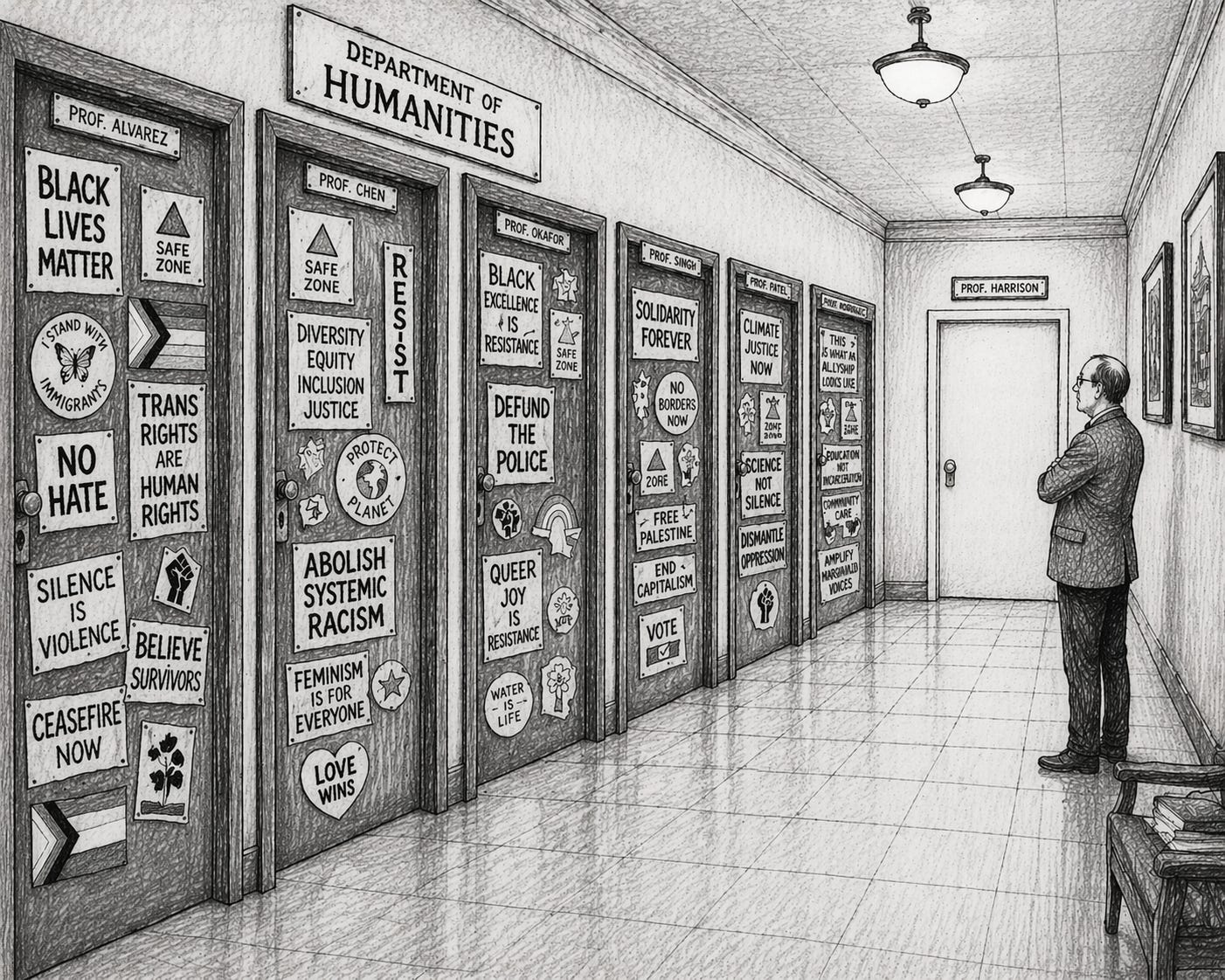
A gay student once told me “it was harder to come out as a conservative” on our campus “than as gay.”
He wasn’t worried about other students. He was worried about us.
He’d done both. He knew the difference. Coming out as gay had earned him support, affirmation, a community. Coming out as conservative — even tentatively, even carefully — had earned him cold shoulders, pointed comments in class, and the quiet but unmistakable sense that he had revealed something shameful about himself. The difference was who was making him feel that way. Other students had been mostly fine. It was the faculty. The administrators. The people with power over his grades, his recommendations, his academic future.
The people with Safe Zone stickers on their doors.
I’ve been thinking about that conversation ever since.
The Signs on the Doors
Walk down any hallway in my building and you’ll see them. Safe Zone stickers — the official insignia of faculty who have completed LGBTQ+ ally training — alongside progressive cause posters and the full iconography of a campus that takes one kind of inclusion seriously. The doors are a bulletin board of approved politics.
Put up a conservative-coded sign and you get sideways glances or worse. At a faculty meeting, a colleague mentioned — approvingly, as a model — that she had instructed a student to remove an “America First” sign visible in his home background during a Zoom class meeting. It was making other students uncomfortable, she said. She was sharing it as a tip. The implication was clear: we should all be watching for this. The student’s bedroom. His wall. His sign. The discomfort, in all likelihood, was entirely her own.
There is no sticker for viewpoint diversity training because that training does not exist. Nobody has ever proposed it. The suggestion would likely not be well received.
This is not an accident. It is a culture, carefully cultivated over decades, in which one set of political identities is celebrated and another is discouraged. Sometimes the discouragement is subtle — the accumulated weight of a thousand small signals that tell students exactly which opinions are safe and which are not. The disapproving glance when someone says the wrong thing. The classroom where certain arguments simply don’t get made.
And sometimes it isn’t subtle at all.
Conservative students learn the campus geography quickly. Certain departments are fine. Certain buildings you avoid entirely if you want to get through the semester without your grades reflecting your politics. Students pass this information to each other the way they pass down any survival knowledge — quietly, informally, person to person. Nobody writes it down. Nobody has to.
A student in the campus conservative club told me once that as a freshman he had been “terrified” to let anyone know his political views. Finding other students who shared them had helped. But he was clear-eyed about the situation: the campus still wasn’t a welcoming place for conservatives, the numbers were too small to drive real change, and the work felt endless.
He wasn’t angry about it. He was just tired.
And this is now spreading beyond the traditional soft targets. A chemistry professor at our university recently published a piece in a campus newsletter arguing that the field needs to be “decolonized” — that the hard science of atoms and molecules carries the weight of colonial epistemology. Chemistry. If the ideology has reached the lab, there is nowhere left on campus it hasn’t touched.
The Numbers
I raised this issue once at a faculty meeting. Gently. I noted that if you looked at political donation records — public information, Federal Election Commission data — our faculty had donated almost exclusively to Democratic candidates. Not predominantly. Not overwhelmingly. Almost exclusively.
A colleague approached me privately afterward. She wanted to correct the record. She thought there might be at least a couple of faculty who supported Republicans — two, out of more than a thousand. She wasn’t certain. She just suspected someone might lean that way.
Well. That changes things!
The actual number rounded to zero. Some colleagues, I suspect, had set up automatic monthly donations to progressive organizations and forgotten about them entirely. Their political convictions were on autopilot.
This is what viewpoint diversity looks like on a campus that has never had to think seriously about viewpoint diversity. Not a blind spot. A void.
The Speaker
The closest thing our campus ever hosted to a conservative speaker was Jennifer Rubin, a woman who spent years at the Washington Post being described as conservative while disagreeing with conservatives about virtually everything. She has since dropped the label entirely. Our faculty considered her a bold choice.
She spent her entire talk attacking Trump.
The audience was rapt.
I once sought internal funding to bring in a heterodox speaker — not a partisan, not a provocateur, just someone whose worldview would have been unfamiliar to a room full of faculty who had donated almost exclusively to one party. The application was rejected. The stated reason: not an appropriate use of funds.
I went back and looked at how the same internal grant had been used in previous years. It had funded a radical environmental activist. A labor organizer. A speaker whose entire public profile was built around a single ideological argument. One of those speakers later made national news for assaulting his partner — the news broke before he was scheduled to appear, and the school quietly canceled the engagement without explanation or announcement. No statement. No forum. No discussion of what it meant that he had been invited in the first place. They had no problem with his ideology. They just didn’t want the story. None of the original bookings had raised any questions about appropriate use of funds. The grant, it turned out, was perfectly appropriate for speakers — just not for that kind of speaker.
Their recommendation, delivered with apparent sincerity, was that I try the speaker committee.
So, I joined the committee. But the other faculty on it would not bring anyone too controversial to campus. By which they meant anyone to the right of Jennifer Rubin. We never quite got around to anyone who might have challenged the room.
The Song
In the spring after his reelection, a university baseball player had chosen “Trump Is Your President” by Bryson Gray as his walk-up song — the few seconds of personal soundtrack that plays as a batter approaches the plate, the kind of individual choice players make every day without anyone paying attention.
It took a letter to the editor in the student newspaper for the outrage to begin. Faculty who had walked past this athlete in the hallways without incident were suddenly in emergency session.
There was an irony nobody seemed to notice or care about. Before the faculty mobilized, essentially nobody outside campus was paying attention. A player had picked a walk-up song. It had not made the news. It had not triggered any external scrutiny.
The faculty made it a story. The emergency meetings, the faculty senate resolution, the demands for institutional statements — these were the thing that drew attention. The administration’s own concern, as they held forums and managed the fallout, was that the faculty response was making it worse. That the performative condemnation was the accelerant, not the fire.
But that was rather the point.
One colleague volunteered to develop a social media campaign against the baseball team — something viral, she hoped, that would counter their moment in the spotlight with the institution’s progressive values. She was open about her willingness to escalate. She had never spoken to this athlete or his teammates. Her frame of reference for dangerous athletic culture was the Duke lacrosse case — the scandal in which the accused athletes were ultimately completely exonerated, the charges dropped, the prosecutor disbarred for misconduct. That case. That was her model for what was happening here. She did her undergraduate degree at Duke. She had been carrying this particular torch for a long time.
The athlete was receiving death threats at the time she proposed this.
She wanted to go viral.
It’s worth noting that several of the same faculty members who demanded action against the baseball player — and team, by extension — had, a semester earlier, enthusiastically participated in a pro-Palestinian demonstration during a campus football game. They did not come for the football. It drew no emergency meetings, no resolutions, no demands for institutional statements. Nobody approached them privately to say that neutrality was not an option. Nobody suggested their silence on anything else was tantamount to endorsement. The difference was not the presence of politics at a campus athletic event. It was whose politics they were. One was viewpoint discrimination. The administration knew it. Nobody said so out loud.
Until, that is, a lecturer put the institutional logic in writing. The athlete’s choice of walk-up song, she argued, had nothing to do with free expression — and the suggestion that it did was itself “offensive.” The real issue was the venue. And the “legitimate question,” she wrote, of why “a white man of apparent privilege felt compelled to make such a conspicuous, unprecedented statement.” Unlike Palestinian solidarity protesters or participants in the Women’s March or BLM — “communities pushing back against real grievances,” motivations, she wrote, that “most people can readily understand” — “what exactly was he protesting? What cause was he advancing? In what sense did someone from his position feel marginalized or unheard?”
She was not asking rhetorically. She wanted an answer. And the answer, in her view, was obvious: he had no legitimate grievance. Therefore he had no legitimate voice.
This was not a fringe view. It was the operating theory. That’s why this faculty member with no tenure or job security felt completely confident putting it in writing without a second thought.
The administration’s official justification for taking action against the baseball player cited institutional neutrality. The university’s statement argued, in essence, that to preserve its integrity as an institution of higher education, the university must remain neutral on politics — that it does not and will not take political positions. Neither, by extension, should student-athletes representing it.
The same institution that does not and will not take political positions had, earlier in the school year, issued statements supporting unauthorized immigrants, condemning hate against minorities and commemorating International Transgender Day of Visibility. Institutional neutrality, it turns out, is a principle that applies in one direction.
Also worth noting: the softball team had been playing music with racial slurs and misogynistic lyrics at their practices for years. Same campus. Same faculty. No letters to the editor. No emergency sessions. No resolutions. Not a word.
And a Clery Act report released the previous semester had shown campus sexual assaults had nearly tripled compared to the prior year. The same faculty who mobilized within days over a walk-up song had nothing to say about that. No statement. No forum. No resolution expressing concern for the safety of students on their own campus.
A pro-Trump walk-up song: emergency faculty meeting. Campus rapes up 300%: silence.
The priorities were, at least, consistent.
A resolution was drafted. The administration was pressured. The song was formally banned. It didn’t matter that the administration had already spoken privately with the coach weeks earlier, the player had agreed to stop, and the song had not been used since. The ban was not addressing an ongoing problem. It was addressing a problem that had already been resolved, privately, like adults, before the faculty had even heard about it. The resolution banned something that was already gone. It was a statement about nothing, issued at volume, at the cost of the student-athlete’s safety. Faculty who declined to sign were approached privately and told that neutrality was not an option — that silence was itself a political stance, that failing to publicly condemn the student-athlete was tantamount to endorsing him.
Virtue-signaling faculty got their moment. The athlete got death threats.
The Double Standard
The pattern, once you see it, is hard to unsee. The campus responds to political provocation selectively — swiftly and loudly when the provocation comes from the right, and not at all when it comes from the left. I watched this play out three times in the same academic year.
A colleague said that conservatives were all liars who deserved to be censored from political discourse. Her comments made Campus Reform. The institution reviewed it. Nothing happened. No resolution. No letter. No forum. No dean holding an emergency meeting. Her Safe Zone sticker remained on her door.
Meanwhile the dean was quietly making the rounds asking faculty to tone down their political rhetoric in class — not because of any principled commitment to keeping politics out of the classroom, but because parents kept calling. Parents paying full tuition who wanted to know why their children were being lectured on politics instead of their chosen subject.
I once handled one of these complaints myself — a professor teaching cinematography, the technical craft of operating a camera, who had apparently decided the curriculum needed supplementing with his political views. A parent wanted to know why their child was getting a political lecture in a class about camera angles. The honest answer was obvious: the professor should stick to teaching cinematography. But academic freedom, as interpreted by the faculty union, protects a professor’s right to teach whatever he wants however he wants — including spending class time on political commentary in a course about camera angles. The parent was paying for one thing. The union was protecting his right to deliver something else entirely. I’d already butted heads with the union a couple times that semester, so I picked my battles. I said nothing to the professor.
And then there was the student who allegedly wrote a paper arguing that certain admissions policies discriminated against white applicants. She received a failing grade. She rewrote it substituting every mention of white students with black students. Same argument. Same statistics. Same structure. She received an A. I couldn’t verify it. I didn't doubt it.
Three data points. One pattern. The parents kept calling. The Safe Zone stickers stayed on the doors. Nothing changed.
The Search
Faculty bias doesn’t stay in the classroom. It follows candidates into the hiring process.
I have sat on enough search committees to have heard things that would not survive five minutes of public scrutiny.
A candidate was nearly disqualified because their reference letter came from someone with the last name Breitbart. No relation to the right-wing website or its founder. The candidate was, as best anyone could tell, a perfectly ordinary liberal academic. It didn’t matter. One search committee member raised the concern in apparent seriousness — and went further. The candidate also held a named professorship honoring a figure she considered problematic. Two data points, she suggested. Too coincidental. A pattern. The candidate was apparently running an elaborate long game. Another faculty member — to her credit — let out an exasperated chuckle. "C’mon," she said. The conversation moved on.
In another search, a cover letter from a candidate from Arkansas prompted a colleague to wonder aloud whether he was a “redneck.” The candidate was not interviewed.
The same colleague, following an interview with another candidate, noted that she knew she shouldn’t say this, but she couldn’t get over how fat he was.
She votes the right way on every resolution. Her Safe Zone sticker is prominently displayed.
After sitting through enough of these moments, I suggested during a search we might consider viewpoint diversity — that having at least one conservative voice on the faculty might benefit our students. A colleague dismissed the concern. “Do you know how much money our president makes?” he said. As though a high salary and conservative politics were synonymous. I did not know how to explain to him that his mental model of conservatism had not been updated since approximately 1987.
The Statements
The institution has a pattern worth documenting.
When an attacker targeted an Asian spa, a statement went out the same day condemning racist violence — before investigators had established the motive, before the facts were known. The institution had decided what the story was and said so publicly.
When a student reported receiving racist messages, statements went out — from the institution, and from my department, and from departments across the campus — condemning the hatred and reaffirming their commitment to inclusion. Campus police investigated. They determined it was a hoax. There was no follow-up statement from anyone. No retraction. No acknowledgment that they had rushed to judgment. The original condemnation is still out there. The findings are not.
On the other hand, nobody issued a statement for the student who had written a letter to the campus newspaper in the weeks after George Floyd’s death saying blue lives mattered and not all cops were evil. Her father was a police officer. She received harassment and threats for it. The university said nothing.
Later, when a shooter identified by police as transgendered killed children at a Christian school — silence, from an institution that had never hesitated to issue statements on school shootings before. When Charlie Kirk was shot and killed on a university campus in Utah — silence.
That last one is worth sitting with. A man was assassinated on a college campus. Shot by a sniper while speaking to students. The kind of event that, had the politics been reversed, would have generated emergency faculty meetings, institutional statements, and resolutions for months.
There was nothing. Not a word.
The statements were not about violence. They were not about victims. They were about which violence fit the narrative and which didn’t.
The Safe Zone stickers were still on the doors.
The Network
The faculty I’ve been describing — a vocal minority, perhaps 20 or 30 strong, a small fraction of the total — have been remarkably effective over the years. They organized the resolution against the baseball player. They successfully lobbied the administration to block certain websites on the campus network — sites with political viewpoints they found objectionable. They organized a pro-Palestinian protest on campus and attended a “No Kings” rally off campus wearing their university shirts, recruiting colleagues via faculty email: come join us. They used the institutional brand and the institutional communication infrastructure to organize political activity while the administration was busy citing institutional neutrality to justify punishing a student for a song.
Their current project is a Signal group — encrypted, invitation-only — dedicated to monitoring and resisting ICE activity involving the campus or students.
The same faculty who demanded a student-athlete be punished for playing a few seconds of a song are now running an encrypted resistance network against federal law enforcement.
The politics evolved. The methods became more radical. The tolerance for dissent remained exactly where it always was.
At zero.
This is the through-line: they will organize, escalate, and even risk breaking the law to protect students they consider part of their coalition. They will actively seek to harm students who play the wrong song. The in-group gets a Signal network. The out-group gets a formal public rebuke on university letterhead.
The Door
My office door remains bare. Not as protest. As standard.
I believe scholars should be neutral in the classroom and that students should be able to think for themselves. I don’t include political statements in my email signature. I don’t make my views obvious to students — deliberately, as a matter of principle, regardless of what those views are.
Down the hall, a colleague’s door is covered in political messaging. His Bluesky feed is a daily dispatch from one side of the culture war. His views are the wallpaper of every interaction he has with students.
He considers this authenticity. He believes journalists should be activists, that objectivity is journalistic malpractice, that taking sides is the point. He has published on this. He teaches it. He regularly makes media appearances criticizing Trump’s latest policy.
I consider it a failure of the basic professional obligation to let students think for themselves.
We have both worked at this institution for years. One of us has been called to account for our politics.
It wasn’t him.
What This Is Actually About
The campus I’m describing has not failed at inclusion. It has succeeded at a very specific kind of inclusion: one that welcomes every identity except the ideologically inconvenient ones. The Safe Zone sticker is not a lie. It means exactly what it says. It just doesn’t mean what the people who put it up think it means.
Academia built an elaborate apparatus of belonging and then aimed it in one direction. The gay student who told me it was harder to come out as conservative than as gay understood this intuitively. He’d tested both. He knew which door was actually open.
The stickers are still on the doors.
More dispatches from the campus that’s lost the plot: subscribe below.
I never engage in political conversations at my university, because I don't share the assumptions or assume the premises that most of my colleagues share about political framings.
Even to play devil's advocate earns me suspicious looks and scornful comments. I just avoid all of it, because it would be pointless to oppose the hive mind, and I don't want to be ostracized.
One colleague rebuked me for not being willing to "take sides" after the recent unpleasantness in the Twin Cities, when all I was doing was being silent about it all at an informal happy hour gathering, not joining in on the kvetching and catastrophizing. Not such a "happy" happy hour.
One thing I have come to understand is that lefty politics is a very dark place, spiritually and emotionally. So much general hatred, resentment, and simmering anger, leavened with self-congratulation and an extraordinary ignorance of principled arguments for opinions that oppose their narrative. Serious epistemic closure persists in the academy.
I'm still working at my age because I love what I do, love my students, and even love my colleagues. I'm grateful to have this fantastic gig. Life's too short for all this pissiness.
Fortunately in my department political talk is quite taboo; every door is bare (it's so universal that I actually wondered if there is a policy against putting things on your door that I didn't know about). While I'd guess that a significant majority at minimum lean left, I don't actually know. Occasionally someone ventures to make a light joke with political undertones, and the resulting silence in the room is deafening. Eventually someone breaks the silence by changing the subject.
I'm quite happy with the dynamics, to be honest. It genuinely does feel "safer" this way, I think, and I'm not even conservative. I say this as someone who used to love to talk about politics, too, because I wanted to understand what everyone's viewpoints were and what motivates those viewpoints (and I still to this day am extremely curious about how people develop their viewpoints) but something has changed over the past decade and now I am of the opinion that at this point it's more productive to solely focus on work at work and to leave politics at home.