


FacultyLeaks.com is an anonymous dispatch from deep inside higher education. Some identifying details have been changed. The dysfunction has not. Today’s dispatch ventures slightly off campus — because sometimes the same virus shows up elsewhere.
There’s a tweet from 2016 that has aged better than almost anything else on the internet:
1. Target a respected institution 2. Kill and clean it 3. Wear it as a skin suit, while demanding respect
I thought about that tweet this week when the Electronic Frontier Foundation (EFF) announced it was leaving X.
EFF was, for a long time, genuinely great. Founded in 1990 by programmers, hackers, libertarians, and progressives united around a single premise: the internet should be free, and someone needed to fight for it. They took on the government’s attempt to control cryptography and won. They fought the PATRIOT Act. They built tools that protect millions of people who will never know their name.
That organization is gone. What remains is wearing its skin.
The Numbers
EFF cited collapsing engagement as their reason for leaving X. In 2018, their tweets generated 50 to 100 million impressions per month. Last year, 1,500 posts earned 13 million impressions for the entire year.
True. Also misleading.
X’s own data shows time spent on the platform rising steadily since Musk took over. Engagement is higher than ever for accounts that understand how the platform works. The problem isn’t X. It’s an account strategy frozen in 2014. X’s head of product pointed out that EFF’s reach on X is 13 times larger than Instagram and 228 times larger than TikTok.
EFF responded by leaving anyway.
The Walled Gardens
EFF is staying on Facebook, Instagram, and TikTok — platforms they have spent years documenting as engines of corporate surveillance and algorithmic manipulation — because that’s where the people are.
They are leaving X, where their reach dwarfs every other platform combined, because the vibes are wrong.
They cited X’s “walled gardens” as a concern. Then announced they were moving to Instagram, TikTok, and Facebook. TikTok — a platform with documented ties to a government running the most sophisticated surveillance state in human history — is apparently compatible with EFF’s digital rights mission. X is not.
One more detail: EFF disabled replies on their departure announcement on X. A digital rights organization that has spent decades fighting for open discourse announced it was leaving a platform — and turned off the comments.
The Former Employee
A man named Seth Schoen worked at EFF from 2001 to 2019. Eighteen years. He recently wrote something worth reading in full, but this is the part that matters:
When he started, EFF was a big tent — progressives and libertarians united around free speech and privacy, able to work together without agreeing on everything else. That coalition held for years. Then it didn’t. The way EFF thinks and talks about its work shifted to what he called a predominantly left-wing framing. People who don’t share that worldview aren’t culturally aligned with EFF anymore, even if they agree with many of their positions.
He was careful. He said EFF still does good work. He noted there were charitable interpretations of what happened. And then he said this:
“I experienced these changes as an enormous personal tragedy.”
Eighteen years. Watching something you built become something else. That sentence deserves to sit for a moment.
The Staff Page and the Money
Go read EFF’s staff page.
You’ll find engineers, lawyers, and cryptographers doing genuinely important work. This post is not about them.
You’ll also find bios describing the mission as “dismantling systems of oppression” and “hypercapitalist technology overreach.” A senior technologist whose work centers on “bodily autonomy” and “transgender liberation.” The person who wrote the X departure announcement came from abortion funds and reproductive justice advocacy. The communications director came from Democratic congressman Eric Swalwell’s presidential campaign.
This isn’t just an internal observation. Independent media analysts rate EFF as left-center biased — more negative coverage of Republican administrations, more collaborative tone toward Democratic ones. EFF’s institutional funders include the Ford Foundation, the Open Society Foundations, and the MacArthur Foundation. When your major funders share a worldview, your organization eventually reflects it. Not through conspiracy. Through gravity.
None of these are bad people. But they are not the coalition Seth Schoen described. They are one side of the American political divide, employed at an organization whose founding power came from refusing to be on any side.
The Pipeline
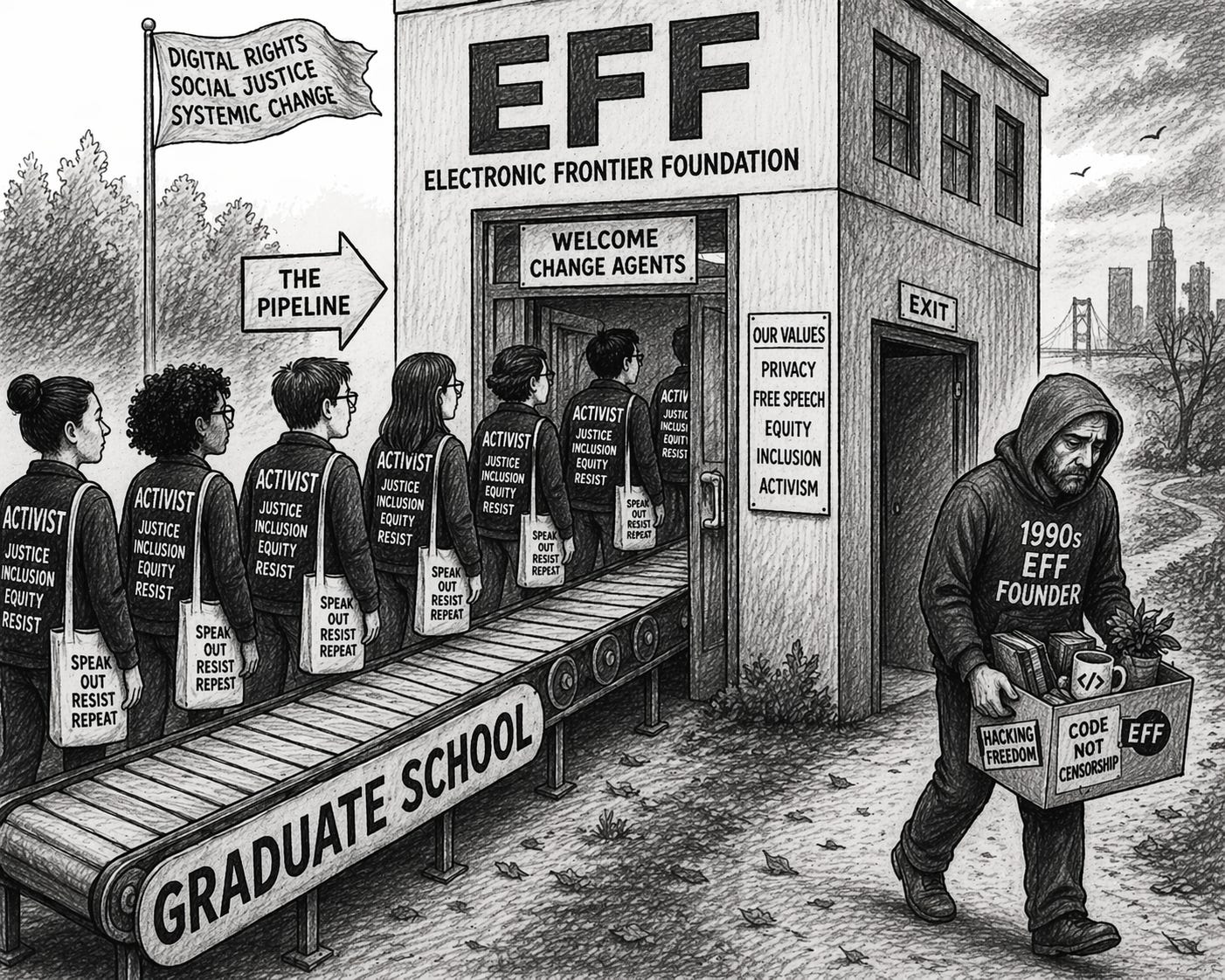
This didn’t happen by accident. It started in graduate school. In classrooms where certain ideas were safe and others weren’t, where certain framings were rewarded and others quietly discouraged, where the Overton window narrowed so gradually nobody noticed until too late.
I know because I work in one of those schools.
The people running EFF’s communications didn’t arrive at their worldview randomly. They were formed somewhere. The formation happened in institutions that selected for ideological conformity long before anyone handed them a job title.
The pipeline runs from campus to every organization that has undergone this transformation. EFF is just the latest — and perhaps the saddest. They spent 30 years fighting institutional capture. They didn’t recognize it when it happened to them.
What Was Lost
EFF won real fights. That work mattered and nothing since erases it.
But the coalition that won those fights no longer exists. Libertarians and progressives, hackers and lawyers, people who disagreed about almost everything except keeping the internet free. That coalition could win because it was bigger than any one political tribe. It could represent everyone because it actually did.
What replaced it can only represent some of the people who need digital rights protection. The rest — the ones who don’t share the framing, who voted the wrong way, who hold the wrong opinions — are no longer culturally welcome, even if the mission statement still technically includes them.
The former longtime employee who called this an enormous personal tragedy is spot on.
The good news, such as it is: the work still needs doing and some organizations are still doing it. FIRE — the Foundation for Individual Rights and Expression — has grown into a $32 million operation with 20 litigating lawyers, backed by a $75 million campaign. They’re winning real cases, including those involving digital rights, and they've kept the big tent. Reclaim The Net does the kind of early-stage digital rights flagging that early EFF did well — catching bad policy before it goes mainstream. Neither has EFF's 35-year tenure. But both have something EFF lost: a reason for people across the political spectrum to trust them.
The coalition can be rebuilt. It just won’t happen at EFF.
The skin suit is on. The respect is still being demanded.
The original institution is gone.
More dispatches from the campus that’s lost the plot — and apparently everywhere else too: subscribe below.
I read the headline of the email, and I was like "They're not much of a loss" (now) then I was able to read further and see you had thoroughly and completely documented the situation. Good work again!
"skin suit" Perfect analogy. Applies to the ACLU, of course.
Your reference to Seth Schoen's article on Hacker News reminded me why I no longer look at that. The fatal flaw there is that you can't Mute or Block people, and it is jam-packed with little keffiyeh-wearers and Antifa wannabes who deserve nothing more than a trip to the bit bucket.