


FacultyLeaks.com is an anonymous dispatch from inside higher education. Some identifying details have been changed. The dysfunction has not.
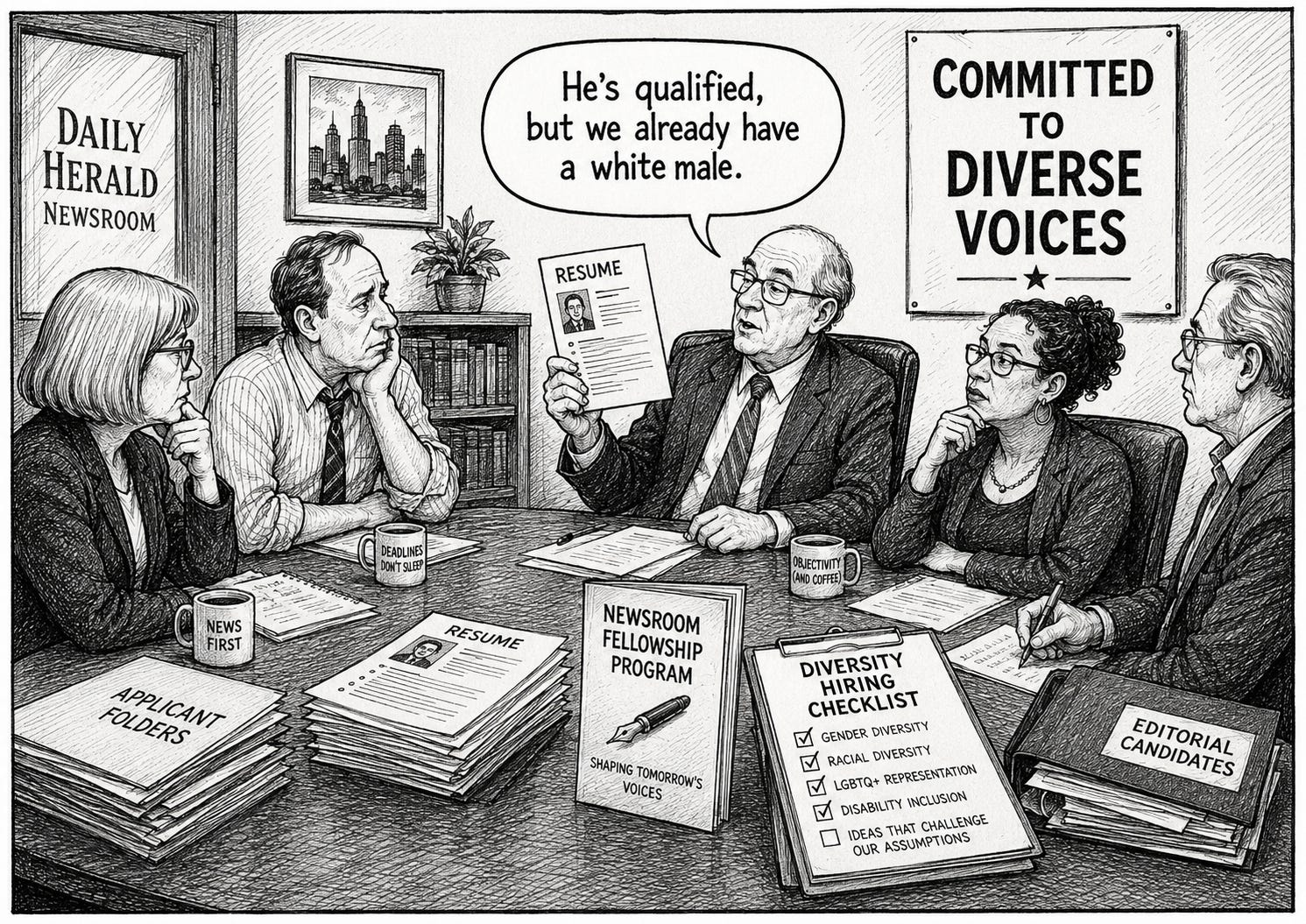
On Tuesday, the Equal Employment Opportunity Commission filed a federal lawsuit against The New York Times, alleging the newspaper passed over a white male employee for a promotion because of his race and sex. The complaint, filed in the Southern District of New York, says the Times’s “stated race and sex-based representation goals” drove the decision not to advance his candidacy for a deputy editor role.
The Times called the suit “politically motivated.” On X, Harvard professor Maya Sen posted the complaint with a punchy observation: “Very short hop, skip & jump to academia.”
Whether others view that as a warning or a welcome, the connection is hard to argue with. More on that later. But let’s stay with journalism for a moment — because the EEOC lawsuit isn’t the revelation. It’s the confirmation. The discrimination has been happening in plain sight, announced in press releases and class photos, for years. The only news is that a federal agency finally decided to look.
The Class Photos
If you want to understand what’s happening in American journalism hiring, skip the mission statements. Look at the pictures. Try finding a white male in a recent intern class photo. It’s like a game of Where’s Waldo — except in most of these cohorts, Waldo isn’t hiding. He’s just not there.
This has been visible for years. In 2016, a Huffington Post executive editor tweeted a photo of an all-female editors meeting as a celebration of diversity. The backlash wasn’t about the absence of men — it was that the women were too white. The missing men weren’t the bug. They were the feature. A decade later, the pattern has only intensified — and it starts at the gate.
To understand why that matters, you need to understand what these programs are. These aren’t volunteer gigs at the campus paper anyone can do. These are the most prestigious and competitive entry points in American journalism — many of them paid, highly selective, and functionally essential for anyone who wants a career at a major outlet. Think of them as the journalism equivalent of a summer associate position at a BigLaw firm or a top medical residency placement. If you want to make it in this industry, this step is all but required.
Here’s what those entry points look like right now.
The Los Angeles Times Fellowship Class of 2026 has 13 fellows. Based on the published photo, none appear to be white males. The program doesn’t hide its origins — it’s the direct descendant of what was originally called the Minority Editorial Training Program, launched to “build a pipeline and provide opportunities for journalists of color.” They’ve since renamed it. The outcomes haven’t changed. The LA Times’s 2025 summer intern class had 26 interns. Perhaps one was a white male.
At NPR, the fall 2025–26 intern class of 18 appears to contain one white male. At Politico, seven interns were selected from nearly 700 applicants for fall 2025. All seven were women. Not a single male of any race. The spring 2026 class had nine — one white male.
The New York Times Fellowship — the paper’s own early-career pipeline, the one that feeds directly into the newsroom now being sued by the EEOC — has 31 fellows in its current class. Only eight are male. At most four are white men.
This pattern extends well beyond national flagships. The Charlotte Observer’s 2025 summer class: one white male out of 10. The Seattle Times 2026 summer cohort: one out of 11. And at the Dow Jones News Fund, the central pipeline program that places interns at the Wall Street Journal, the Washington Post, and dozens of other outlets, the class of 81 is — per the Fund’s own announcement — 63% women and 65% students of color. Their stated mission: producing journalists who “better reflect the demographics of the communities they cover.”
Add it up across these programs. Roughly 206 entry-level positions. White males hold somewhere around 13 to 21 of them, depending on how generously you count the ambiguous cases. That’s somewhere between 6 and 10% — for a group that represents approximately 22% of current college enrollment.
These weren’t cherry-picked. They were the first programs that came up in a quick search of publicly available journalism intern and fellowship announcements. If anything, a more exhaustive survey would likely make the picture worse.
The Inexorable Zero
In Teamsters v. United States (1977), the Supreme Court held that when a demographic group’s representation in a workforce is so far below its share of the qualified population that the disparity “is itself a telltale sign of purposeful discrimination,” detailed statistical analysis becomes unnecessary. The Court called this an “inexorable zero” — a pattern so stark it supports an inference of discrimination on its face.
No regression model required. No hiring memo needed. The evidence is on Instagram.
And the baseline isn’t some theoretical abstraction. As Jacob Savage documented in Compact last December, “the pipeline hadn’t changed much — white men were still nearly half the applicants — but they were now filling closer to 10% of open positions.” A senior hiring editor told Savage directly: “It was a given that we weren’t gonna hire the best person… It was jarring how we would talk about excluding white guys.”
None of this is a knock against the women and journalists of color who earned these positions. This is about the math. When a group that constitutes a significant share of the applicant pool is represented at rates approaching zero in the selected cohort — across an entire industry, year after year — something other than merit is doing the sorting.
The Architecture
What makes this particularly difficult for the outlets to defend is that many of them have published the institutional architecture behind these outcomes.
The Philadelphia Inquirer maintains an entire public-facing DEI webpage dedicated to its commitment to becoming an “anti-racist organization.” It features an “Anti-Racist Workflow Guide,” a racial content consultation channel, and employee resource groups organized around BIPOC identity, LGBTQ+ identity, and women — with no corresponding group for viewpoint or ideological diversity. The internship program sits on the same page, nestled under the anti-racist framework.
NPR describes its internship program as helping the organization do “the kind of journalism that embraces the rich diversity of the country.” The LA Times Fellowship was literally called the Minority Editorial Training Program until they renamed it. These aren’t hidden internal memos. They’re public mission statements.
And here’s the legal irony: many of these outlets have moved away from explicitly race-restricted fellowship criteria. The language is now neutral — “various backgrounds,” “diverse thinkers and doers.” But the outcomes are statistically identical to the old race-restricted programs. Under Title VII, that’s not a defense. If anything, it makes things worse — when neutral language produces the same discriminatory results, courts can conclude the neutrality is just window dressing — or what the law calls “pretextual.”
They didn’t stop discriminating. They just stopped saying the quiet part out loud. Most of them, anyway.
The FRONTLINE/Firelight Investigative Journalism Fellowship, run in partnership with PBS and funded by the Corporation for Public Broadcasting, is “open by invitation only to emerging, diverse filmmakers.” Not open applications — invitations, to pre-selected “diverse” candidates, with taxpayer money.
The Downstream
The consequences extend beyond individual careers. White men are the most reliably conservative-leaning demographic in American politics. When you systematically exclude them from the journalism pipeline, you’re not just discriminating against individuals — you’re engineering newsrooms that are ideologically homogeneous by design.
Public trust in media sits at historic lows. Americans — particularly conservatives and independents — consistently report that they perceive liberal bias in mainstream coverage. Newsrooms respond by pledging to “rebuild trust” and “serve all communities.” But their hiring practices are doing precisely the opposite: constructing editorial staffs drawn from an increasingly narrow demographic and ideological slice of the country, then wondering why the public doesn’t see itself reflected in the coverage.
These outlets say they want newsrooms that reflect the communities they serve. America is roughly 30% white male. Their intern cohorts are running at 6-10%. They are not reflecting their communities. They are curating them.
The Reckoning
The EEOC v. New York Times is a single case about a single employee denied a single promotion. But the complaint’s core allegation — that “stated race and sex-based representation goals” drove an employment decision — describes something far larger than one newsroom. It describes an industry.
The receipts have been public the whole time. Every spring, summer, and fall, the class photos go up like trophies — in press releases and Instagram carousels and fellowship announcements. The evidence was never buried. It was celebrated.
Professor Sen’s observation stands on its own terms. It is a very short hop, skip, and jump — not just to academia, but to every institution that spent the last decade building a pipeline designed to exclude a specific demographic group, then published the receipts.
The class photos were always the evidence. The EEOC just finally looked. Now look at new faculty hire announcements at universities across the country — you’ll see the same trend. EEOC Chair Andrea Lucas should take a peek.
More dispatches from the campus that’s lost the plot: subscribe below.
Excellent work! Let’s hope that exposing this malfeasance will lead to its elimination.
It's fantastic to see. Unfortunately it's a single case and it's been 18 months since Republicans won the presidential election.
Is it remotely enough?