


FacultyLeaks.com is an anonymous dispatch from inside higher education. Some identifying details have been changed. The dysfunction has not.
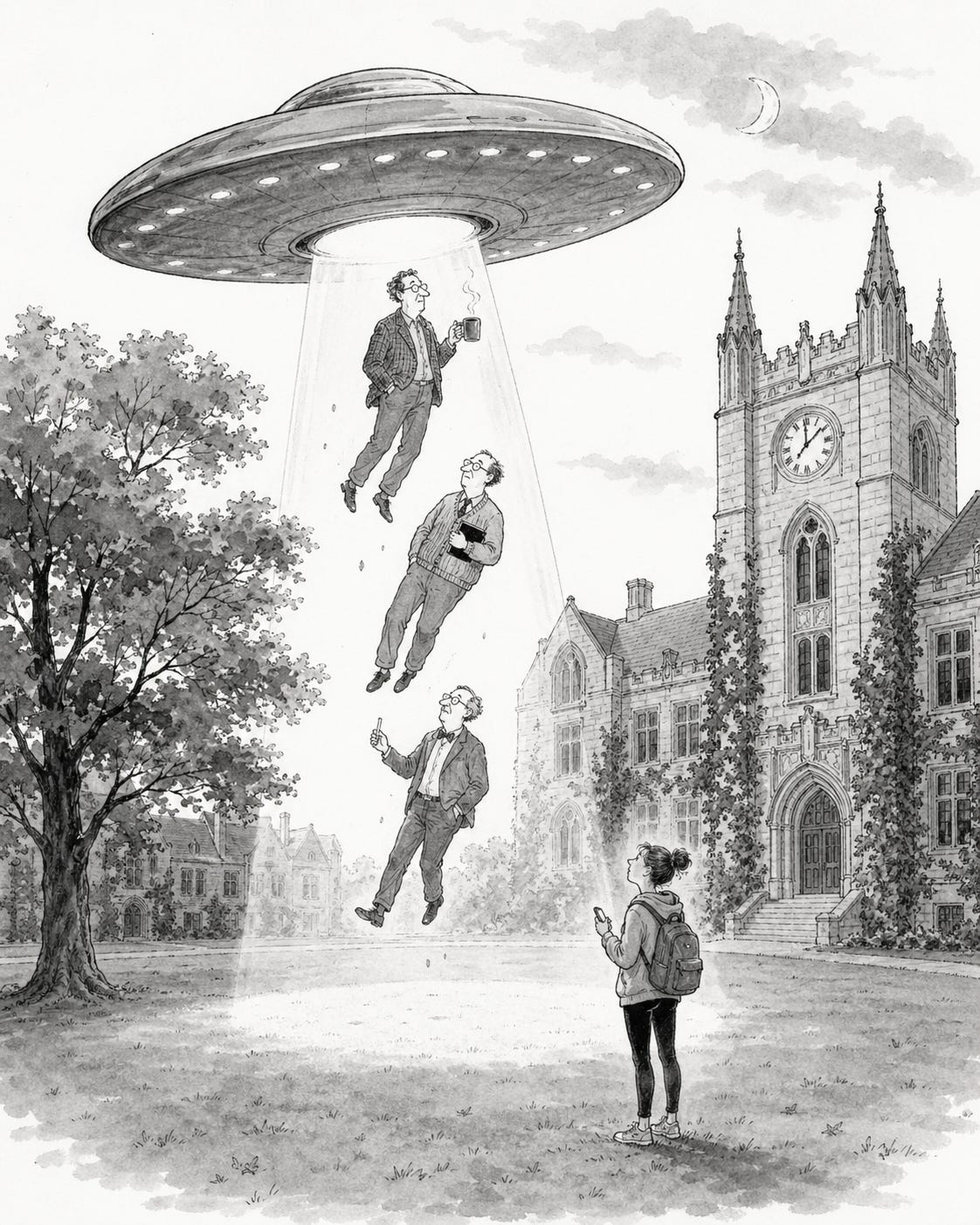
There is a 1998 cult classic movie called The Faculty in which students at a high school slowly realize their teachers have been replaced by aliens. The teachers look the same, talk the same, but something is unmistakably off.
I have started to feel like I am living that movie every time I step onto campus.
Speaking Klingon
A few weeks ago I emailed faculty across a few departments to let them know that a film director from India would be visiting campus to give a talk, in case any wanted to bring their classes. A Dutch art historian hit reply-all to inform everyone that the word “Bollywood” was perhaps problematically colonial — and to wonder whether “Filme” might be a more inclusive alternative.
This was the first time I heard of “Filme.” I had to Google it. The director himself uses “Bollywood.” So does the Indian film industry and every Indian and Indian-American friend I’ve ever had, including academics. But somewhere in the (mostly Western) scholarly literature the term had been flagged as problematic, and a European academic had appointed herself its guardian on behalf of people who had never asked for her help.
This is the kind of conversation that now clutters my inbox routinely. The technical vocabulary of the contemporary academy is functionally a separate language. Consider “intra-action”: professor Karen Barad’s term for the idea that everything is connected. Don’t worry, it only takes her about 400 pages to say so. Or consider “cisheteropatriarchy,” “onto-epistemology,” or the now-ubiquitous demand to “problematize” literally everything from parking permits to plotlines. Then there’s “trauma-informed pedagogy,” which began as a clinical concept and now floats through committee minutes about syllabus deadlines, flexible grading, and whether campus spaces are sufficiently trauma-informed and decolonized.
The function of this vocabulary is not communication. Most of these terms can be replaced with regular English without losing anything except the pretension. They are loyalty tests, not concepts. Drop “diffractive methodology” or “agential cut” in a paper and three reviewers nod; ask what it means in plain English and you’ve outed yourself as an outsider.
It’s like these people are speaking Klingon. But at least Klingon has a dictionary and a consistent grammar. Academic jargon is designed to be untranslatable on purpose.
The Reception
This is why I skip faculty receptions. The wine is mid at best and the company is stranger still. I would need a copious amount of alcohol just to stand being in the room for 10 minutes, and there is a non-trivial risk I would say something honest and get called in for a talk with the dean or HR.
Once, in line at the campus coffee shop, I overheard a colleague telling another professor that she and her partner had originally planned to send her child to an academically stronger school. They had decided instead, she said, that they wanted her around “a more diverse student body, because that’s really important.” I looked the chosen school up later. Online forums described an environment that was demonstrably unsafe. She had either not looked it up or not clocked it. She had simply enrolled her child in someone else’s experiment and decided this was the moral choice. If her child has a rough experience, will she chalk it up as the price of cultural enrichment?
Some of the weirdness is harmless. Academics have always been odd. But the current version has settled into a tone that is neither charmingly eccentric nor seriously scholarly. When I was in college, my professors sometimes took the class out for pitchers of beer at the off-campus dive; the faculty went to baseball games together during summer breaks. The contemporary version’s idea of a Saturday off campus is attending a “No Kings” protest — promoted, as it happens, by the American Association of University Professors.
My colleagues also find it strange that I give students my cell phone number. My professors in graduate school did, and it was one of the reasons I found them approachable. But one of my colleagues said it was “ew,” apparently appalled that I would let undergraduates call or text me. Every other profession calls this accessibility. Students barely read email anymore — if they won’t come to the mountain, the mountain texts. But many faculty treat students less like people they serve and more like subjects they preside over. Some practically panic if they run into a student off campus, as if the encounter might contaminate their private lives.
The campus staff, by contrast, remain reassuringly human. The landscaper who trims the hedges has a clearer view of the world than almost all full professors I know. The IT guy who fixes the projector when it’s glitchy is the sanest person I will speak to all day. I rely on weekly chats with staff like this to keep functioning, the way most people depend on coffee.
Sealed In
None of this is accidental. The system selects for it, and the numbers confirm it.
A 2018 study by Mitchell Langbert found that among 8,688 tenure-track faculty at America’s top liberal-arts colleges, registered Democrats outnumbered Republicans 10.4 to 1. At elite humanities and social science departments, the registered Republican is functionally extinct.
This is not a complaint about Democrats. It is a structural observation about a guild that has spent 40 years applying a single cultural and ideological filter. When a profession self-selects that aggressively, it stops looking like the country it claims to educate. It develops its own dialect, its own etiquette, its own taboos. Insiders experience this as normal. Everyone else experiences it as The Faculty.
Class homogeneity makes it worse. A 2022 study in Nature Human Behaviour found that U.S. tenure-track faculty are 25 times more likely than the average American to have a parent with a Ph.D. The professoriate is now overwhelmingly drawn from the same narrow socioeconomic slice. Combine ideological inbreeding with class inbreeding and you get an organism statistically incapable of producing the range of views and life experiences that a normal human institution would contain.
William F. Buckley once said he would rather be governed by the first 2,000 names in the Boston phone book than by the Harvard faculty. The line used to be a joke.
People who have never met a working-class family in Middle America will nonetheless spend their careers theorizing about that family’s interests, prescribing policies on its behalf, and explaining to one another why it keeps voting the wrong way. The room is full of people who agree, and none of them has ever had to convince anyone outside it of anything. Worse, they look down on those families — and are actively hostile to certain ordinary jobs the country depends on. Last semester a colleague mentioned, in passing, that she would never write a recommendation letter for a student applying to military Officer Training School. She said it the way one might refuse to recommend someone to a multi-level marketing scheme.
The alienness exists on a spectrum. You will find much more of it in humanities than STEM, more at a small liberal arts college on the coasts than at a state flagship in the South or Midwest — but the cultural gravity pulls in the same direction everywhere. Conservative spaces have their own brand of weirdness — attend CPAC or a Federalist Society event and you’ll see it. The difference is that conservatives typically know they are not the norm. The academy has convinced itself it is the baseline of human normality. That is what makes the alien invasion feel so complete.
Self-selection alone does not explain the full pathology. Confinement does. In the early 1990s, eight researchers sealed themselves inside Biosphere II, an Arizona greenhouse meant to simulate a closed planetary ecosystem — they had, in effect, built their own alien planet and moved into it. Within months the crew had fractured into two hostile factions that stopped speaking to each other. By the end of the two-year experiment they had developed their own folk grievances, their own surveillance norms, their own informal hierarchies of moral standing — a closed society in miniature, with all the dysfunctions of a real one and none of the exits. They had, quite literally, moved into a giant pod.
The academy is the 30-year version, with better food. Harvard professor Arthur Brooks recently argued in The Free Press that the deepest problem on American campuses is not ideology but the pressure to conform — a diagnosis Yale itself confirmed this April in a self-critical report acknowledging that “echo chambers do not produce the best teaching, research, or scholarship.” Closed groups develop their own gravity. People who would speak up in any other context find that here, the social cost is too high. Chris Brunet, whose must-read Substack covers higher-ed scandals, has written about making peace with never pursuing a PhD after learning exactly how high.
The Other Nay
There is one small ray of hope. In faculty senate, whenever the latest ceremonial resolution comes up — a land acknowledgment, a denunciation of something the university has no power over, or a vote to revoke an honorary degree given a decade ago because the recipient has since expressed wrongthink — there is invariably one other “nay.” Votes are cast by handheld clicker, anonymously, so I will never know who the other holdout is. The room is too big to guess by faces. I would buy that person a drink if I could.
Two votes against, every single time. More than I expected. A quiet reminder that not everyone in the building has been replaced by bodysnatchers.
Letters from the Outside
I am not the only one who sees it. A Ph.D. anthropologist from the South messaged me to describe her years at a major state university up north. A professor announced, in front of her, that the world would be better if “we just nuked Mississippi.” A famous woman in the department told her to cut her hair because “nobody wants a Southern belle.” She cut it. A senior faculty member used to sing “My Magnolia!” down the hallway at her — and later declared in class that if he ever discovered a Republican in the program he would form a committee to have them expelled.
She was, for the record, a registered Democrat. Her peers suspected her of being conservative because she dressed up for class and once criticized the United Nations.
These stories are not outliers. They are the median. Education researchers sanitize the dynamic into terms like “rapport,” “approachability,” and “classroom climate,” but spend 10 minutes on Reddit or graduate forums and the subtext is not subtle. A 2024 survey found that 60% of college students do not feel comfortable disagreeing with their professors. The professors involved nonetheless believe they are the reasonable ones in the room. Their colleagues agree. They have been inside the building so long that nothing inside it registers as strange anymore. The pod people never notice the pods.
The Verdict
The public has overwhelmingly noticed too. Gallup’s measure of confidence in higher education fell from 57% in 2015 to an all-time low of 36% in 2024, with a modest rebound to 42% in 2025. The most common reason cited is politicization — 38% of skeptics now point to political agendas.
This is an industry that spent a decade telling the country the country was the problem. The country finally answered.
In the movie the students defeat the aliens with a drug they manage to procure. There is no equivalent in real life. The aliens in academia were hired through a national search, granted tenure by peer vote, and will remain until retirement. They will train the next generation in their own image. They will continue to ask, when a director from Mumbai arrives on campus, whether we shouldn’t really be calling it “Filme.”
The students figure it out first. They always have.
More dispatches from the campus that’s lost the plot: subscribe below.
Couple of comments. Your experience with "Filme" vs. Bollywood reminds me of the occasion a few years ago (during Peak Woke) when I was on a hiring committee for a post in archaeology (not in my department - I was an external representative), and one of the people on the committee objected to our describing the position as one in "New World Archaeology", which she claimed was unacceptably Eurocentric. I lost my temper, and went straight on my phone and Googled the phrase "New World Archaeology", simply to demonstrate that it was still in general use among practitioners in the field, and I flatly refused to be on a committee that used whatever neologism this person had come up with as a substitute. I won - I think simply because I was so indignant and scornful: they weren't used to people pushing back on social justice-themed suggestions.
The other thing, though, is that I'm always a little suspicious of surveys which use "registered Democrat" as a proxy for "liberal", and "registered Republican" to mean "conservative". I consider myself conservative, but I'm a registered Democrat, simply because I'm in a deep blue city in a deep blue state, and Democrats always win: voting in Democratic primaries is the only meaningful way to influence the outcome of the election. If I lived in (e.g.) Idaho, I would be a registered Republican, for the same reason, even if I was more liberal. Given that many more elite universities are in blue states than in purple or red states, I wonder if some of those "registered Democrats" are, like me, simply strategically registered conservatives. I'm sure conservatives are massively outnumbered by liberals, especially in the social sciences and humanities, but I am concerned that the skew may be exaggerated by the wording of the question.
Filme, ffs.
In the '90s there was an early version of woke called "PC" that prompted a great book by Robert Hughes called "Culture of Complaint." Back then, the stupid thing du jour was taking anything that could be connected to a male out of everything. So we got "herstory" and "womyn" and "policeperson." Hughes was having none of it, especially because he understood the English language better than the clowns who were demanding that we reinvent words.
I thought the stupidity went away, but I guess they were just regrouping.