


FacultyLeaks.com is an anonymous dispatch from inside higher education. Some identifying details have been changed. The dysfunction has not.
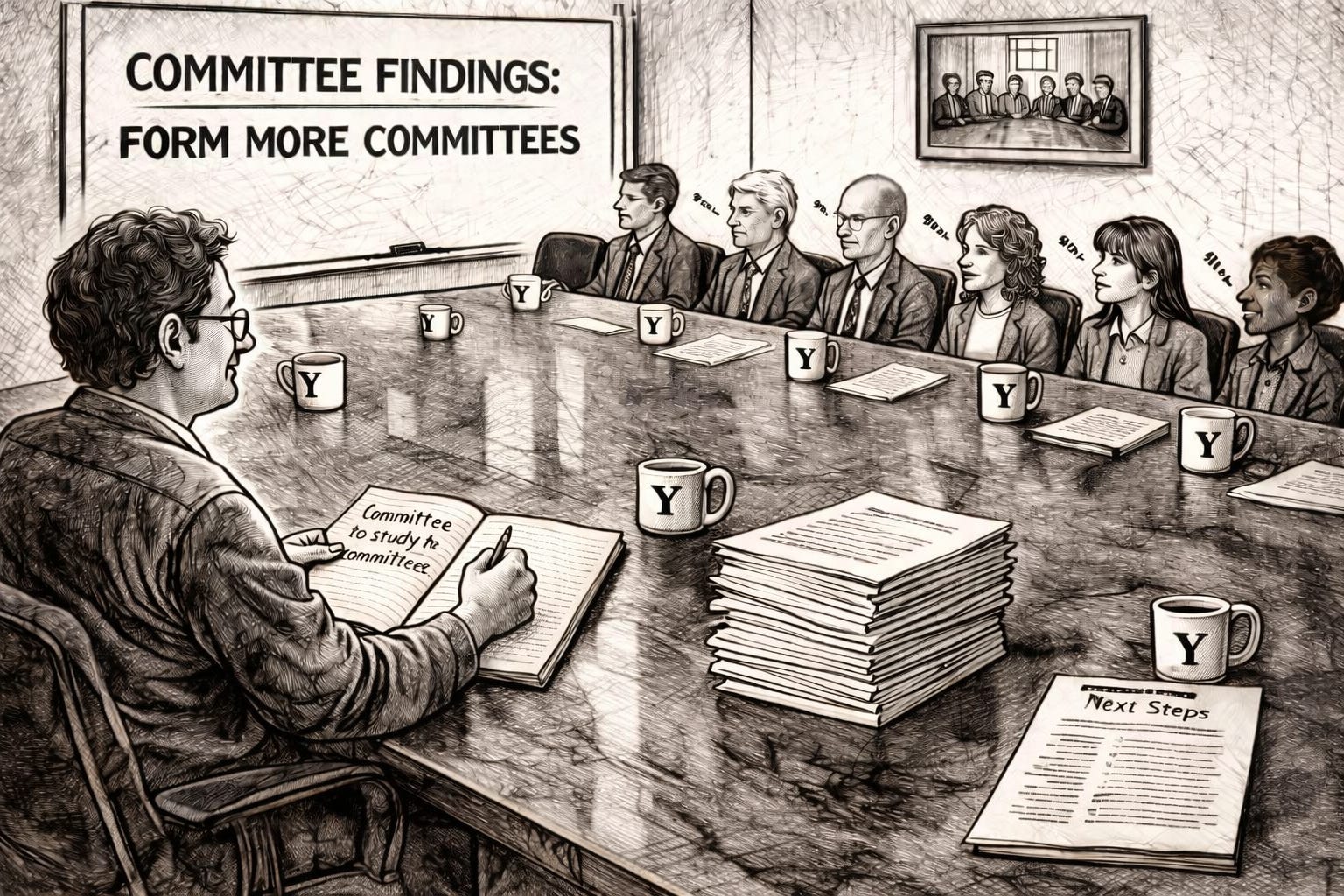
In April 2025, Yale President Maurie McInnis asked a committee to examine the problem of declining trust in higher education. A year later, the Committee on Trust in Higher Education has submitted its report.
The committee consisted of 10 tenured Yale faculty members.
They studied Yale.
To their credit, the committee acknowledged this problem early. Public commenters questioned whether tenured Yale faculty could objectively examine trust in Yale. The committee said this concern “redoubled their commitment” to humility and broad outreach. Then they spent a year producing a 50-page report. By tenured Yale faculty. About Yale. Submitted unanimously.
The humility, it seems, had limits.
What the Numbers Say
The report is, in places, admirably honest. The data it presents is genuinely damning, and the committee deserves credit for not burying it.
Trust in higher education has fallen from 57% in 2015 to 36% in 2024 — a historic low. 70% of Americans say higher education is heading in the wrong direction. Among self-identified Republicans, confidence dropped from 56% to 26% over the same period.
At Yale specifically, registered Democrats outnumber Republicans 36 to 1 across the Faculty of Arts and Sciences, the Law School, and the School of Management. Nearly a third of Yale undergraduates don’t feel free to express their political beliefs on campus — up from 17% in 2015. In 1963, 10% of Yale grades were A or A-minus. In 2022-23, that number was 79%. The median Yale student receives an A.
The committee presents all of this straightforwardly. They call grade inflation a “collective action problem.” They call the political homogeneity real. They acknowledge the culture of self-censorship. They even note, with apparent sincerity, that “echo chambers do not produce the best teaching, research, or scholarship.”
So far so good. Then come the recommendations.
The Postponement Agenda
There are 20 of them.
Recommendation 1 is “Take Responsibility.” It is addressed to faculty, trustees, administrators, and — this is real — first-year undergraduates. When responsibility belongs to everyone, it belongs to no one. This is the institutional version of a statement condemning all forms of hate.
The remaining 19 recommendations are a masterclass in institutional can-kicking. Self-studies. Joint committees. Faculty-student committees. More committees to study the committees. A civic education initiative. A grant program. Town halls. Advisory councils. And — this one is real — a recommendation that Yale “communicate effectively.”
Declining trust is, apparently, a communications problem. The solution is not to change what Yale does. It is to explain what Yale does better. To people who have already decided they don’t trust Yale.
This is not a reform agenda. It is a postponement agenda dressed in the language of reform. The committee spent a year studying institutional inertia and responded with institutional inertia. These institutions aren’t failing because the world became harsher. They’re failing because they mistook a collapse of legitimacy for a PR problem. Yale’s 20th recommendation proves the point.
Grade Inflation: Talk, Don’t Act
In 1963, 10% of Yale grades were A or A-minus. Today it’s 79%. The median student receives an A. The committee calls this a “collective action problem” — no individual professor wants to be the strict grader whose students are disadvantaged relative to peers.
To address it, the committee recommends a 3.0 mean grade — an idea, they note, that “will require further conversation among the faculty.” The faculty who have been inflating grades for decades will converse about whether to stop.
This is a choice. Mandatory grading curves are standard at most law and medical schools, implemented through administrative policy rather than faculty consensus. Harvard Law, Columbia Law — schools operating in the same elite tier as Yale — enforce grading curves by administrative decision. Someone made the call.
Yale College’s solution: further conversation among the faculty. The faculty who created the problem will discuss whether to fix it, on their own timeline, with no enforcement mechanism and no deadline.
The difference isn’t academic freedom. It’s institutional will.
Governance: The Dog That Didn’t Bark
The committee spent a year trying to determine what share of Yale’s budget goes to academic functions versus administration. They could not get the answer. “The difficulty,” they write, “is itself the finding.”
A university that cannot account for its own administrative growth to its own committee does not have a messaging problem. It has a governance problem. The recommendation: another committee, with faculty representation, to review administrative structure.
One imagines the committee that will be appointed to study that committee’s findings.
What the Report Refuses to Name
Here is what a 50-page Yale report on declining trust in higher education does not mention: DEI offices, DEI hiring criteria, mandatory DEI statements, ideological litmus tests in faculty searches, campus speech codes, Safe Zone culture, or the systematic exclusion of conservative speakers and perspectives from campus programming.
The report acknowledges a 36-to-1 partisan imbalance. It does not ask how that imbalance was produced or what institutional mechanisms maintain it. It recommends self-studies and pipeline programs. It does not recommend examining whether the hiring process itself filters for ideological conformity.
A report on why the public doesn’t trust Yale that cannot name the thing the public doesn’t trust Yale about is not a diagnosis. It’s a press release.
The Line That Explains Everything
Buried in the section on politics and intellectual pluralism, the report notes that “nearly everyone we spoke to agreed on one thing: Echo chambers do not produce the best teaching, research, or scholarship.”
Nearly everyone agreed. In a report submitted unanimously. By a committee of 10 Yale faculty members who apparently all reached the same conclusions after a year of deliberation.
The irony does not appear to have registered.
What Would Actually Help
The report’s honest data points toward a real problem. The public has stopped trusting higher education because higher education has, in measurable ways, stopped deserving trust — through grade inflation that renders degrees meaningless, through political homogeneity that produces ideological conformity, through administrative expansion that consumes resources without academic justification, and through a culture of self-censorship that punishes heterodox thought.
Nationwide, more than half of graduates are underemployed one year after graduation. Ten years out, 45% are still working jobs that don’t require a degree. The Federal Reserve Bank of Philadelphia projects up to 80 college closures per year.
The implicit promise — trust us, we are the gatekeepers — is collapsing. People are finding faster, cheaper, and often better alternatives on their own. Yale’s report doesn’t confront that. It assumes legitimacy remains intact and that better communication will restore public confidence. That’s not a reform strategy. It’s denial.
The Actual Cure
Not 20 committees. Not better messaging. Not a civic education initiative that reaches first-year students three times a year.
The cure is the report’s own first recommendation — actually followed: Take responsibility. Name the problem. Change the practices that caused it.
The committee submitted its findings unanimously. Yale will now form committees to consider them.
The 21st recommendation writes itself.
More dispatches from the campus that’s lost the plot: subscribe below.
My university has a "committee on committees". I kid you not. It is a faculty committee to identify folks to serve on university level committees, and it has existed for at least 30 years based on my time as a faculty member.
The biggest issue with the faculty committees is that they are staffed with folks willing to spend time writing reports such as the Yale one and so are the folks that one would LEAST want to serve on a committee like this (ie spend time on something that is irrelevant to the real world and will be dumped later into the black hole of central admin with no actions instead of focusing on teaching and scholarship).
They are over focused on "process" and not hurting anyone's feelings (remember "words are violence" and "silence is violence" at the same time based on the messaging of the progressive left) so are unable to bluntly state the problem and suggest solutions.... That said, I have seen administrative dictates be worse as they often further entrench administrative bloat while forcing unworkable solutions upon folks (and depending on their political beliefs, these administrators can make things worse in regard to the issues that lead to the loss of trust in higher ed).
Unfortunately I dont have the answer on how to get out of that circular mess, particular when the institution is a private one so there is no oversight from outside (ie a state legislature).
This committee's outcome was so very, very predictable. A groupthink institution produces a groupthink report. Kick that can.
But what more could they have done? The distrust of academia derives not from its messaging, or how academia frames what it does, but from the structure and character of contemporary academia—its elitism, its political homogeneity, its epistemic closure, its institutional narcissism. Its incentives and disincentives.
Academia is an unsustainable walled garden. It can't be fixed. The walls will crumble away and all the high-maintenance exotic cultivated plants will die, replaced by aggressive hardy weeds that thrive in the native ecosystem.
This is good news, right? Academics love sustainable ecosystems!