


FacultyLeaks.com is an anonymous dispatch from inside higher education. Some identifying details have been changed. The dysfunction has not.
Professor Kevin Bryan has written eight rules to restore public trust in universities. Professor Alex Tabarrok, who blogs at at Marginal Revolution, likes them. I like some of them too.
But let’s talk about what’s missing.
Rules 1, 2, and 4 are genuinely good. Produce useful knowledge. Serve the public. Do neutral, objective research. Hard to argue with any of that — which is exactly why they’ll be endorsed without hesitation by the same departments that just hired someone because her dissertation “centered marginalized epistemologies.” Everyone will nod. Nothing will change.
Rule 3 is where it gets interesting.
“Attract Talent from All of Society. Useful knowledge can be created by people from any social or economic background. Do not waste talent. Do not select talent based on who knows ‘how to play the game.’”
Bryan frames this as a socioeconomic problem. In practice that framing gets captured immediately — translated into demographic proxies that sound neutral and aren’t. The actual missing diversity is ideological. A department that’s 40% women and 0% conservatives hasn’t solved the diversity problem. It’s replaced one monoculture with another and given it a better press release.
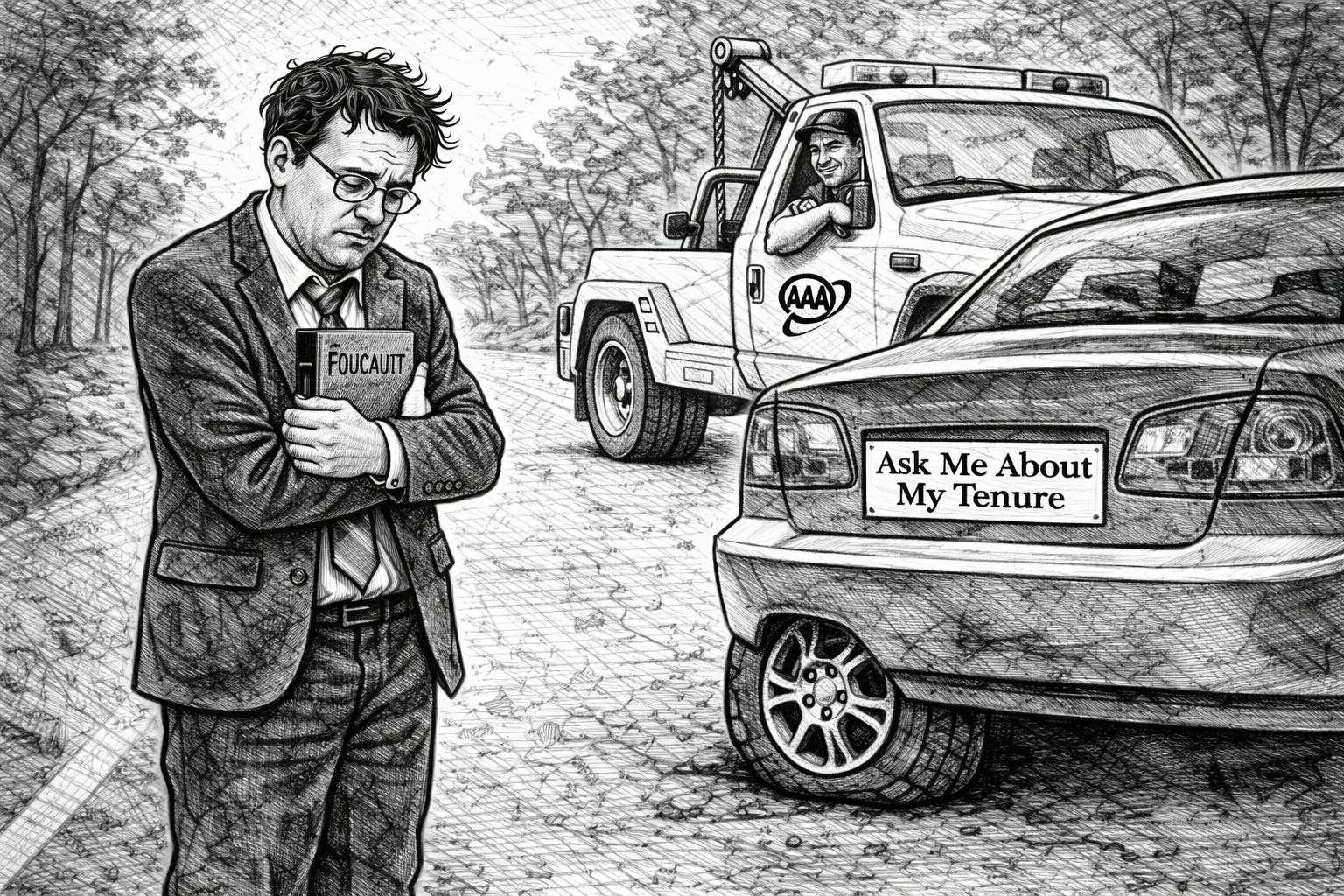
There’s a second problem Bryan doesn’t name. A huge swath of academia — especially the humanities — is populated by people who have only ever known one institution: school. K-12, college, grad school, maybe a postdoc or a visiting position, then tenure track. No detours. No jobs where a customer could walk away or a boss could let them go. No skills tested against anything except a faculty committee. Many of these people have never negotiated a contract, managed a budget, or worked alongside someone whose hands were dirty at the end of the day. I’d wager a meaningful number couldn’t change a flat tire.
Some of them would consider that last sentence a compliment.
My department’s administrative staff — people who have worked alongside faculty for decades — can tell you immediately which faculty actually need their jobs and which ones don’t. It’s not subtle. And the ones who don’t need the job are almost always the ones who treat support staff like personal assistants. Print this out for me. Move those boxes out of my office. The people who’ve never had a boss tend to become the worst ones.
You hear it directly, if you’re in a position to hear it. I don’t understand why we have to recruit students or attend admissions events. That’s not my job. It’s always the same people. Privileged senior faculty with nice homes, rich spouses, or one foot already out the door. People for whom the paycheck is an afterthought.
I think about enrollment constantly. Whether our courses fill. Whether we stay relevant. Whether we still have a department in 10 years. Because at a tuition-dependent institution — which is most institutions — you are not just an ivory tower. You are also a business. If your courses don’t enroll, you face budget cuts. If you don’t develop new courses students actually want, you lose them to departments that do. Even elite schools aren’t fully insulated: if the cash-cow master’s program stops attracting students, or the business school isn’t offering AI or fintech concentrations while competing schools are, yield suffers. The endowment cushions the fall. It doesn’t eliminate it.
The faculty who came up through working industries — the ones who spent years in the field before entering the classroom — tend to understand this instinctively. They update their syllabi. They show up to open houses. They know students aren’t an interruption to academic life. They’re the point of it.
The ones who went K-12 straight through to tenure have never had to think this way.
I want to be clear about something. I’ve worked in industries where layoffs were routine — where one bad quarter of earnings could trigger a round of cuts and you knew your name might be on the list. Where your predecessor’s firing was the reason you had a job at all. Academia, by contrast, is the brass ring. Teach what you want. Research what interests you. Share knowledge with students for as long as you choose. Barring something genuinely illegal — embezzlement, sexual harassment — the job is yours for life. Only Supreme Court justices have something comparable.
I feel lucky every day. And that’s exactly why it bothers me to watch colleagues treat it like a waiting room. In my experience, the ones who treat the job as optional are almost never the ones who needed it in the first place. If you’ve stopped publishing, stopped updating your courses, stopped showing up for students — why are you here? The job is a gift. Coasting through it isn’t just bad for students and institutions. It’s a kind of grift. You’re collecting a salary for a performance you stopped giving years ago.
Which brings me to what’s missing from Bryan’s list.
Rule 9: Accountability must be structurally possible.
Bryan’s Rule 7 says fraud brings “immediate dismissal.” That sentence could only have been written by someone who has never tried to remove a tenured faculty member. In the real world, if you repeatedly skip required office hours, stop updating your courses, or simply check out for a decade, you get fired. Not after a governance review. Not after a strongly worded email. You get fired, because that’s what employed adults understand employment to mean.
In academia, the strongly worded email is the endpoint. The faculty governance process exists to protect you from whatever comes next. Tenure doesn’t just protect bad actors. It teaches them that performance was optional.
The Yale Report was polite about this. Bryan’s rules are polite about this. Everyone is very polite about this.
The incentive structure actively punishes the people who try to enforce standards and protects the people who violate them. The whistleblower gets frozen out. The ideological bully gets a named chair. The colleague who quietly does good work watches the Dean’s office rearrange itself to accommodate whoever screams loudest.
Eight rules is a good start. But rule nine is the one that determines whether the other eight are a reform agenda or a reading list.
What rule would you add? Comment below.
More dispatches from the campus that’s lost the plot: subscribe below.
10. You have to come to work, stay at work, and do things in person.
I've been teaching at this place for 31 years now. COVID, along with Zoom, has degraded the culture because so many faculty members decided they preferred staying home. There used to be so many more chance interactions—in particular interactions among faculty from different disciplines—and now the hallways are relatively empty. Many faculty members are only here when they have to be.
And then there is the Zoom meeting. You can tell that some of those faces are looking at a different screen while pretending to pay attention, or their eyes downcast, playing with their phone. But even when everyone is engaged, it's just not the same as meatspace. It's robotic, non-human—"remote", you might say. I can't stand it.
I get it: human nature. You can rationalize that you're still getting the job done, so why drive your car through bad weather? Why leave the comfort of your kitchen table? I think people rationalize away something clearly visible: we are disconnected from each other, as compared with 10 years ago. I think the negative effect on the sense of academic/collegial community is strong.
I'm looking for a rule to address a problem I heard described by an Ivy trustee some years ago. That year, the school graduated one German major and had three tenured faculty in German. So my rule goes something like "Your tenure expires when your services are no longer needed."