


FacultyLeaks.com is an anonymous dispatch from inside higher education. Some identifying details have been changed. The dysfunction has not.
Pop quiz: Which of these degrees is designated as STEM by the U.S. government?
A) Chemical Engineering
B) Drama Therapy
C) Communications
D) Forestry
The correct answer? All of the above.
STEM stands for Science, Technology, Engineering, and Mathematics. It’s basically the hard sciences: physics, chemistry, calculus, computer science, mechanical engineering, etc. Fields where you take organic chemistry or differential equations, not where you write a thesis on Instagram’s impact on political discourse.
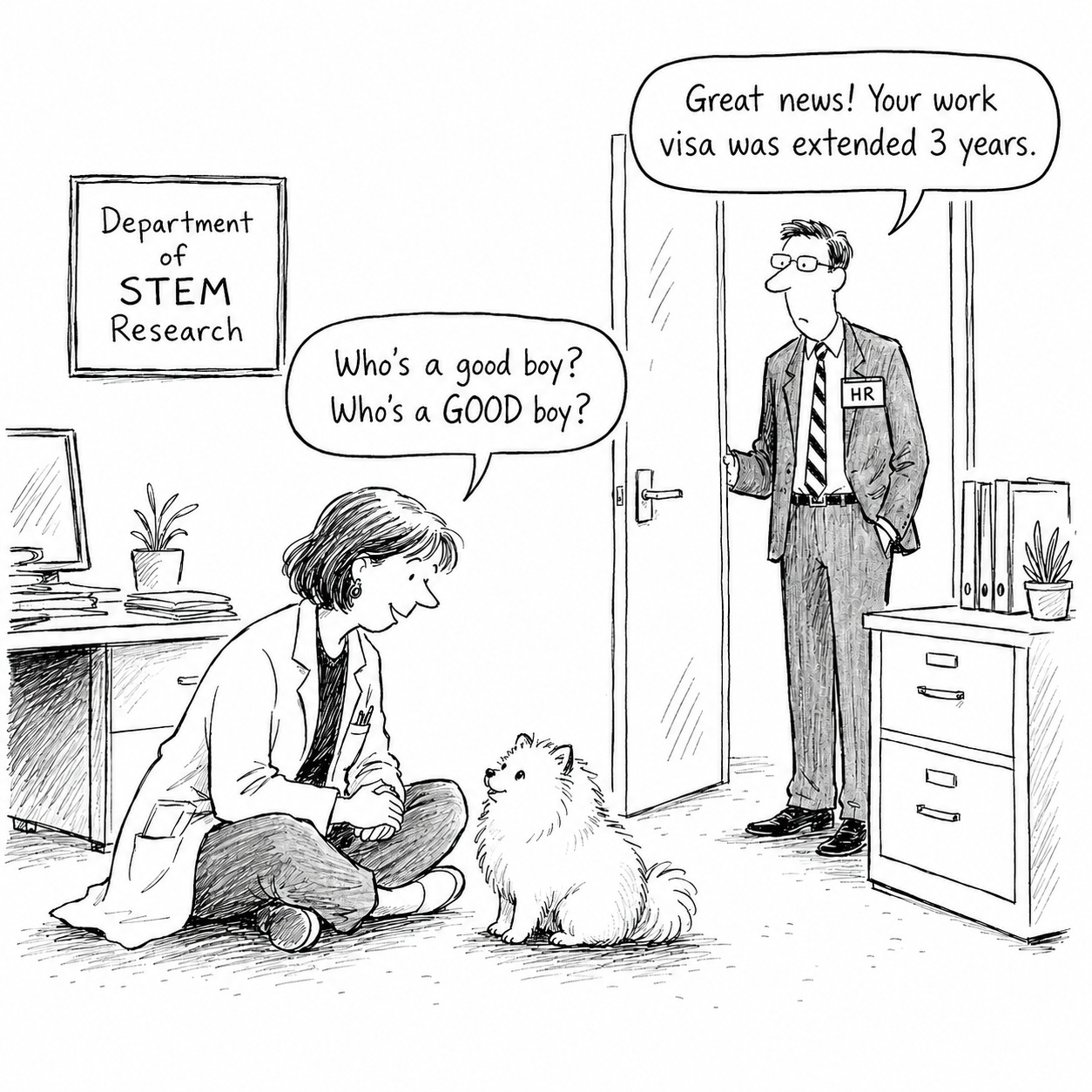
But the federal government now classifies 536 degree programs as STEM, including the ones above along with developmental psychology, strategic communication, demography, critical media practices, forestry, landscape architecture and anthrozoology (the study of why your friend talks to their Pomeranian in a baby voice and insists he “understands everything”).
Why does it matter? Because a STEM designation gets a foreign graduate up to three years of post-graduation work authorization in the U.S. A non-STEM degree gets only 12 months. That’s a massive incentive for universities to reclassify soft degrees as STEM to attract full-tuition international students — and that’s exactly what they’re doing.
I know about this because it’s happening at my own university. A program long understood on campus as a less rigorous fallback was recently reclassified as STEM. It did not add math, science, engineering, or anything resembling technical rigor. The curriculum stayed exactly the same. Only the federal classification changed. Suddenly, it could be marketed as STEM to international students. The whole thing is absurd.
Everyone’s fighting about H-1B visas. This pipeline is bigger, quieter, and easier to exploit. Congress never voted to create this system, officially known as the STEM OPT extension. It was born from a lobbyist working a Georgetown dinner party. The faculty who teach these bogus “STEM” programs are still paid like humanities professors. And the abuse gets worse by the year, as more programs are added that have no business being called STEM. In the entire history of the program, as far as I can tell, everyone has been trying to add fields to the list. Nobody has asked the federal government to remove one. If that bothers you, keep reading. I’ll tell you what you can do about it at the end of this piece.
The Pipeline Nobody’s Talking About
Last week the Trump administration announced that foreigners living in the U.S. on temporary visas who want a green card must return to their home countries to apply — a process that could take years — ending a decades-old practice that let them adjust their status without leaving. The White House is also finalizing a rule to limit foreign students to four-year stays, ending the open-ended “duration of status” framework. Foreign enrollment at U.S. universities has already dropped for the first time in three years.
Silicon Valley went ballistic over the news. Andrew Ng, co-founder of Coursera and adjunct CS professor at Stanford, called it “a capricious attack on legal immigration” that will “hurt American competitiveness in AI.” Venture capitalists warned it would cripple startups. The argument, as always, is that America needs high-skilled immigrants and any restriction will cost us.
But while everyone is fighting about that, here’s the part nobody is talking about: hundreds of soft degrees, including journalism and drama therapy, are federally designated as STEM, and we’re pretending we have a severe shortage of native talent in these fields. America surely can’t produce that homegrown talent, right?
Here’s how the system works. Every one of those degrees is on the Department of Homeland Security’s official STEM Designated Degree Program List. If your degree’s CIP code (Classification of Instructional Programs, a six-digit taxonomy the Department of Education assigns to every degree program in the country) appears on that list, you can work in America for a total of three years after graduation in a job related to your field of study. If it doesn’t, you get 12 months and then you leave.
For an aerospace engineer, “related to your field” is narrow. For a communications grad, it means almost anything with a keyboard. The government’s own guidance shows how elastic the standard really is. Their sample qualifying jobs include a business grad working as a loan officer at a mortgage company, a music grad playing the harp in hospital rooms, and a kinesiology grad teaching exercise classes at a health food store — listed right alongside an electrical engineer at a government contractor and a PhD computer scientist. During the first 12 months of standard OPT, candidates can even do unpaid volunteer work to stop their unemployment clock, or be self-employed, or work through staffing agencies.
Universities know this. And they’re exploiting it. I don’t blame the foreign students. They’re responding rationally to the incentives placed in front of them. The real problem is the universities and employers gaming the system, turning an academic classification system into a tuition pipeline and a cheap-labor workaround.
The original idea behind the STEM OPT extension was simple. OPT stands for Optional Practical Training, a program created by regulation in 1992 that lets foreign students on F-1 visas work in the U.S. after graduation. America supposedly had a shortage of engineers, mathematicians, and scientists. Foreign students who earned degrees in those fields should get extra time to work here because we needed them. The four core fields were engineering, biological sciences, math, and physical sciences. OK, hard to argue with that.
But then the list started growing.
DHS added 18 “related” CIP series that pull from fields like agriculture, architecture, communications, education, psychology, homeland security, social sciences, transportation, and business. At the six-digit CIP code level, any program in those series can petition for inclusion.
Senator Chuck Grassley of Iowa noticed this in 2022. He wrote to DHS Secretary Alejandro Mayorkas and didn’t mince words: “There is no way, under any common-sense understanding of what fields are considered STEM fields, that degree programs in economics, business, journalism, anthrozoology, industrial and organizational psychology, much less drama therapy and classics, should be considered degrees in STEM fields.” He called the whole program a “back door visa” that had been “distorted” from its original purpose.
Nothing happened. Instead, DHS added more codes in 2023 and 2024. Among the additions was Demography and Population Studies — I guess when you keep adding majors to the STEM list, eventually you need someone to count them. At last count, 536 programs qualified. The four core STEM fields account for maybe a quarter of the list. The rest is regulatory fiction.
The Genesis: A Georgetown Dinner Party
And here’s the craziest part: the whole thing started at a dinner party in Georgetown.
In 2007, Microsoft’s head lobbyist Jack Krumholtz attended a D.C. dinner hosted by power couple Ed and Debra Cohen. DHS Secretary Michael Chertoff was there. A major immigration bill that would have doubled H-1B visas had just collapsed in Congress. Microsoft needed foreign workers and the H-1B cap wasn’t keeping up with demand.
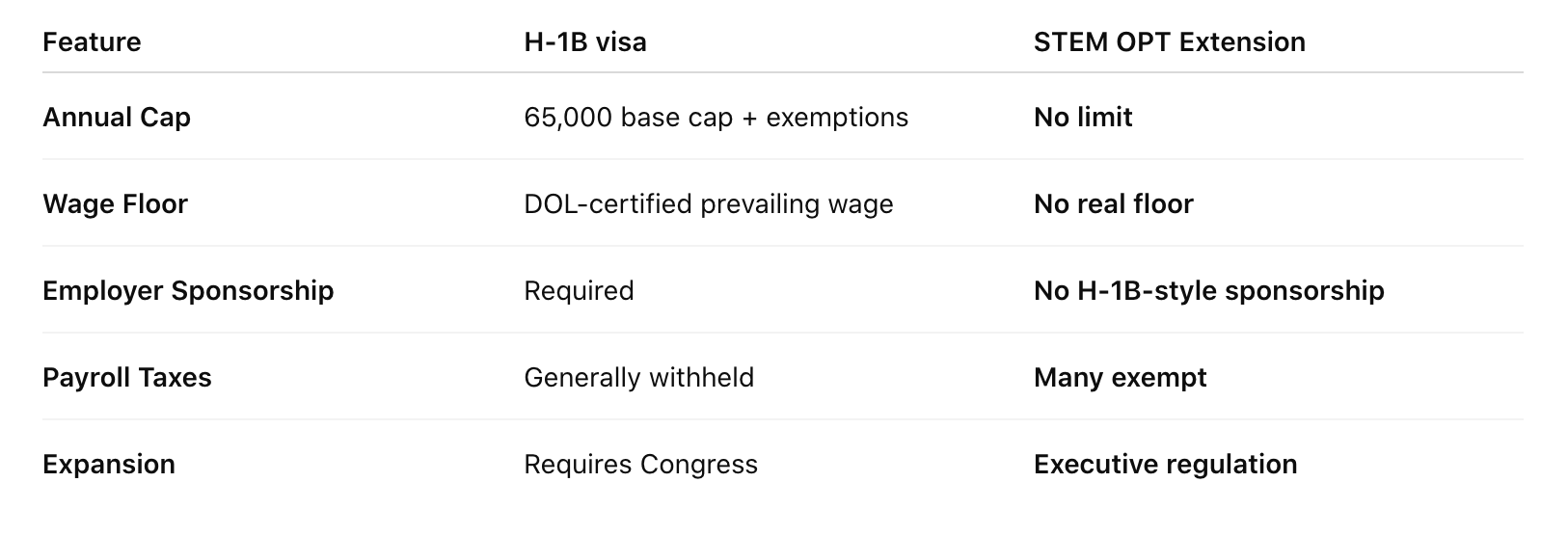
Krumholtz followed up with a letter. He told Chertoff that DHS could “easily and immediately” fix the problem by extending OPT, because “OPT exists solely by regulation,” no congressional action required. Just change the rules, extend the work period, and use student visas as a backdoor around the H-1B cap. The beauty of the workaround: H-1B visas are capped at 65,000 a year and require employers to pay the prevailing wage, certified by the Department of Labor. OPT has no limit on numbers, no real floor on wages, no congressional vote needed to expand it. Just a regulation that one cabinet secretary can change over dinner.
It worked. In April 2008, DHS published an interim rule extending STEM OPT from 12 to 29 months, bypassing the normal notice-and-comment process. The Washington Alliance of Technology Workers later alleged that “DHS worked in secret with industry lobbyists to craft regulations implementing Microsoft’s scheme.” A federal court agreed in 2015 that the 2008 rule had been promulgated unlawfully. DHS responded by issuing a new rule in 2016 that did the same thing but extended the period to 36 months. That rule added a “commensurate compensation” standard on paper, but it’s self-reported by employers on a training plan form with minimal enforcement. An H-1B employer submits to a DOL wage determination. An OPT employer checks a box.
Congress never authorized the STEM OPT extension specifically. The entire program, from its creation under Bush to its expansion under Obama to its continued inflation under Biden, exists by executive fiat. The Economic Policy Institute called it out plainly: the program “has no authorization in the law.” A D.C. Circuit court disagreed in 2022, ruling that Congress implicitly accepted the program by never bothering to stop it. That’s the best legal defense of OPT: nobody said no.
So, to recap: This is a program that was never passed by Congress, born from a lobbyist working a dinner party, designed to circumvent visa caps that Congress deliberately set to protect American workers. And on top of it, universities built something even more creative.
The nomination process is open to any “interested party.” NAFSA, the international educators’ association, actively encourages universities to submit new CIP codes for inclusion every year by the August 1 deadline. The Niskanen Center, a D.C. think tank, filed a public comment in 2024 pointing out that Wharton MBA students all take the same core business courses regardless of whether their specific major qualifies as STEM, yet nine of Wharton’s 21 majors have STEM designation and 12 don’t. Their solution wasn’t to question why business degrees are on a STEM list. It was to add more. The pressure only goes one direction. Nobody lobbies to remove codes from the list. In fact, DHS has never removed a single code. The 2023 Federal Register notice included a footnote: “While the 2016 STEM Rule provided for ‘additions or deletions to the list,’ no deletions will be made at this time.” No deletions have been made at any time.
The CIP Code Shell Game
Here’s how it works. Every degree program in the country gets a CIP code. Universities assign these codes to their own programs, and a program’s code determines whether it qualifies as STEM. Nobody forces a university to classify communications as STEM. They choose to, because the code determines visa eligibility, and visa eligibility drives international enrollment.
So if you’re a university that wants to market a three-year OPT extension to international applicants, you don’t need to change your curriculum. You just need to change your CIP code.
Penn State’s economics department says it plainly on their website: “Our Undergraduate Program has been reclassified as a STEM Program.” The old code was 45.0601, Economics, General. The new code is 45.0603, Econometrics and Quantitative Economics. Same program, same faculty, same courses. Different code, different visa outcome.
Michigan State’s College of Communication Arts and Sciences announced STEM designation for its Strategic Communication master’s program by saying the quiet part out loud. The designation “increases the overall value of our graduate programs specifically for international students by offering extended work opportunities.” Not better training, or more rigorous coursework. Extended work opportunities. It’s a recruitment pitch dressed up as academic achievement. Most department chairs see the designation and think “great, we’re STEM now” without asking what that claim actually commits them to. At a minimum, it’s a form of false advertising to international students. Call it what it is: academic dishonesty.
University of Colorado - Boulder got STEM designation for a PhD in “Emerging Technologies and Media Art Practice” housed in the Department of Critical Media Practices. Critical Media Practices... STEM? A more appropriate acronym might be WTF.
It’s the ultimate academic identity crisis. Your journalism degree can now identify as STEM.
Defenders will argue that modern communications and economics programs increasingly incorporate statistics, coding, and data analytics. Fair enough. But if the standard for STEM designation is that a program uses some quantitative tools, the category becomes so elastic it can’t distinguish strategically critical fields from ordinary white-collar professions. Plumbers use more applied physics than most communications majors. Nobody’s putting them on the STEM list.
The Labor Market That Doesn’t Exist
The whole policy rationale for STEM OPT was supposed to be about domestic labor shortages in fields critical to American competitiveness. So let’s look at the labor market for some of these newly minted STEM fields.
Journalism lost 25% of its jobs between 1990 and 2008. Then it fell off a cliff, losing another 74% of the remaining workforce through 2024, according to the Columbia Journalism Review. In January 2024 alone, the Los Angeles Times cut 20% of its newsroom, Sports Illustrated laid off nearly its entire staff, and The Messenger shut down completely after less than a year, leaving over 300 people out of work. Through November 2025, media and entertainment shed over 17,000 jobs, up 18% from the year before. And, just a few months ago, the Washington Post laid off one-third of its staff.
There is no journalist shortage threatening American competitiveness. There are experienced reporters with decades of clips freelancing for pennies, working retail, driving for Uber. The field has been in a structural collapse for 20 years.
But a university can slap “Digital Communication and Media/Multimedia” on what is functionally a journalism program, get the STEM CIP code, and now a foreign graduate can work at a media company for three years on OPT while the American j-school graduate from the same university competes for the same shrinking pool of jobs with no special visa advantage. Columbia’s journalism school — arguably the most prestigious j-school in the country — openly promotes OPT work visas to its international students, who make up nearly half the class.
You could run the same exercise across dozens of these newly minted STEM categories. Look at the labor market for public relations, business, or economics. None of these fields have a structural domestic labor shortage that would justify a specialized immigration pathway. They have an oversupply of domestic graduates competing for entry-level corporate roles. Yet, by slapping a tech-sounding label onto a corporate communications or general business curriculum, a university can mint a brand-new STEM degree out of thin air.
And with minimal wage oversight, there’s little stopping employers from using OPT workers as cheap labor with creative job titles. Some already are. ICE recently identified over 10,000 fraud cases across OPT employers nationwide. On the anonymous professional network Blind, one STEM OPT worker posted that they’re being paid $500 a month.
Follow the Money
OPT participation has more than tripled since 2007. In that year, about 155,000 foreign students had OPT authorization. By 2024, it was over 500,000. More than two-thirds are from Asian countries, with India and China alone accounting for nearly 60% of all participants. A congressman recently put it bluntly: “Big corporations pushed for the OPT, STEM-OPT, and CPT programs to import foreign workers and undercut American graduates. These programs were never authorized by Congress.” Senator Eric Schmitt of Missouri went further, calling out OPT by name: “Programs like H-1B, L-1, F-1, and OPT are displacing U.S. workers, suppressing wages, and hollowing out our middle class. Fraud and abuse are rampant.”
Then-DHS Secretary Kristi Noem responded with a letter confirming that the department is reviewing the entire OPT program, evaluating whether its regulatory framework “appropriately serves U.S. labor market, tax, and national security interests and remains aligned with congressional intent.” She acknowledged “the significant increase in the number of foreign student visa holders engaged in practical training programs and the potential risks and challenges,” and signaled that formal regulatory changes may be coming through a rulemaking process. Noem has since been replaced by Secretary Markwayne Mullin, but the review remains active.
There’s another incentive nobody talks about: many OPT workers are exempt from FICA and Medicare payroll taxes, making them cheaper than an American worker before you even get to wages. Even H-1B workers generally are not exempt. A federal analysis estimated that closing this loophole alone would generate $32 billion over 10 years. Congressman Glenn Grothman introduced a bill to end the exemption just last week, calling it “a financial incentive to hire foreign workers over Americans.”
So employers get cheaper labor, and universities get full tuition. International students generally pay the full sticker price. Marketing a STEM designation means marketing a three-year work visa, which means more international applicants, which means more tuition revenue.
And it doesn’t stop at the university. An entire parallel recruitment industry has sprung up around OPT. Dedicated job portals like OPTnation and United OPT exist solely to match foreign graduates with employers. Universities run marketing pages selling OPT hiring as “a workforce solution” — Arizona State University brags that over 11,000 international students have been placed through OPT and CPT since 2017 across more than 6,600 employers. Resume databases let recruiters filter candidates by visa status.
People are upset that H-1B workers undercut American talent. OPT is even more egregious: it has an entire hiring ecosystem designed to make the process easy, while employers self-certify compensation on a form nobody meaningfully audits. Everyone is obsessing over H-1B reform and green card backlogs while ignoring the most glaring work visa loophole in the system.
DHS is supposed to protect the homeland. Letting more foreign nationals stay and work on student visas, with less oversight than an H-1B, in fields where there’s no labor shortage, runs in the opposite direction. But DHS didn’t drive this expansion. This was a top-down edict. I’m sure the rank and file at DHS don’t believe drama therapy is a STEM field any more than you do. The White House told them to administer the list, across three administrations, with industry lobbyists and university associations pushing from the outside.
Their list keeps getting longer, more programs qualify, more students enroll, more tuition flows. Universities nominate new CIP codes every year. Nobody nominates codes for removal. The term “STEM” has now been stretched so thin it doesn’t mean anything a normal person would recognize. At this rate, English, gender studies and puppetry are next.
The Salary Tell
Universities know this is a charade. If these fields were actually STEM, they’d pay the faculty who teach them like STEM faculty. They don’t.
CUPA-HR, which runs the largest faculty salary survey in the country, reports that engineering faculty earn a median salary of $119,000 and computer science faculty earn $113,000 across all ranks. According to NCES data, professors in engineering and computer science earn 20-30% more than their counterparts in humanities and social sciences.
Communications professors? Salary.com puts the average at $69,000 for assistant professors. Psychology, education, and the whole cluster of newly-STEM-designated fields sit right there with English and history, not with engineering and computer science.
Universities know exactly which category these programs belong to. They know it every time they set a starting salary or make a retention offer. Communications is not engineering. The pay reflects that. But when it’s time to recruit international students paying full tuition, suddenly communications is a STEM field with all the visa benefits that implies.
Same department, two classifications — whichever one makes the university money at that particular moment.
You can see the contradiction most clearly in employment law. When universities recruit international students, these programs are STEM. But if faculty in those newly designated “STEM” fields asked to be paid like engineering or computer science faculty, the university would suddenly remember that the disciplines are not equivalent. Courts tend to agree. In one Equal Pay Act case, a sociology professor argued that humanities and social science faculty were systematically paid less than engineering and business faculty. The court sided with the university, reasoning that an engineering professorship requires different skills, effort, and responsibility than other professorships.
Exactly. That’s the point. Universities know these fields are different when payroll is on the line. They only forget when international tuition is on the line.
What You Can Do
Most people have no idea any of this is going on. The universities are counting on that. But now that you know, you can do something about it.
The DHS nomination process is open to the public. Anyone can request removal of a CIP code from the STEM list by emailing the SEVP Response Center at SEVP@hsi.dhs.gov with the subject line “Attention: STEM CIP Code Nomination.” The request should identify the six-digit CIP code and explain why the field does not involve research, innovation, or development of new technologies using engineering, mathematics, computer science, or the natural sciences.
Nobody ever asks DHS to remove anything from the list. Maybe start with drama therapy.
More dispatches from the campus that’s lost the plot: subscribe below.
I agree that extended OPT for folks with "STEM" degrees that were "tuition generating" needs to stop, it is really just a back door to the US immigration system. However, many graduate STEM degrees (like a Ph.D. in engineering or biochemistry) are fully supported by US tax dollars since the students are paid by grant supported research assistantships. Now, whether admissions practices into those programs are favoring foreign applicants (in some cases yes) is another question. That said, it IS in the national interest to retain those folks in the USA since the US tax payer paid to train them. My fear is that the extended STEM OPT will be removed with no subtlety.
There needs to be a distinction made between tuition generating BS/MS programs (many of which are low quality even at top universities), and fully supported doctoral programs. There is no national interest in retaining those poorly trained MS students but paying to train Ph.D. students then kicking them out of the country is just dumb.
Good post. I had no idea that the truly soft degree programs could be STEM. What a scam.
But one note: my discipline, landscape architecture, is (IMO) appropriately STEM. It's a widely misunderstood discipline; I know this because I rarely meet an adult outside of my work environment who knows what it is. People assume it's equivalent to ornamental horticulture, or primarily about garden design.
There is actually a significant overlap with civil engineering, structural engineering, and environmental engineering. A considerable overlap with urban planning. Landscape architects have to know how to do technical grading design, design stormwater/hydrological systems, design retaining walls and other site structures, design roads, work with principles of agronomy, ecosystems, etc. Planting design is part of it but rarely the primary focus of a design office.
Central Park in NYC is a work of landscape architecture. Sometimes people imagine it was preserved from development, but it was wholly created by the design team of Frederick Law Olmsted and Calvert Vaux: massive site grading to create topographical drama, internal roads, walkways, bridges, ponds, fountains, plazas, site structures, walls, buildings (Vaux was an architect), etc. A good example of contemporary landscape architecture in NYC is Brooklyn Bridge Park, or the High Line.
Occasionally we get students in our BLA program who wash out because they cannot handle the technical courses.