


FacultyLeaks.com is an anonymous dispatch from inside higher education. Some identifying details have been changed. The dysfunction has not.
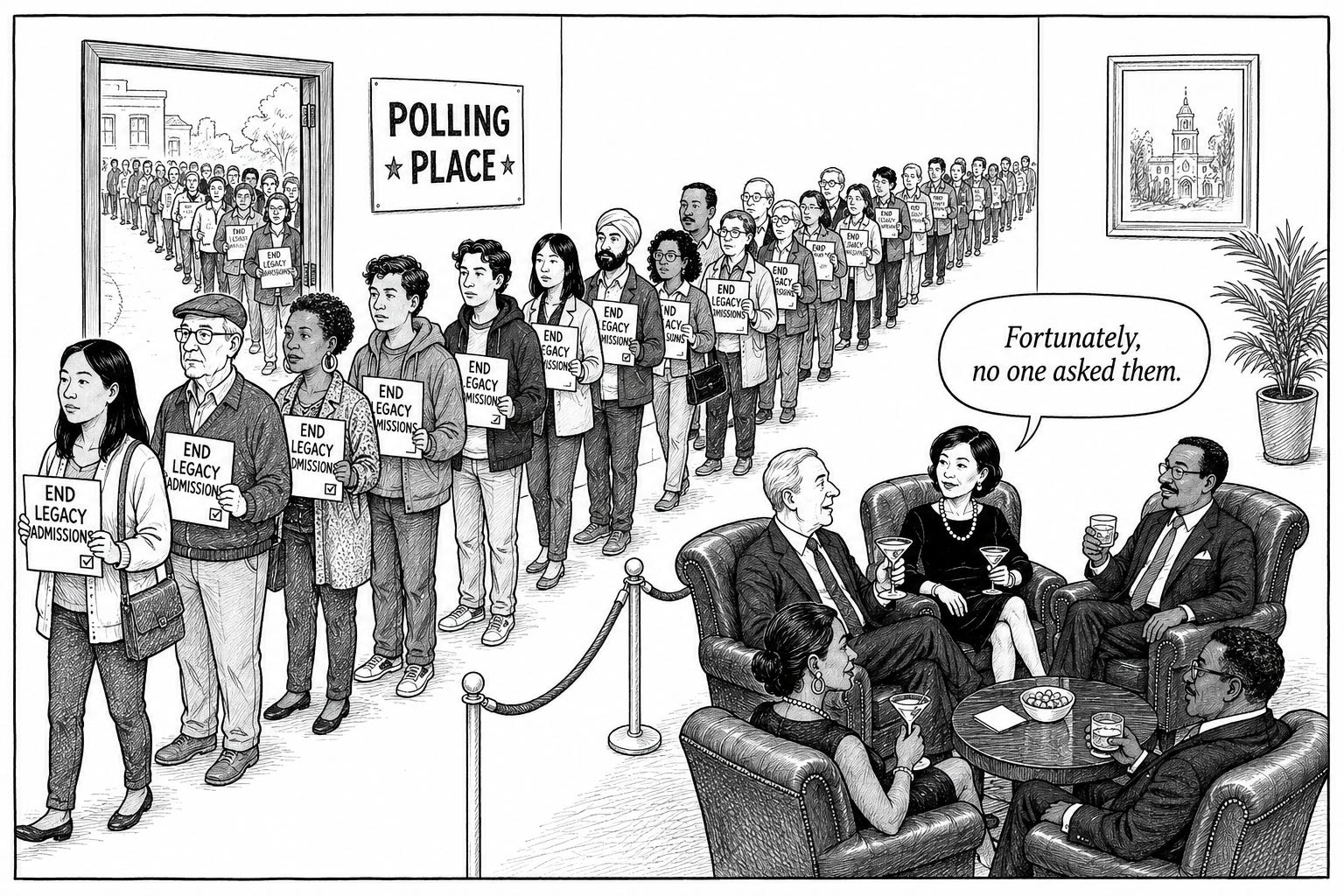
The Department of Justice hit Yale School of Medicine and UCLA’s David Geffen School of Medicine this month with findings that both schools illegally discriminated on the basis of race in their admissions, in violation of the Supreme Court’s 2023 ruling in Students for Fair Admissions v. Harvard (SFFA). The DOJ cited internal documents and statistical evidence showing that both schools continued to favor Black and Hispanic applicants over White and Asian applicants with stronger academic credentials.
The deflection was immediate.
Scroll through any thread on the enforcement actions and you’ll find the whataboutism within seconds: What about legacy admits? It’s a textbook red herring. The DOJ enforces a Supreme Court ruling on race-based admissions and the response is to change the subject entirely.
But even lawmakers who should know better couldn’t help themselves. Congresswoman Grace Meng argued: “You can’t have an honest conversation about affirmative action, discrimination without analyzing data on legacy admissions too.” Others called legacy admits “affirmative action for rich white kids.” Black students aren’t the issue, they say. “Yell at the legacy admissions.”
Others go further. Asian Americans who oppose race-based admissions aren’t exercising their own judgment. They’re pawns, a “model minority tool for white conservatives” who were “perfectly fine” with legacy admits and only objected when Black students got seats.
Here’s the twist: almost everyone wants legacy admissions gone.
Middle- and working-class White and Asian families don’t support legacy admissions either. Pew found that 75% of Americans don’t think legacy status should factor into admissions at all. Data for Progress found 68% support an outright ban, including majorities of Democrats, Republicans, and Independents. This isn’t a contested question. Almost nobody outside of university development offices and alumni boards wants this practice to continue.
It doesn’t help the average applicant. A landmark Opportunity Insights study out of Harvard found that legacy preferences are the single largest contributor to the overrepresentation of the top 1% at Ivy-Plus schools. Students from families earning over $611,000 a year are more than twice as likely to be admitted as middle-class students with comparable test scores. Legacy applicants from the top 1% have a 45% chance of admission at elite schools, compared to 9% for non-legacy applicants. This is a wealth program. That’s it.
And here’s another aspect they’re missing: at Harvard, about 70% of legacy applicants are White, which means roughly 30% are not. Because colleges have diversified over the last 40 years, the legacy pipeline is no longer exclusively White. Ending legacy admissions would displace non-White legacy admits too. Legacy admissions started as a WASP pipeline. In 2026, they’re a wealth pipeline. The racial composition has changed. The class composition hasn’t.
In fact, some advocates have argued that banning legacy admissions now would disproportionately hurt Black alumni families who are just beginning to benefit from the pipeline. I’d still end it. Merit should mean merit. But the point stands: this isn’t the simple racial narrative people pretend it is.
So yes, go ahead and end legacy admissions today. I agree with you. It’s a wealth privilege, not a racial one. And moving to a system based purely on individual merit benefits the vast majority of regular students of all backgrounds.
I saw this up close in high school. Two of my best classmates, one with a perfect SAT score, applied to a very elite school and didn’t get in. Meanwhile two other classmates who were legacies got admitted. They were qualified, sure. But they weren’t the strongest applicants. Everyone knew it. That was when we learned how legacy admissions actually worked. It was more about nepotism than merit. That was a long time ago. The system still hasn’t changed. But almost no one wants it to stay.
There’s also a legal reality that the “what about legacy” crowd skips over: race is a protected class under federal civil rights law. Income isn’t. The DOJ can investigate Yale Med and UCLA Med because the Civil Rights Act and the Fourteenth Amendment give it the authority to do so. There is no equivalent federal statute that prohibits wealth-based admissions preferences. You can argue that there should be, and I’d probably agree with you, but that requires legislation. That’s exactly why bills like the Fair College Admissions for Students Act (FCASA) have been introduced and why states have been passing their own bans. The SFFA enforcement crowd supports those efforts too.
The difference isn’t willingness. It’s that one is a direct violation of explicit statutory text, while the other requires proving an indirect disparate impact claim, which is harder and slower. And, for the record, the Department of Education opened a disparate impact investigation into Harvard’s legacy policy back in 2023. It’s still ongoing nearly three years later. Compare that to the Yale and UCLA findings, which took about a year. That’s the difference between a direct statutory violation and a disparate impact claim. It’s not that nobody is trying. It’s that the legal tools are weaker.
Now, on the claim that Asian Americans were “perfectly fine” with legacy admits and only objected to Black students: this is flatly untrue. SFFA’s own expert filings explicitly showed that legacy preferences disproportionately disadvantaged Asian American applicants and argued that removing them would increase Asian American admissions. SFFA’s founder Edward Blum has publicly stated that SFFA opposes legacy preferences, calling them a practice that “inhibits and diminishes the opportunities of applicants from modest socioeconomic backgrounds.” The plaintiffs didn’t carve out an exception for legacy. They argued for evaluation based on individual achievement.
Telling an entire ethnic group that their legal advocacy is really just servility to White interests is not the progressive argument people think it is. It’s condescending. And it recycles the same “model minority” framework it claims to critique, just from a different direction.
The people making these arguments seem to think supporters of SFFA enforcement would balk at eliminating legacy preferences. They won’t. Most of them have been saying it for years.
You’re not exposing a contradiction. You’re describing a shared goal and pretending it’s a debate. And if you can’t grasp that this is a basic logical fallacy, maybe elite admissions isn’t the conversation for you.
More dispatches from the campus that’s lost the plot: subscribe below.
Professor, I disagree, legacy admissions should be at the top of any list of incoming students. Legacy’s provide a connection to the past and a pipeline of generational donations to the permanent university fund (endowment). Legacy’s have a vested interest and attachment to the school. This is especially true for families connected to the professional departments/schools (business/medical). Legacies should be encouraged not put upon by people that have no historical come connection or offer long term benefits to the university. Again we are only talking about the elite private and elite public schools. This is not an issue at the huge commuter public universities like CS Northridge or any Cal State branch, in the UC System it is only applicable to UCLA and Berkeley same with all the UTexas branches except for UT Austin as it is a public elite school. Legacies should be emphasized and promoted as a way to keep the heritage of the school intact.
Most people don't realize that legacy admissions at elite universities like Yale has been basically obsolete for a long time. I am a private college counselor and I frequently have parents ask me if their kid's legacy status will give them an edge in the admissions process at [insert Ivy here]. My response is always the same: did you or someone else in your family donate the library or a similar structure with your family name on it? If not, the answer is no.