

FacultyLeaks.com is an anonymous dispatch from inside higher education. Some identifying details have been changed. The dysfunction has not.
A professor sent us a tip last week. They had been browsing their own institution’s website and found something they didn’t expect: a page listing a numerical minimum, a specific percentage of new faculty hires that had to come from designated racial groups.
The number was real. The page was still up. A racial hiring quota, posted on a university’s publicly viewable website, in 2026.
The professor asked us not to link to it. The exact wording is unique enough that anyone could trace it back to the institution and, by extension, to them — and they’re actively pursuing a remedy.
Their point was simple: this is not unusual. Universities have this kind of language on more pages than anyone realizes. They wrote it down because the cultural moment rewarded saying it out loud. They issued press releases and built it into their marketing. They wanted it seen.
The legal landscape has since shifted. Statements that once served as marketing assets now serve as evidence. Universities are scrambling to take down what they once rushed to post.
We think you should look at your own institution.
The Cleanup Has Started
A lot of schools figured out, somewhere around 2024, that the language they spent 2020 and 2021 putting on their websites is now a legal liability. Some of it always was.
The Supreme Court’s Students for Fair Admissions v. Harvard decision struck down race-conscious admissions in 2023 and has since been invoked to challenge racial preferences in hiring, scholarships, contracting, and virtually every other context where race is a factor. State legislatures passed new laws. The Department of Education issued sweeping guidance on proxy discrimination that threatened federal funding — guidance that has since been vacated by a federal court, though the pages have not gone back up. And the Title VII case law that prohibits racial discrimination in employment never actually changed in the first place. All of it converged on a moment where general counsels were quietly emailing communications offices asking them to take pages down.
The scrubbing is well-documented. Northeastern University removed all DEI language from its website in late January 2025 and rebranded its Office of Diversity, Equity and Inclusion as the “Office of Belonging.” Florida State University circulated an internal list of roughly two dozen keywords — including “antiracist,” “biases,” “ethnicity,” “inequities,” “oppression,” and “systemic” — to be removed from university webpages. The University of South Florida deleted entire pages from its psychology, history, and English department sites, and quietly renamed an existing policy from “Diversity and Equal Opportunity” to “Equal Opportunity.” The University of Denver removed its Pride Lounge and renamed its Division of Diversity, Equity, and Inclusion to the “Division of Community Support and Engagement.” The Chronicle of Higher Education has been tracking the changes across hundreds of institutions.
It’s a real trend. It is also incomplete.
Universities are large, decentralized, and bad at keeping track of their own websites. A page on the central HR site might get scrubbed while the same policy lives on, untouched, on a college subsite, a department page, the diversity office’s archive, and a 2022 strategic plan PDF that nobody remembered was indexed.
Even when they do scrub successfully, the Wayback Machine has the original. So does Google’s cache. So do the screenshots that critics, journalists, and disgruntled alumni took before the cleanup began.
The receipts are still out there.
Categories Worth a Look
The professor’s tip pointed at a hiring quota. That’s just one category. There are many more.
Identity-restricted scholarships, programs, or housing that conflict with the institution’s own nondiscrimination policy. Mandatory DEI training requirements that condition employment. Cluster hires — multi-position faculty searches defined by race. Bias-reporting systems with no due-process protections. Promotion criteria that require ideological commitment statements. Land acknowledgments adopted as official institutional positions. Endowed chairs with politically defined eligibility. Pipeline programs whose stated criteria contradict the federal civil rights laws under which the institution receives funding.
Every one of these things has been, at some point, written down on an institutional website. Most of them still are.
How to Look
You do not need to be a hacker to find this content. You do not need anything beyond a browser and an hour. Here is what we suggest.
Start with the institution’s main domain. Go to Google. Type:
site:youruniversity.edu “diversity”
Then variations:
site:youruniversity.edu “underrepresented”
site:youruniversity.edu “minimum percentage”
site:youruniversity.edu “cluster hire”
site:youruniversity.edu “land acknowledgment”
site:youruniversity.edu “anti-racism” (and “antiracism” — different word, different results)
site:youruniversity.edu “BIPOC”
site:youruniversity.edu “DEI training” mandatory
site:youruniversity.edu “bias incident”
Branch into specific contexts. Hiring and tenure documents are often the richest territory:
site:youruniversity.edu “search committee” diversity
site:youruniversity.edu “diversity statement” required
site:youruniversity.edu “tenure” “diversity”
Scholarships and admissions are another layer:
site:youruniversity.edu “scholarship” “first-generation”
site:youruniversity.edu “scholarship” “Black”
site:youruniversity.edu “scholarship” “Hispanic”
site:youruniversity.edu “scholarship” “women”
You will find scholarships restricted by race or gender. Many were written into gift agreements decades ago and have never been touched. Some are now legally questionable. Some are squarely illegal post-SFFA. They are all still listed on the financial aid page.
Check subdomains separately. A school’s law school often lives at law.youruniversity.edu. The medical school at medicine.youruniversity.edu. The Graduate School of Education at gse.youruniversity.edu. Each subdomain is its own ecosystem with its own communications staff who may not have gotten the memo.
Check PDFs. Strategic plans, accreditation self-studies, departmental reports, and grant applications are often archived as PDFs and forgotten. Add filetype:pdf to any search:
site:youruniversity.edu filetype:pdf “diversity goals”
The 2021 Strategic Plan, written when nobody thought the legal landscape would shift, is often where the most explicit language lives.
Use the Wayback Machine for anything that’s gone. Go to web.archive.org, paste the URL of the current version of a page, and look at the snapshots. If the page was edited or deleted in 2024 or 2025, the older versions are still there. Compare the 2022 version to the 2025 version. The difference is itself a disclosure.
Use Google’s cache. When a page has been recently changed, the cached version sometimes lingers for weeks. Search for the page, click the three-dot menu next to the result, and select “About this result” — sometimes a cached version is still accessible.
Stick to what is public. Public-facing pages, public PDFs, archived versions of pages, anything findable from a browser without a login. Leaked internal emails and restricted intranet documents are a different category, with different legal stakes, and not part of this exercise.
Why It Matters
Institutions wrote this material down because, at the time, writing it down was the point. The cultural moment rewarded loud public commitments to DEI. Schools that stayed quiet were viewed with suspicion. Schools that signaled hardest got favorable press, marketing wins, foundation funding, and accreditor approval. Posting it was the asset.
That asset has become a liability.
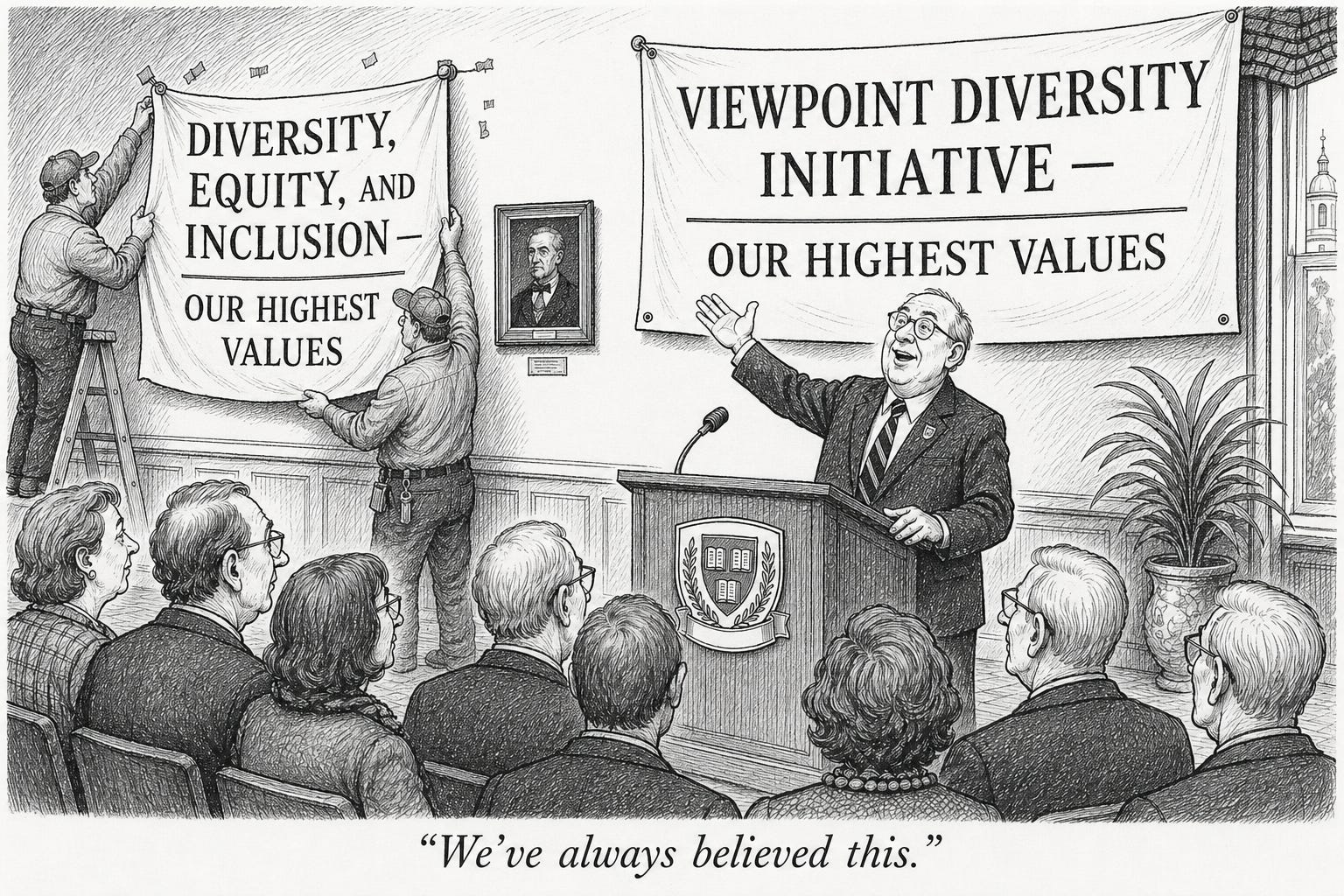
Harvard is now openly fundraising for endowed professorships in “viewpoint diversity” — $10 million per chair, several hundred million dollars total, with the explicit goal of broadening ideological representation on its faculty. The same Harvard whose faculty mocked viewpoint-diversity arguments when conservatives raised them under the previous administration. The only thing that changed was who occupied the White House.
The Supreme Court has spoken. State legislatures have passed new laws. The Department of Education issued guidance that accelerated the scrubbing — and then a federal court struck that guidance down. The legal pressure has eased. But the pages that survived the panic are settling into permanence, and the institutions that built an apparatus on the old assumptions have not finished updating to the new ones. If you are going to look, now is the time, before the next round of quiet edits buries what’s left.
There is something worth noticing about institutions that change positions this fast. The 2020 statements were not principled. The 2025 retractions are not principled either. The same universities that wrote anti-racism into their hiring documents in 2021 quietly removed it in 2025. Same leadership, in many cases. Different White House.
These are not institutions with convictions. These are institutions with weathervanes. Whatever they say next, remember what they said before — and how quickly they unsaid it.
The pages are public, the records are searchable, and the Wayback Machine is free. Look at your own institution. See what’s there. If you find something, post it in the comments.
The EEOC has started looking, too. In February 2026, the agency filed a subpoena enforcement action against Nike after launching an investigation based largely on the company’s own public documents such as published diversity targets, workforce representation goals, and statements about building a representative workforce. The company posted the numbers. The agency read them. Universities have posted the same kind of numbers. The agency can read those too.
More dispatches from the campus that’s lost the plot: subscribe below.
This is excellent work — both as a how‑to for open‑source sleuthing and as a snapshot of how fast universities pivot when the legal and political wind shifts. The “weathervane” line at the end is earned.
What struck me reading it from the higher‑ed/policy side is that you’re very close to a deeper diagnosis you only gesture at in the last few paragraphs.
You document three important facts:
Institutions loudly wrote DEI preferences and even numerical targets into public‑facing policies when the cultural moment rewarded it.
The Supreme Court, state legislatures, and federal enforcement posture changed.
The same institutions are now quietly scrubbing or renaming without ever admitting error.
That’s not just hypocrisy; it’s a system doing exactly what it has been wired to do. The public pages you’re surfacing were never just “policies” — they were narrative artifacts. In 2020–21, posting “antiracist cluster hire with minimum percentage of underrepresented faculty” wasn’t simply about HR; it was a way of purchasing status in a moral economy: accreditors, foundations, elite media, and the internal activist‑administrative class all treated that language as proof of virtue. Now the legal and political incentives have inverted, and the same sentences function as evidence in a lawsuit. So the copy changes while the underlying reflex — align with the dominant story and minimize current risk — stays exactly the same.
That’s why your “these are not institutions with convictions, these are institutions with weathervanes” line lands, but also why it’s almost too generous. It implies a kind of whimsical weakness of character. What your own reporting actually shows is something more structural and harder to fix: once an institution defines its public identity in terms of a moralized narrative (oppressor/oppressed, “antiracism” as a litmus test, etc.), its leaders will reliably sacrifice consistency and legal clarity to stay inside that narrative, right up until a counter‑vailing power (courts, regulators, funders) forces them to reverse. The reversal is rarely principled either. It’s just a new risk calculation.
The other dot your piece helps connect, but doesn’t fully spell out, is the two‑audience problem. The scrubbing you describe mostly affects the external audience — courts, agencies, parents, journalists. The internal audience — DEI staff, activist faculty, accreditor culture, HR training vendors — still lives inside the 2020–21 worldview. For them, the “quiet edits” are a regrettable legal accommodation, not a change in mission. That’s why you can have a central HR page cleaned up while nearly identical language survives in subdomains, PDFs, departmental bylaws, and informal hiring rubrics. The ideology doesn’t disappear with the text; it adapts and goes private.
That has big implications for the reform‑minded readers you’re writing for. Screenshots and Wayback captures are crucial, but they’re the symptoms. The causal chain runs something like:
A particular theory of justice (history as structural oppression, “equity” as outcome balancing) becomes dominant in elite culture.
Universities adopt its vocabulary to signal virtue and to compete for status, money, and protection.
That vocabulary gets written into policies and websites because metrics and targets are how bureaucracies prove commitment.
Law and politics shift; the same text now looks like a confession.
Leadership scrubs the most egregious language, rebrands offices, and hopes no one asks what replaced the old doctrine.
You’ve documented steps 3–5 beautifully. I’d love to see more pieces from you that interrogate steps 1–2: not just “what did they say on the page?” but “what theory of the world made them think it was morally necessary to say it?” Until that’s surfaced and argued with honestly, we’ll keep getting better‑drafted versions of the same commitments, just with more careful lawyerly euphemisms.
Last thing: your practical advice section is gold. The search strings, the PDF angle, the Wayback comparisons — that’s the kind of concrete method most academics and parents have no idea how to use. It might be worth a follow‑up that pairs those tools with interview questions or governance actions: “once you’ve found X on your campus, here’s how to bring it up in a way that forces the institution to choose between its public narrative and its legal obligations.”
In any case, this is one of the clearest pieces I’ve seen that shows how quickly the story flipped from “antiracist forever” to “we never said that.” You’ve got the receipts. The next step is exactly what you’re inching toward: explaining the operating system that produced them.
Consider updating this post with clear step by step instructions for people to file EEOC claims if their university/employer could be illegally discriminating on them by having maintained the illegal DEI practices. Remind them tonsave and acreen capture or print screen evidence, and that there are strict filing deadlines so file asap. Accordingly, if they have knowledge or evidence that the university has accepted any federal funds (grants, but also student financial aid via Title IV funds), then that could also constitute evidemce of fraud, and thus provide step by step links to filing as such to dept pf ed, treasury, doj new fraud division, and jd vance White House fraud commission. Again, save all files and evidence- especially faculty emails of others in their univ indicating intent to subvert and rebrand and covertly non comply