


FacultyLeaks.com is an anonymous dispatch from inside higher education. Some identifying details have been changed. The dysfunction has not.
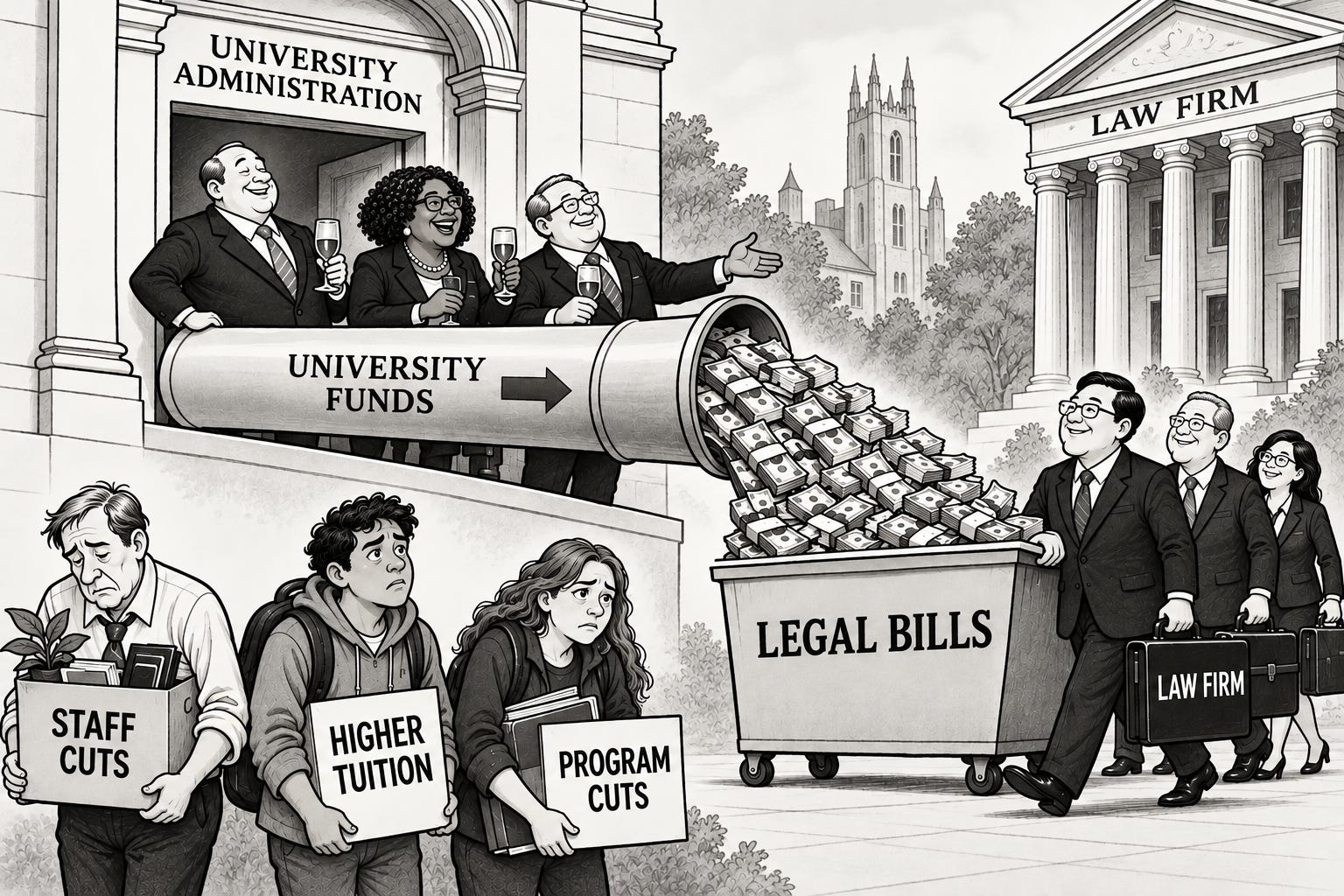
My university is budgeting for a significant decrease in legal expenses this academic year. I find that astonishing in 2026.
Colleges and universities are facing mounting legal challenges from seemingly every direction. The Trump administration is investigating schools over admissions, employment discrimination, antisemitism and immigration compliance. And it’s not just Republicans. New York’s Democratic governor, Kathy Hochul, recently demanded an independent investigation into Cornell University’s handling of sexual assault allegations, prompting the university to hire outside counsel. Lawsuits and regulatory challenges are multiplying.
My own university is under federal investigation, although its administrators have been doing their best to keep that quiet. Yet somehow, they expect to spend substantially less on lawyers. That’s either wishful thinking or spectacularly bad budgeting. Maybe I’ll blow up the next faculty meeting by asking the provost about it.
Legal expenses are becoming a major budget issue across higher education, and the bills are only getting bigger.
Harvard’s $210 million legal bill
Consider Harvard. According to an Oct. 16 report in The Harvard Crimson, Harvard spent approximately $210 million on legal expenses in fiscal year 2026, up nearly 70% from the previous year and roughly 10 times what it spent just a few years ago.
To put that number in perspective, Harvard spent more on legal expenses in a single year than some prestigious colleges spend operating their entire institutions. Haverford College reported annual operating expenses of approximately $135 million in 2025, while Bryn Mawr College spent about $150 million. Harvard’s legal bill also exceeded the annual core operating budgets of several public universities, including Cal State Bakersfield and Sonoma State. Harvard’s $210 million legal bill was so large that it exceeded the annual revenue of dozens of the nation’s 200 highest-grossing law firms, according to the Am Law 200 rankings.
Meanwhile, despite its record $68 billion endowment, Harvard eliminated approximately 165 staff positions to save an estimated $20 million annually and initially slashed Ph.D. admissions by more than half. Much of Harvard’s endowment is restricted, and federal funding cuts have created real financial pressures. But the contrast is still striking: Harvard spent $210 million on legal expenses while eliminating jobs to save one-tenth that amount.
Apparently, there’s always money for lawyers and legal settlements, even when there isn’t money for employees and students.
And Harvard’s $210 million legal bill wasn’t entirely the cost of fighting Washington. According to Harvard Magazine, it also included a $53 million settlement with families whose relatives’ donated remains were stolen and sold from Harvard Medical School’s morgue. That scandal had nothing to do with the Trump administration. The university faced lawsuits alleging that it failed to protect the donated remains, and the Massachusetts Supreme Judicial Court found an extraordinary failure of supervision at the morgue.
Harvard isn’t alone in facing mounting legal bills. The Maine Monitor reported that Bowdoin College’s legal expenses jumped from $1.1 million to $3.5 million in a single year, while Colby College spent $5.3 million on legal services in 2023. And then there’s Oberlin College, which paid $36.6 million in 2022 after losing a defamation lawsuit brought by a local bakery that university administrators helped portray as racist. The college then found itself in another legal battle, this time with its own insurers over who should foot the bill.
Higher education has spent years warning about declining enrollment, rising costs and budget deficits. Now it has another financial headache: the growing cost of lawyers, lawsuits and government investigations.
Universities have every right to challenge government overreach, and Harvard has successfully challenged some of the Trump administration’s actions in court. But not every federal investigation constitutes government overreach. Some universities have given regulators legitimate reasons to investigate them, and some of their legal problems are entirely self-inflicted.
Who pays the price?
Having seen how university administrators operate behind closed doors, I suspect the problems run much deeper than the public realizes.
Some administrators simply don’t care about the rules. They dislike the existing system, believe they know better and do what they want, regardless of the legal consequences.
In the ideological fervor that swept campuses after George Floyd’s death in 2020, too many universities began treating equal employment laws, merit-based hiring and fair and lawful admissions practices as obstacles to their diversity goals rather than obligations they were required to honor. As I’ve written previously, I’ve seen this at my own university.
Harvard itself fought all the way to the Supreme Court to defend a race-conscious admissions system that the justices ultimately ruled unlawful in 2023.
Some universities seemed to believe that discriminating against white and Asian applicants was acceptable as long as it advanced their diversity goals. But federal civil rights laws don’t make exceptions for good intentions. Administrators who should have known better convinced themselves that the ends justified the means. Now they’re discovering just how expensive that mistake can be.
I suspect many more universities deserve federal investigation than are currently receiving it.
And the legal challenges aren’t limited to discrimination. Title IX rules keep changing. Immigration compliance is increasingly complicated. College athletics has become a legal industry unto itself.
There are new legal developments seemingly every week. Just last week, Bloomberg Law reported that some EEOC offices have shortened employers’ deadlines for responding to discrimination charges from 30 days to just 15. That doesn’t leave much time to locate documents, interview witnesses and prepare a credible response, especially if a university relies on outside attorneys who are still trying to figure out who reports to whom.
With government investigations multiplying, employment laws growing more complicated and litigation costs soaring, universities should be budgeting realistically for legal expenses, not pretending they’re about to disappear. Unless AI stops hallucinating and gets admitted to the bar, universities had better get used to forking over big bucks to lawyers.
Unfortunately, the administrators responsible for creating much of this legal exposure won’t be the ones paying for it.
By the time the investigations and lawsuits are resolved, those administrators may have retired, moved on to better-paying jobs or been pushed out with generous severance packages. Meanwhile, students face higher tuition, faculty lose programs and staff members lose their jobs.
It’s a little like the NCAA sanctioning a college sports program years after the violations occurred. The coach who broke the rules has already taken another job. The ineligible player has gone pro. Meanwhile, the current student-athletes, who had nothing to do with the violations, are left serving the punishment.
The people who created the mess move on. Everyone else pays for their mistakes.
More dispatches from the campus that’s lost the plot: subscribe below.
Thank you. However, your piece is too long. The quick version about Harvard: #1. They violated the Civil Rights Act #2. They hired a President based on her skin color and gender, while ignoring her poor academic record, #3. Student organizations at Harvard - 31 of them -signed a statement on Oct. 8, 2023 placing blame on Israel for Hamas murdering 1200 people. Indeed, Harvard leads administrative policies at U.S. colleges, supporting racism, sexism, and victimhood. One result: Men comprise only 42% of college students, as many of them sense colleges consider them toxic, patriarchal, and oppressors. Then, there is the demographic cliff and AI, that reduce demand and need for college.