


FacultyLeaks.com is an anonymous dispatch from inside higher education. Some identifying details have been changed. The dysfunction has not.
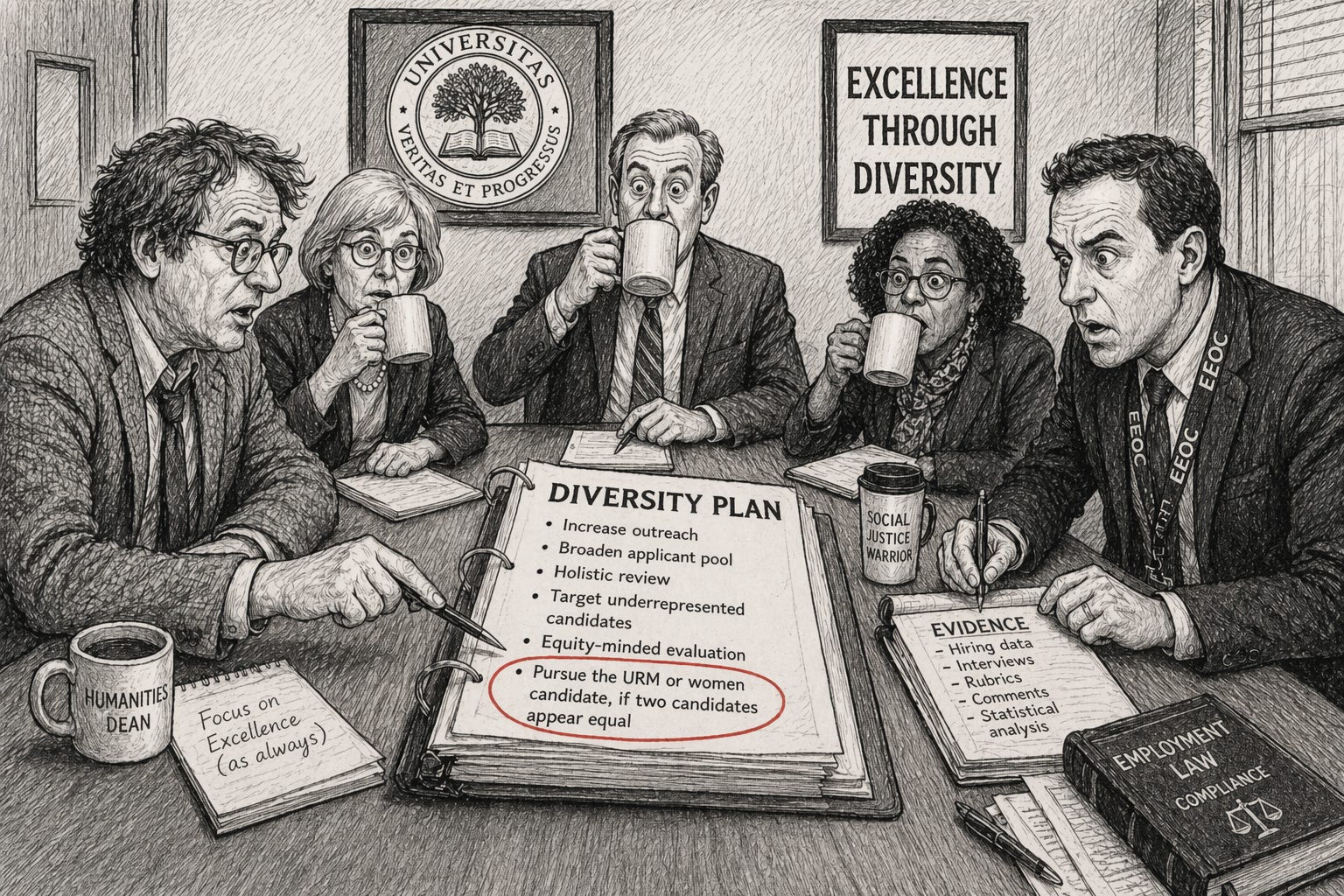
A source sent us a 2020 diversity plan from a flagship state business school. It’s 64 pages long, with seven department-level tactical plans and an appendix listing more than 150 DEI initiatives.
After George Floyd was killed in May 2020, every major institution was under pressure to show it was taking racial inequality seriously, and business schools were no exception. The result was a wave of documents like this one — formal plans with demographic targets, lists of programs and committees, and a paper trail proving the school was doing the work. Most of those plans have since been quietly pulled from their websites.
Plans of this kind usually use careful language to disguise what they’re actually doing. The preferences are real, but they’re dressed up to look like something else. This school didn’t bother.
Marketing couldn’t be bothered
Every department in the school got its own appendix in the plan. Most wrote in the cautious dialect of HR memos, with phrases like “proactively engage,” “broaden the pool,” and “intentional outreach.” The Marketing Department apparently didn’t get the memo, because its tactical plan lists, in plain bullet form, four official steps to “increase recruiting and retention of underrepresented (URM) faculty and tenure-track women faculty”:
Pursue the URM or women faculty, if two candidates appear equal.
Target hiring a tenured URM faculty member.
Target URM and women graduates of the school.
Target the top URM and women students at the flagship campus.
Those aren’t paraphrases or summaries. That’s what the document says.
The Chair of the EEOC on tiebreakers
The Marketing Department’s first bullet describes what employment lawyers call a tiebreaker, where two finalists look equal on the merits and the employer uses race or sex to decide between them. The current Chair of the EEOC, Andrea Lucas, has been telling employment lawyers since 2024 that tiebreakers based on race or sex are illegal under federal civil rights law, and that this remains true whether the employer treats race as a plus factor, a tipping point, or anything in between. Rooting out what she calls unlawful DEI-motivated discrimination is now her stated enforcement priority at the agency.
The Marketing Department wrote the tiebreaker into a formal recruitment plan four years before she said so, on school letterhead, and circulated the document to peer institutions.
Extra lines
Universities don’t usually create faculty positions out of nothing. A department gets a “line” — a slot to hire — when there’s a specific gap to fill, like a retiring labor economist, an unmet teaching need in operations, or a research area the school wants to grow into. The line follows the academic need.
Page 10 of the plan describes a different practice. The dean’s office hands out extra lines, beyond the usual allocation, to departments that can recruit URM candidates. The plan admits that these candidates’ research areas “may not coincide closely with” what the department actually needs. In other words, the line is the reward for the hire, rather than the other way around.
Finance gets creative
The Finance Department’s appendix opens with a table ranking the department first in its athletic conference for global diversity, which isn’t relevant to anything except that they wanted it on the record.
The department then floats some longer-term ideas. One is to offer the MBA as an “intermediate exit” from the PhD program, meaning a student who can’t finish the doctorate could still walk away with a master’s, and to use this as a recruiting inducement for minority students. A different degree pathway, designed around race. Also on the list: scholarships for URM and women high schoolers conditioned on an interest in finance or STEM, to feed the eventual faculty pipeline a decade out.
Forms for everyone, forever
Every tenure-track professor at the university — not just at the business school, but across every college on campus — fills out an annual report each fall documenting their research, teaching, and service from the previous year. The report goes to the central university administration, where it feeds into merit raises, promotion reviews, and tenure decisions. The software is called Digital Measures.
In September 2020, the dean of the business school wrote to the university’s Executive Vice President for Academic Affairs and asked him to modify the software so that every professor, in every department, would be required to document their DEI activity each year alongside their research and teaching. He agreed, and the change was scheduled to take effect in 2022.
The dean of one school had successfully lobbied the central administration to add a permanent DEI reporting requirement for every tenure-track faculty member at the entire university. The plan describes this approvingly. It explains that the addition will “elevate the importance and value placed on DEI activities” and let the school “better track faculty involvement.”
AACSB
Most readers have never heard of AACSB, but every business school dean is terrified of it. AACSB is the international accrediting body for business schools, and it reviews each school every five years to confirm the faculty are “qualified” — meaning still actively engaged in research, teaching, and professional development. A school that loses AACSB accreditation effectively dies, because employers stop recruiting from it and students stop applying. So the worksheets get filled out.
In September 2020, this school added DEI teaching and research activities to those worksheets. AACSB didn’t require it; the school did it to itself. Points for DEI now count alongside points for publications on the form every faculty member fills out to demonstrate they’re still fit to teach.
This is how capture happens — not by memo, but by metric. A tenured professor can roll her eyes at a DEI committee, but she can’t roll her eyes at the accreditation worksheet.
The part where they admit it won’t work
The plan concedes, in writing, that the URM doctoral pipeline is tiny, that every business school in the country is chasing the same handful of candidates, and that only two of seven departments hit the 10% URM faculty target. The response, from a school that prides itself on data-driven management, is more committees, more task forces, more tactical plans, and more extra lines.
What the plan doesn’t count
The plan counts committees, initiatives, and hires. It doesn’t count what those cost — the faculty hours consumed by mandatory training and DEI committee service, the hiring decisions run through ideological screens before a CV gets read, the promotion process that asks every faculty member to document DEI activity alongside research and teaching, or the signal this sends to research-oriented scholars about where the school’s priorities actually are. Research-oriented faculty with outside options notice these signals, and then they leave. The plan documents the machinery that replaces them.
Reading it in 2026
In June 2023, the Supreme Court decided Students for Fair Admissions v. Harvard. The holding was about college admissions: race cannot be a factor in whether a student gets in. But the reasoning was broader. The Court held that treating people differently based on race — even to correct historical imbalances, even as one factor among many, even with good intentions — violates the Fourteenth Amendment and the Civil Rights Act.
The reasoning didn’t stop at admissions. Lower courts and federal agencies have been extending it ever since, into private employment, scholarships, contracting, and faculty hiring. Andrea Lucas told employment lawyers that tiebreakers based on race or sex are illegal, Trump made her head of the EEOC, and rooting out unlawful DEI-motivated discrimination is now her enforcement priority.
And a flagship state business school left a 64-page document sitting on its website with pursue the URM candidate if equal printed in bullet form. That’s not a legal argument. It’s an exhibit.
The school has quietly pulled the plan from its website, but the PDF lives on in the files of peer schools, consultants, and the source who sent it to us. Whether any of this is still in effect — the extra faculty lines, the annual report DEI questions, the AACSB worksheet additions, the tactical plans — we can’t say from the outside. If you know, write in.
The lesson isn’t that the policies were wrong. That argument is available elsewhere. The lesson is narrower: if you’re going to do this, don’t write it down. This one did.
More dispatches from the campus that’s lost the plot: subscribe below.
I recall Joe Biden, when he was titular president, explaining to all of us that DEI wasn't about discriminating against anyone; it was only about choosing a minority candidate when all else was equal. I had seen this same argument in many places, such as newspaper opinion pieces written by harrumphing old white editorialists such as Donald Kaul, who wrote for the Des Moines Register back in the day.
And I thought: how is that not discrimination? And then, after serving on many search committees and chairing quite a few, I recognized that committee members who want very badly to hire a nonwhite person don't limit themselves to "all else being equal". They spin the evidence any way they can to elevate the ranking of a minority candidate, and downplay the evidence for a disfavored white candidate.
Search committee work can be very frustrating, because there is so much dishonesty and gaslighting by people doing work-arounds.
I don't know if the writing style for this is supposed to emulate AI or if it is AI, but it's barely readable.