


FacultyLeaks.com is an anonymous dispatch from inside higher education. Some identifying details have been changed. The dysfunction has not.
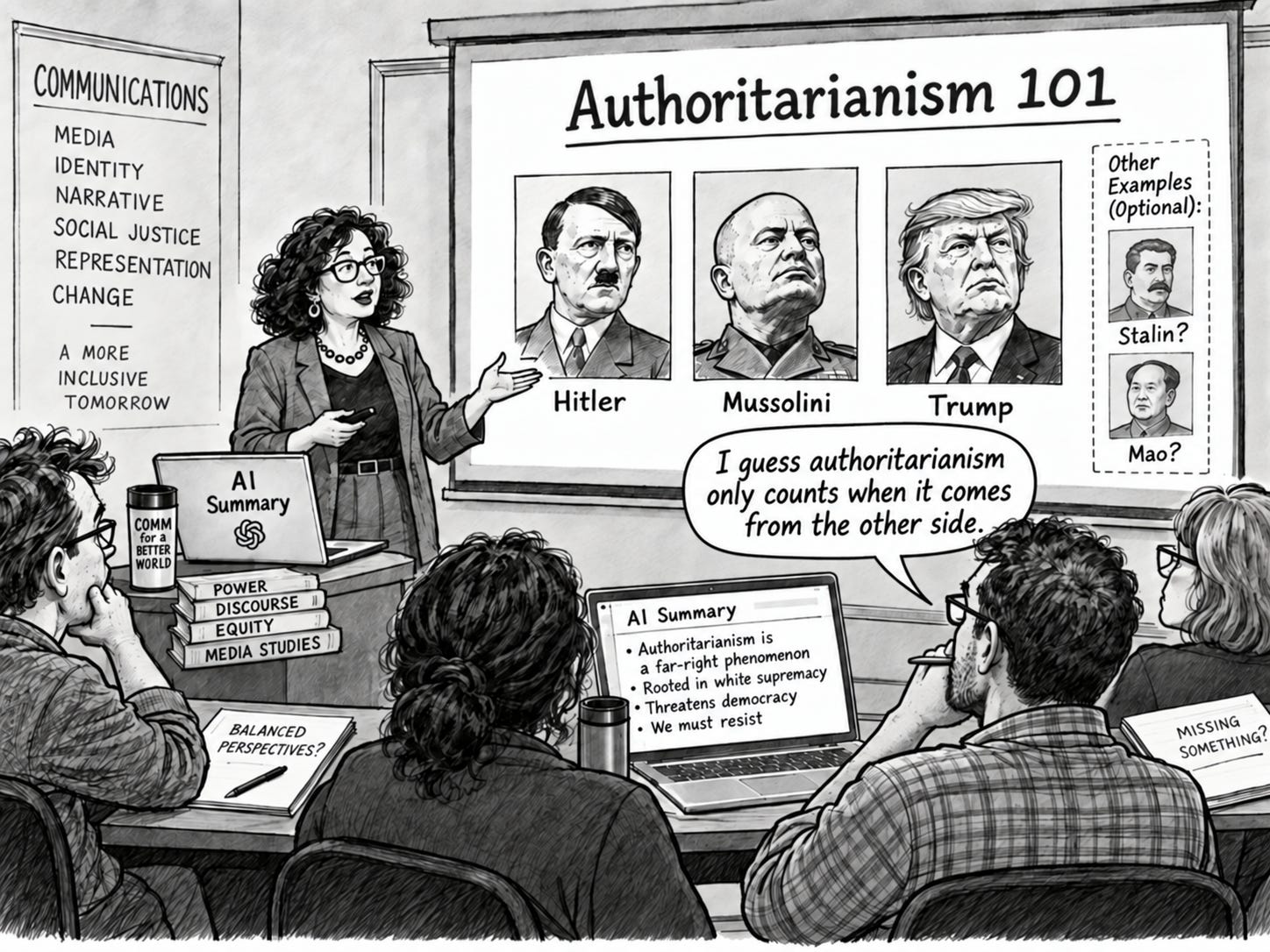
The National Communication Association would like to teach you about authoritarianism.
Conveniently, it has already picked the authoritarians — and you can probably guess who made the list and who didn’t.
NCA, the U.S.’s largest professional association for communication scholars and educators, is promoting its updated “Addressing Authoritarianism” resource library for the 2026–27 academic year. The library is intended to provide communication professors with resources for teaching and researching authoritarianism and fascism.
Among those resources is a sample course outline called “Authoritarianism 101”.
The module’s suggested historical case studies include Hitler, Mussolini, Trump, Modi, Bolsonaro and Orbán, with Putin appearing later in a speech-analysis exercise.
Stalin still doesn’t make an appearance. Neither does Mao.
The political direction isn’t exactly subtle. The module’s named examples are drawn overwhelmingly from nationalist and right-wing politics, while two of history’s most consequential communist authoritarian rulers are nowhere among the suggested case studies. Which is a little strange if the subject is supposed to be authoritarianism rather than right-wing authoritarianism.
Then again, it’s worth remembering the political makeup of the field producing this material. A 2017 NCA report on faculty political affiliation found a 20-to-1 ratio of registered Democrats to Republicans among Journalism/Communication faculty. And 60% of the Journalism/Communication departments examined had no registered Republicans at all.
So perhaps it shouldn’t be surprising when a field that politically lopsided produces an introductory lesson on authoritarianism that omits comparable examples from the authoritarian left.
But it is worth paying attention to, because communication programs train many of the future journalists, media professionals and influencers who will help shape public understanding of politics.
And then there’s the reading list.
NCA has also assembled a “Secondary Education Anti-Authoritarianism Reading List” for middle- and high-school students.
It has an interesting detail: the book descriptions are labeled “AI Summary.”
The issue isn’t that NCA used AI. This substack uses it too.
The issue is what the summaries say. Fahrenheit 451 supposedly warns about “white nationalist and authoritarian ideologies.” Lord of the Flies critiques “white nationalist ideologies.” And The Hunger Games draws parallels to “white nationalist hierarchies.”
These aren’t the conventional summaries of these books. They’re particular ideological interpretations being presented to middle- and high-school teachers under the seemingly neutral heading “AI Summary.”
NCA doesn’t say which AI produced them, what prompts were used, or how much human editing was involved. Apparently the AI picked up its house style pretty quickly.
To NCA’s credit, the broader reading list does include left-wing authoritarianism. Animal Farm is there, and its AI summary explicitly describes the book as an allegory of the Russian Revolution and Stalinism. Darkness at Noon, about a revolutionary consumed by the communist totalitarian system he helped create, is there too. Czesław Miłosz’s The Captive Mind deals explicitly with intellectual life under Stalinism.
So the problem isn’t that NCA has somehow never heard of communist authoritarianism. That makes the selections in “Authoritarianism 101” more interesting, not less.
None of this means Trump or Orbán should be off limits. Of course professors can discuss them. Hitler and Mussolini obviously belong in teaching material dealing with fascism. But Stalin and Mao aren’t exactly obscure historical figures. Communist governments have given us plenty of examples of censorship, propaganda, political repression and suppression of dissent.
And with the Democratic Socialists of America recently gaining momentum in U.S. politics, Marxist and communist political identities aren’t purely historical curiosities either. DSA officially calls itself democratic socialist, but its own 2021 membership survey found substantial numbers of its 100,000-plus members identifying as Marxists (38%) and communists (27%). DSA has also explicitly described its project as building a mass socialist movement capable of abolishing capitalism. (The survey also found that roughly 1 in 10 respondents described themselves as teachers, scholars or academics).
Whatever terminology one prefers, Marxist and communist currents remain part of contemporary American politics. That makes their omission from an introductory lesson on authoritarianism harder to dismiss as merely ancient history.
If the goal is to teach students how authoritarianism works, why not Stalin? Why not Mao? Why not compare censorship, propaganda and political repression under authoritarian governments of the left and right and let students examine the similarities and differences?
That would actually be an interesting class. Instead, “Authoritarianism 101” risks teaching students something much simpler: which authoritarians their professors expect them to recognize.
More dispatches from the campus that’s lost the plot: subscribe below.
Nor is there any mention of Fidel Castro, Hugo Chávez, Daniel Ortega, or Juan Perón to pick a few from our hemisphere.
I also note the absence of Winston Churchill, Margaret Thatcher and Ronald "Mr. Gorbachev, tear down this wall" Reagan who, with the support of Pope John Paul II, liberated millions from authoritarianism.
Homeschool