

The Last Dinosaurs: Why Academia Keeps Protecting Its Worst Senior Faculty
On the care and feeding of faculty who outlasted their usefulness

FacultyLeaks.com is an anonymous dispatch from inside higher education. Some details have been changed. The dysfunction has not.
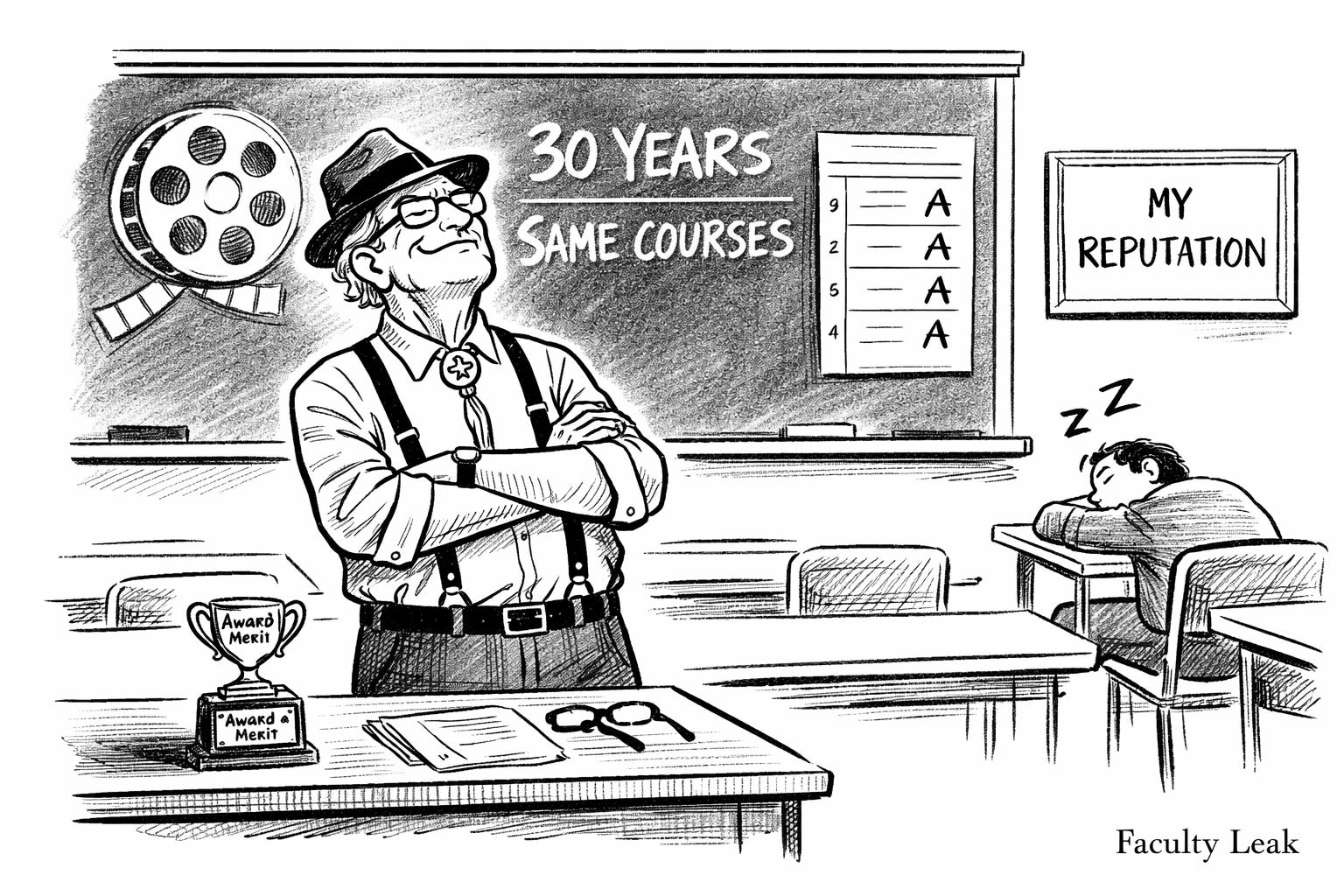
There is a specific kind of silence that falls over a faculty meeting when someone brings up Professor So-and-So. You know who I mean. Tenured since the Reagan administration. Hasn’t published anything — not a book chapter, not a conference paper, nothing — since current students’ parents were in college. Teaches the same two courses he’s always taught, fills the seats through grade inflation and low expectations, and spends the rest of his time defending the precise square footage of his office and complaining about the parking situation. The chair glances down at the table. The junior faculty study their laptops. Someone changes the subject. The meeting moves on.
This is how it has always worked in higher education. And it is slowly strangling the enterprise from the inside.
Last semester, a professor at a university I know well resigned in protest over a routine course enrollment cap. He was replaced by lunch. The department kept moving. Nobody panicked. The students were notified of their new instructor and went about their lives with the indifference that 18-year-olds typically bring to news about adjunct staffing changes.
I want to talk about what that looked like — and why it matters.
How the System Made Them
You can’t really understand these guys without understanding the world that built them.
Professors who entered academia in the 1970s and ‘80s landed in a version of the profession that basically no longer exists. Tenure decisions were looser — more about relationships and collegiality than actual scholarly records. Publication expectations were a fraction of what junior faculty navigate today. Departments ran on seniority and informal consensus rather than management, and chairs were colleagues first and administrators basically never. “Academic freedom” — which is a real and important thing — got stretched over time into a catchall that somehow covered everything from how you graded to whether you showed up to curriculum meetings to how many students you jammed into your film elective.
In that environment, a certain kind of operator thrived. Not necessarily the best scholars or the most dedicated teachers. The ones who were good at staying. At making themselves just inconvenient enough that previous chairs decided it was easier to work around them than through them. At accumulating small perks — a course release here, an administrative stipend there, a long-standing exemption from whatever policy everyone else had to follow — until those perks hardened into something that felt, to them, like rights.
Thirty or forty years later, those operators are in their seventies. Some have technically retired but stuck around as adjuncts, in courtesy arrangements that let them keep the office, the classroom, the identity. And when someone finally comes along and actually manages the department — enforces the course cap, reassigns the administrative role that’s been collecting a stipend on autopilot for a decade, asks why the internship program has been generating student complaints for years — they react with the only thing they have left.
Righteous indignation. Scaled to an eleven.
Victor
Let’s start with one such professor I’ll call Victor. He fancied himself a filmmaker.
You would know him immediately if you saw him. The brimmed hat. The suspenders. The bolo tie — yes, even though we are nowhere near Texas. The full aging-bohemian-auteur aesthetic, assembled sometime in the 1980s and maintained without revision ever since, the sartorial equivalent of a man who decided what kind of person he was going to be and never saw reason to reconsider. He also did tai chi. Of course he did.
He had made documentaries — or something that functioned as documentaries. Largely unedited footage assembled without much apparent structure, the kind of thing that results when someone with access to a camera mistakes enthusiasm for craft. The films had collected a respectable haul of festival laurels: “Award of Merit,” “Certificate of Merit,” “Special Jury Prize.” What Victor perhaps did not advertise was that the film festival ecosystem has an entire shadow tier of what filmmakers bluntly call award mills — organizations that function less like curators and more like vanity publishers, trading laurels for entry fees. Submit, pay, receive a graphic you can put on your poster. His films had found their natural home there. He mentioned the awards when the opportunity arose.
Over the years, Victor had also carved out a small academic fiefdom: a curriculum minor built around courses he liked teaching, which mostly meant watching films, discussing films, and celebrating films. His classes filled every semester. He took this as confirmation of his legendary status.
The actual explanation was less flattering. His courses counted toward general education requirements students needed regardless of who was teaching them. The demand wasn’t for Victor. It was for the credit hours. You could have put a mannequin at the front of that classroom and gotten the same enrollment — though the mannequin might have graded harder.
The minor Victor had spent years building around his interests had, at last count, zero declared students. Not a struggling handful. Zero. Not one student in the entire university had decided his minor was worth committing to. But it stayed on the books semester after semester, because no previous chair wanted the conversation.
He also gave literally everyone A’s — including students he complained didn’t belong in college. Students knew it, talked about it, and sought out his courses specifically for that reason. Victor considered this a sign of his effectiveness as an educator.
When Victor retired, the department let him continue as an adjunct at his request — a professional courtesy, the kind extended to people you don’t want an awkward conversation with. But he apparently interpreted the arrangement as: same job, same informal exemptions, indefinitely.
So when a standard reminder went to all faculty — course caps exist, they apply to everyone, don’t overenroll your sections — Victor responded with something approaching genuine bewilderment. He had been overenrolling for over 30 years, he explained. No harm had come to the department. Most of his students weren’t even majors — they enrolled because of his reputation. He doubted, in fact, that those students would bother with another communications course taught by a colleague who didn’t have “a good enough reputation to attract enough students on their own.”
Sit with that sentence. A retired adjunct — semester-by-semester courtesy appointment, no governance role, no tenure, no standing — put it in writing that his tenured colleagues couldn’t draw students without him.
The reply from the chair was calm: policy applies to all faculty including adjuncts, no exceptions, send students who ask to me directly.
It’s worth being clear about why course caps exist, because Victor’s argument — I’ve been doing this for years, no harm done — is the one people who don’t work in academia might find superficially reasonable. Caps aren’t bureaucratic formality. They exist to maintain quality, prevent a race to the bottom on rigor, and distribute enrollment fairly. When one person overenrolls indefinitely, they shrink the department’s overall section offerings, limit other instructors’ hours, disrupt course rotations, and force colleagues to absorb the imbalances. What feels like personal flexibility is structural hoarding. And when that person is giving everyone A’s to keep seats full, the harm to academic standards compounds quietly over years.
Victor announced he was resigning. He would contact the deans. He would personally explain the situation to his students. There was, in his telling, simply no other honorable path.
He resigned. In writing. Twice. Same day.
By lunch, the course had been reassigned. The department kept moving. Students notified of the change responded with the indifference 18-year-olds typically bring to news about adjunct staffing.
Victor, discovering his theatrical exit hadn’t triggered the expected institutional crisis, regrouped. Two days later he sent a new email — cc’ing the director of a campus support program for neurodiverse students, a well-regarded initiative that does genuinely important work. His cinema courses, he explained, had been a “launching pad” for these students. It would be a shame if the department were to lapse in its support of this much-respected community.
There was one student from that program in his class. One.
A dean later confirmed what was by then obvious: Victor’s sustained refusal to follow the enrollment policy had violated his own collective bargaining agreement. His union concluded there wasn’t much of a case to make — a polite way of saying you quit over a course cap, and you’re on your own.
Decades of self-mythology — the beloved maverick, the irreplaceable draw — sustained by an institution’s long habit of finding accommodation easier than confrontation. When the accommodation stopped, the myth didn’t slowly deflate. It just ended. On a Tuesday afternoon. Before dinner.
He wasn’t fighting the chair anymore. He was fighting the reality that the department didn’t actually need him. That is a much harder fight to win.
Gerald
Gerald’s situation is different in the specifics but identical in the psychology, and in some ways sadder.
Gerald had once been department chair himself — a tenure during which enrollment dropped by 50%, facilities deteriorated, and the department drifted into the comfortable stagnation that sets in when nobody is actually steering. He left the role with his relationships intact and a deep, unshakeable belief that his years of service had purchased permanent insider status that subsequent leadership couldn’t really touch.
The clearest expression of that status was the internship coordinator role. Stipend, course release, a decade of occupancy. What it didn’t have, under Gerald’s watch, was functioning results. Colleagues had been quietly complaining for years. Students had escalated concerns to the dean’s office — some of them seniors who’d received such vague advising they couldn’t figure out how to graduate on time. The chair had to personally clean up multiple situations that never should have required a chair.
When the role was reassigned to a junior colleague who had actually built the program’s current infrastructure — done the real unglamorous work of making the thing run — Gerald was livid.
The email he sent deserves a moment of appreciation. He called the decision “frankly, disturbing.” He wrote that he “couldn’t let this continue” — the chair’s decision, about the chair’s department — as though the org chart ran in the other direction. He audited his junior colleague’s teaching schedule and declared she obviously had bandwidth for the role, as if other people’s workloads were his to assess and judge. He invoked his support during a contentious hiring dispute that, on closer inspection, he had opposed just as loudly as everyone else.
The response was short: decision is final, schedule is submitted, all internship questions go to the new coordinator.
Gerald threatened to go to the union. Said students were confused and distressed. Demanded a formal meeting with the chair and a dean present — this from a man whose job was to help students find internships.
Four days later, on a Saturday night — the classic hour of the humbled — he emailed asking if they could find time to “square things up.” The chair offered office hours the following Tuesday afternoon. Not Gerald’s preferred morning slot, but a perfectly reasonable time.
Gerald wrote back: actually, let’s just pass on the meeting. Let’s maintain our collegiality going forward.
He had burned through every available escalation in three weeks. And he folded because the offered time was an hour later than he wanted, and he realized somewhere in that gap that showing up would only mean hearing “no” to his face. The gracious withdrawal was not graciousness. It was self-preservation dressed up in the language of magnanimity.
A month later he tried again, demanding he be reinstated to his sinecure — longer email, words like “arbitrary” and “cutting” and “unprecedented.” The reply, which deans were copied on, said the matter was closed and future emails on the subject would go unanswered.
He went quiet. Started routing requests through the department secretary. Applied for a research release and was denied. His last academic publication of any kind appeared when most of his current students’ parents were in college. The faculty voted to cut his signature course from the core curriculum. The internship program, in its first semester under new coordination, improved measurably.
A look at Gerald’s current syllabus tells you most of what you need to know about where he is intellectually. It’s a History of Mass Media course — genuinely his subject, the thing he’s spent a career on — and it devotes one hour-long class session to the internet and artificial intelligence. Social media gets no treatment. His readings include dead links pointing to webpages that haven’t been updated in years and some that show error messages. The contact information lists a personal AOL address. Gerald teaches the history of how communication technologies transform human society and consciousness. He still uses AOL. There’s probably a McLuhan thesis in there somewhere about how we never fully abandon old media environments. Gerald is living it.
Gerald still walks the halls. He nods when he has to. He doesn’t make eye contact with the chair if he can help it.
The tantrum, when it came, wasn’t just ego. It was the sound of an entire obsolete power structure collapsing in real time — and Gerald being the last one to hear it.
Why Nobody Says This Out Loud
Every dean in every building in this country knows who their Victor is. Who their Gerald is. The junior faculty know. The staff knows. In many cases the students know, or sense it.
The knowledge isn’t the problem. The problem is that saying something has always cost more in the short term than saying nothing. So previous chairs absorbed the entitlement and worked around it. Previous deans took the complaints and filed them. Previous colleagues covered for the disorganized advising and told themselves it wasn’t their problem. And those years of accommodation stacked into something the recipient eventually couldn’t distinguish from something earned.
Victor built a mythology around being a celebrated filmmaker — and his evidence for this was a stack of “Awards of Merit” from organizations that essentially charge a fee and mail you a laurel graphic. Gerald spent a decade running an internship program badly enough that students went to the dean, and still wrote emails about how the department couldn’t function without him. Neither of them seems to have ever asked the basic question: what have I actually produced lately that justifies this level of certainty about my own importance?
The answer, in both cases, is: nothing. For decades.
And that’s the thing about this particular flavor of boomer academic entitlement — it’s not just confidence, it’s confidence that has been completely insulated from feedback. Real feedback, anyway. The kind that comes from peer review, from enrollment trends, from student outcomes, from any external measure of whether the work is actually good. They opted out of all of that, quietly and gradually, and replaced it with the in-house validation of a department that was too conflict-averse to say otherwise.
The self-regard isn’t the cause of the problem. It’s the symptom. The cause is 30 years of institutional silence that let them mistake tolerance for admiration.
By the time anyone says “no” and means it, the person hearing it has spent 30 or 40 years being told “yes.” They don’t experience refusal as correction. They experience it as betrayal. Which is why the meltdowns are so out of proportion — a course cap, an internship reassignment, a policy that applies to everyone. Those things aren’t really the issue. The issue is the sudden discovery that the protective arrangement is over. That seniority doesn’t mean immunity. That the institution moved on while they weren’t paying attention.
The Generational Ledger
There’s a financial angle to this that doesn’t get talked about much, and it should.
The same senior faculty who accumulated the informal perks also came of age in an economy their junior colleagues will never see. They bought condos and houses in major cities when academic salaries could actually do that. They have pensions that no longer exist for anyone hired after a certain year. They started at salaries that, relative to cost of living, were much better than what incoming faculty make today — and then accumulated raises on top for 30 years while entry-level wages stagnated.
A professor who started at a regional university in the early 2000s at $63,000 has watched starting salaries inch up to around $80,000 two decades later. That sounds like progress until you run the inflation numbers and realize junior faculty are actually earning less in real terms than their senior colleagues did at the same career stage. Junior faculty in expensive cities aren’t building wealth. They’re not buying property. A lot of them are barely keeping up, while watching the people who hold the stipends and course releases treat those resources as personal property.
The people who got the better deal are the ones fighting hardest against change. This is not a coincidence.
The department at the center of these stories lost more than half its majors over the decade Victor and Gerald helped shape. In a single year under new leadership it is up 25 percent. Production studios are being built. It’s on the campus tour now for the first time anyone can remember, because there is finally something worth showing.
Victor’s minor had zero declared students. Gerald’s internship program runs better without him.
Neither man contributed anything to the turnaround. They weren’t obstacles to progress so much as part of the drag — the accumulated weight of low standards, protected mediocrity, and 30 years of everyone deciding it wasn’t their problem. The building happened in spite of them, or after them, or over their explicit objections. But they’ll tell versions of this story for the rest of their lives in which they were reasonable and principled and the institution lost its way. That’s fine. The department doesn’t need their understanding. It just needs to keep moving forward.
What Actually Has to Change
This isn’t an argument for being cruel to old professors. Many senior faculty are doing the work, mentoring students, contributing in ways that matter. Long careers earn real things.
The argument is narrower.
Courtesy appointments need to be treated as courtesies — time-limited, conditional, revocable. Not a second tenure. The moment an institution lets a retired faculty member return as an adjunct and acts like it can never take that back, it has created exactly the dynamic that produces Victor.
Policies have to apply to everyone. This sounds obvious. It is apparently radical. The course cap that applies to the new hire but somehow not to the person who’s been ignoring it for 30 years isn’t a policy. It’s a caste system.
Chairs need their deans to back them. The culture that treats administrative accountability as a personality conflict — that expects department chairs to absorb insubordination indefinitely in the name of not making things awkward — protects the wrong people.
And the faculty meeting silence has to end. The glance at the table, the changed subject, the careful non-confrontation — that’s not collegiality. That’s complicity. Silence isn’t collegiality; it’s often the mechanism by which the problem compounds. Every time a room full of people who know exactly what’s happening decide it’s not their problem, the problem gets a little more entrenched.
The Last Dinosaurs didn’t fall from the sky. The institution built them, fed them, and looked away. It can stop.
The course cap was just the occasion. Someone finally didn’t blink. And the department — the students, the junior faculty, the staff, everyone except the two people described above — is better for it.
If you work in higher education, you know exactly who I’m writing about. You probably have your own Victor. Your own Gerald. And if you’re the chair who finally said enough — or the junior faculty member who has been waiting for someone to — this one’s for you.
More dispatches from the campus that’s lost the plot: subscribe below.
Kids like their dinos?