


FacultyLeaks.com is an anonymous dispatch from inside higher education. Some identifying details have been changed. The dysfunction has not.
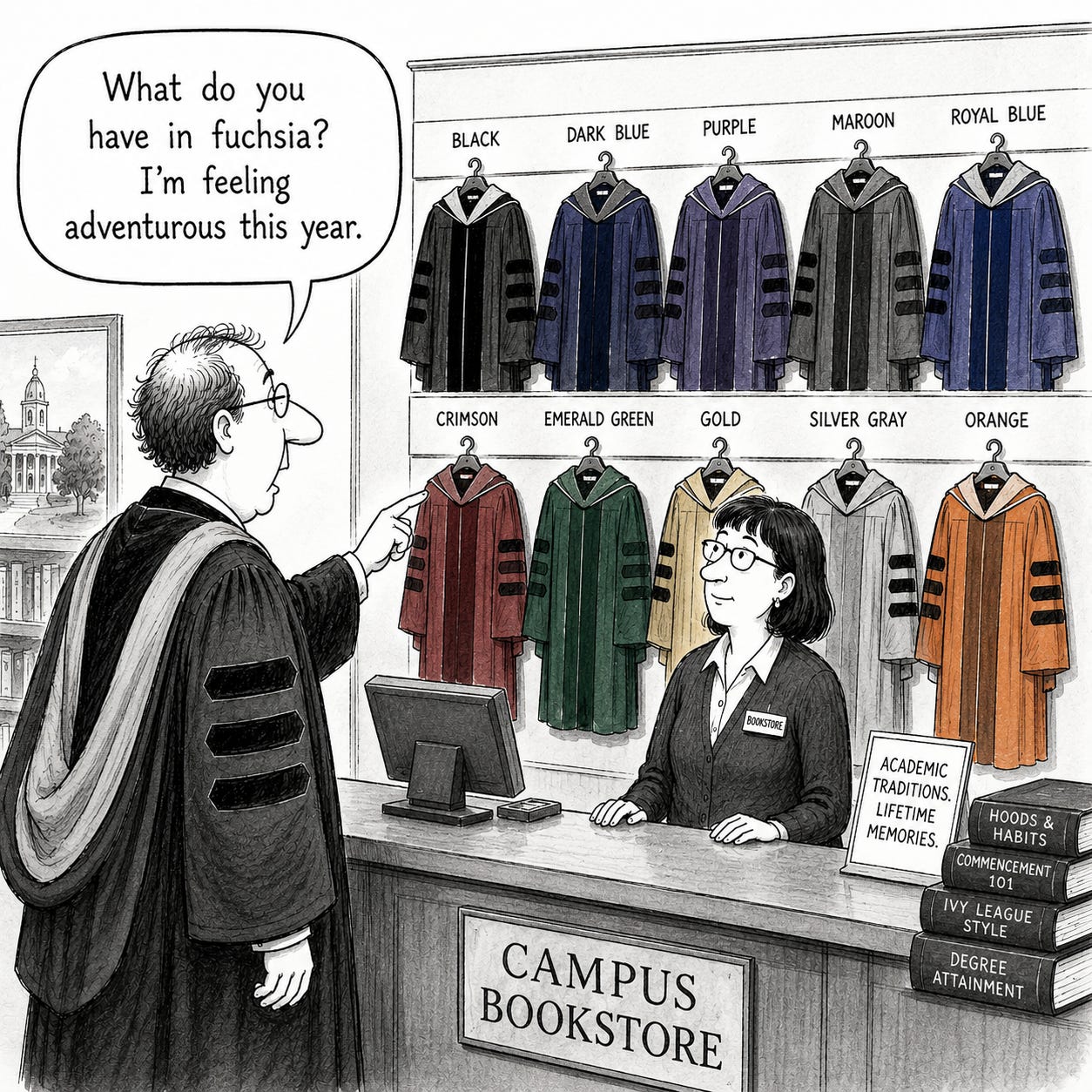
Every May, the same thing happens: commencement is next week and I don’t have a gown.
Doctoral regalia costs $1,500.
For what, exactly? Custom robe, velvet panels, sleeve bars, a hood with satin lining in your school’s colors — the full medieval cosplay package. But still, it’s a ripoff. You have to order it through a single vendor your university picked for you. There’s no alternative, there’s no shopping around.
I never bought mine. My university offered to cover it as part of the hire package. I didn’t bother taking them up on it because it felt like a waste of student money for something I might not use enough to justify the cost. That was so many years ago that the rental fees since then have almost certainly cost more than the gown would have. The vendor gets paid either way.
So I check whatever the bookstore has available last minute that’s in my size and cosplay a different discipline. Commencement is basically my Halloween. What am I going to dress up as this year? A business professor? Law professor? History? I think I’ve worn my actual degree’s hood colors exactly once. This year I was tempted to grab the Doctor of Engineering gown because the orange looks cool, but it felt like stolen valor — that’s not a degree I’m earning in this lifetime. Even my trolling has limits.
I also always decline the hat — the “tam” — it looks ridiculously pretentious and it’s one more thing to lose. The whole setup is worth more than a MacBook, so I need to be sure I return it all in one piece.
I will confess I do like the Pomp and Circumstance music. It makes me misty-eyed and takes me back to my own graduations with my proud parents watching. And I love seeing the students — there’s a palpable elation, like they made it, they completed the journey. It’s like watching a team you’ve followed for years finally win the championship. Bumping into students before or after the ceremony and having them thank me on their big day, that’s everything. Makes sitting through four hours of names being called worth it.
But the gown? Nobody ever notices what discipline I’m wearing. The regalia is pure theater, but it’s theater that extracts real money.
The $1,500 Costume
A doctoral gown isn’t the cheap polyester number undergrads wear. It’s a tailored robe with velvet trim, specialty degree colors, and fabric supposedly built to last decades. A quality set runs $700 to $1,500, depending on whether you want the Bristol (entry-level), the Sussex (mid-tier), or the Windsor (the premium line). Add the Herff Jones or Jostens near-monopoly pricing — both are billion-dollar-a-year companies — and the emotional surcharge (once in a lifetime, they tell you), while swiping your card.
Even undergrads aren’t spared. A basic gown in your school’s colors, no frills, no fancy hat or scarf or cape, made overseas, can cost $100-plus for something that should be $20 max. Worn once and never touched again. For some students, buying a cap and gown means not buying food for two weeks.
But wait. The brochure proudly notes that the trademarked ‘EarthGrad™’ fabric rescues 74 plastic bottles from a landfill. So yeah, it’s totally worth it — even though the vendor is charging a 500% markup to drape your students in literal garbage while calling it a sustainability initiative. Apropos, given the absolute landfill of financial despair many of them are stepping into.
The Ecosystem
The gown is just the most visible piece. Higher ed runs on a parallel economy of third-party vendors who monetize every stage of student life behind institutional branding.
Textbook publishers sell access codes that expire after one semester, killing the used-book market. Proctoring software companies charge per-exam fees so students can be watched through their own webcams. Parking gets outsourced to contractors. Meal plans have markups that would embarrass an airport Cinnabon.
It’s not just students getting squeezed — departments burn money on this stuff too. Take Scantron: we don’t even use them anymore, but we have a stockpile sitting in a cabinet — exam sheets we paid a premium for that became a complete waste of money. A department secretary told me what those things cost at institutional rates. It’s criminal.
People love to mock the government for paying $600 for a toilet seat 40 years ago, which is, like, $1,700 in today’s money. Academia has the same problem, it’s just lesser known. Approved vendors, captive budgets, nobody in the room whose job it is to ask if the price makes sense.
A standard desk chair that costs $60 at IKEA becomes a $754 “ergonomic educational seating solution” once it goes through an approved procurement vendor. I didn’t realize this until we were renovating a classroom recently and I saw the invoice. Some of that is defensible: ADA specs, fire codes, durability. But departments aren’t spending their own money, procurement rules favor approved vendors over cheap ones, and universities don’t comparison shop.
Now that I’m department chair, I constantly get calls and emails from vendors trying to sell me something. If I don’t respond to the first email, they hound me. “Just following up on this,” they write, as if they’re a dean contacting me about an urgent administrative crisis. These vultures will even try to enlist me for sales leads. “Do you know someone else who might need this? Do you have their contact info?”
Nobody’s Watching
Most people inside the system don’t think about any of this. Faculty are insulated from the costs. All those administrators schools have hired over the past two decades? They just check the approved vendor list and follow the procurement policy like bots. The one thing students notice is the textbook — ask any professor how many of theirs actually buy it. But the rest of the vendor economy hums along in the background because the people paying the fees have the least power to change anything.
Higher ed is starting to look like an airport or a ballgame. The expensive ticket just gets you through the gate. Everything else — the food, the parking, the merchandise you can’t buy anywhere else — bleeds you once you’re inside.
The gown is a perfect symbol of the whole thing. You already paid to earn the degree. Now pay again for the costume, from the one company we’ll allow, by the deadline we set.
Tradition is a hell of a business model.
More dispatches from the campus that’s lost the plot: subscribe below.
I love reading your articles. They remind me why getting out of academic medicine 30 years ago was the best decision I ever made.
Professor what you describe is a closed economy, you got taxpayers dollars, student dollars, and alumni dollars and prices will rise to meet the available funds. Leave no dollar unused. 💰💲💰
But if you think your gowns are expensive you should see what The Church and its suppliers charge my brother, who is a priest, for his vestments…