


FacultyLeaks.com is an anonymous dispatch from inside higher education. Some identifying details have been changed. The dysfunction has not.
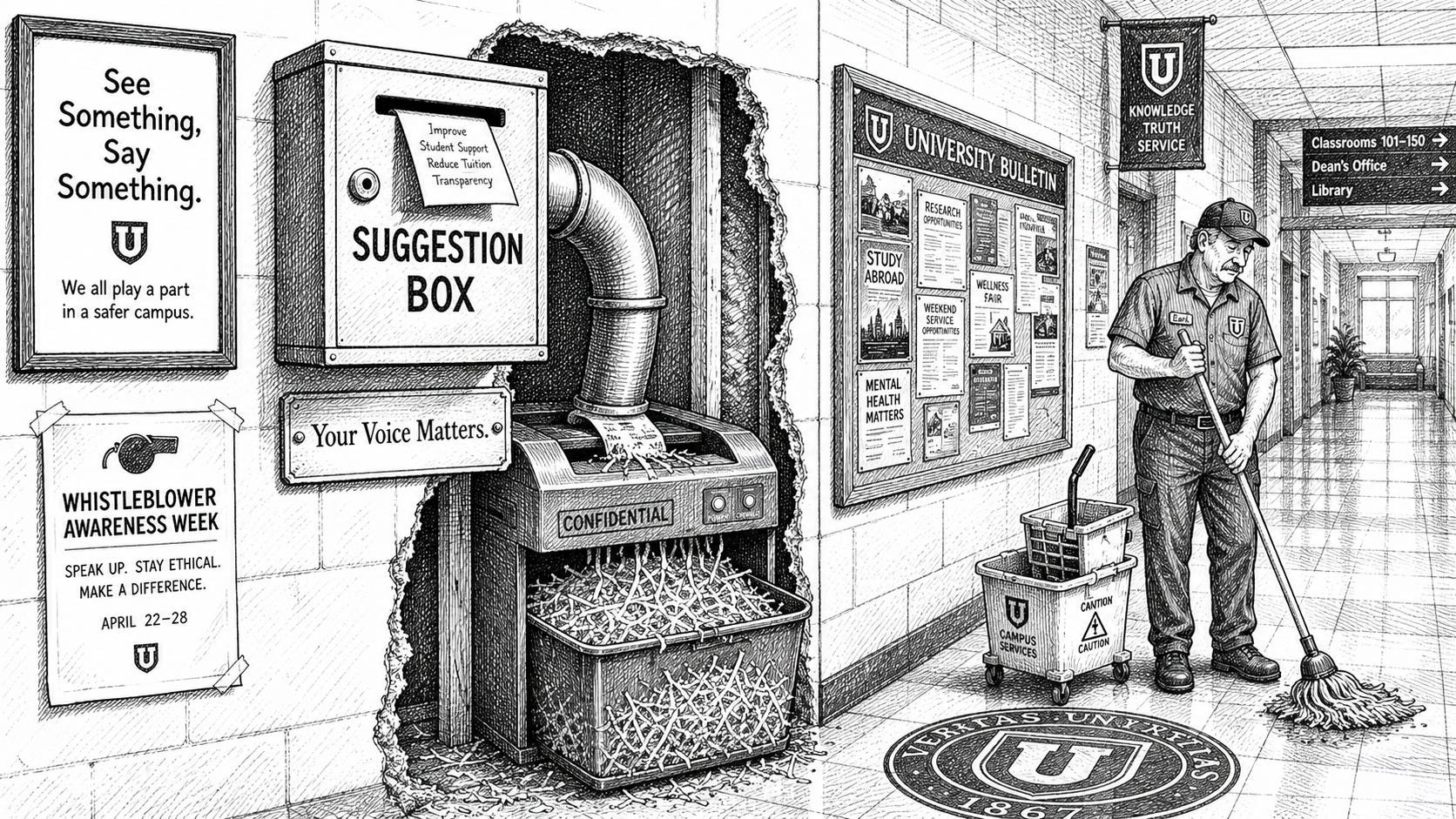
Martin Hackworth, a retired Idaho State University faculty member and Substack writer, recently published a piece arguing that FacultyLeaks.com is part of the very problem it aims to expose. His argument is straightforward: tenure exists to protect speech. Use it. Put your name on it. Stop hiding.
It’s a fair critique. It deserves a serious answer. And Hackworth is not alone in making it. Some version of this challenge shows up in the comments to almost every essay published here: Provide names, tell us which school.
I recognize that my anonymity has costs. Readers should be skeptical of any anonymous source. They should demand evidence over assertion. They should wonder about motive. That’s not a flaw in the audience. That’s the audience doing its job. The burden falls on the anonymous writer to earn trust the hard way — through documentation, through specificity, through being right over and over again until the pattern speaks louder than a byline.
For what it’s worth, I share the skepticism. When I see a news article that relies on anonymous sources (and often for something that doesn’t really merit anonymity) my first instinct is to discount it. Readers should bring that same instinct here.
I accept that burden.
But Hackworth’s critique rests on an assumption that should be stated plainly, because it is wrong: that the person behind this Substack has not spoken up.
I have.
I have raised these issues internally, through every channel that exists. Multiple times. Over the span of years. I have the receipts. So do those who can do something about it.
The question is not whether I have spoken up. The question is whether they will act.
Hackworth imagines a simple calculus: risk the chair position, hire a lawyer, enforce tenure, be a grizzly. It’s a good story. He lived it, at real personal cost, and he’s earned the right to tell it. But it is his story. It is not everyone’s story. The assumption that the only thing standing between an anonymous writer and a byline is a shortage of nerve is the kind of thing that sounds right but isn’t.
There are situations — legal, institutional, professional — where identification does not merely create inconvenience. It ends the work. Not because the writer is fired, but because the writing becomes impossible. Every sentence becomes a grievance filing, every observation a conflict of interest, every documented failure a personnel matter that someone will claim cannot be discussed publicly. The institution does not need to destroy you. It just needs to make the conversation about you instead of about what you wrote.
That is not a hypothetical. Anyone who has worked in a university for more than 15 minutes knows exactly how this operates.
Hackworth describes spending decades writing under his own name, making just over $40,000 a year as a senior lecturer, and watching colleague after colleague refuse to follow his example. He draws the lesson that people should be braver. Maybe. But there is another lesson in that data, and it is the one his colleagues actually learned: the system often punishes exactly what he is advocating. He is proof of his own counterargument.
He compares this Substack to Miles Taylor, the anonymous Trump administration official whose credibility took a beating once his identity was revealed — not because he was anonymous, but because he had denied being “Anonymous,” and because a DHS deputy chief of staff, later chief of staff, turned out to be a less dramatic figure than the cabinet-level insider many readers had imagined. Taylor’s problem was not anonymity. Taylor’s problem was that the reveal was smaller than the mystery.
Faculty Leaks is built on documents. On institutional policies. On hiring data, governance structures, and accreditation standards. Some identifying details have been changed — that is done for anonymity, and readers should weigh it accordingly. But the patterns are real. The dysfunction is real. And the evidence exists whether or not you know who is writing about it.
Will identification come eventually? Maybe. Anonymity gets harder to maintain the longer you do this. It’s possible some people have already figured out who I am. But they’re not the doxxing type — and I haven’t committed any crime. The goal of this Substack is not to remain anonymous forever. The goal is to remain honest for as long as possible. And right now, those two things are the same.
To the readers who remain skeptical: good. Stay skeptical. Read critically. Demand evidence. That is the appropriate relationship between an audience and an anonymous source.
To Hackworth: the critique is reasonable. The assumption behind it is not.
And to the people at federal government enforcement agencies who have heard my concerns directly:
I am still waiting for you to do your job. It’s been almost 500 days.
More dispatches from the campus that’s lost the plot: subscribe below.
I agree with facultyleaks on the fact that not everyone is facing the same situation. I also tried hard to escalate concerns internally, to point out discrimination and wrongdoings sometimes even by the same decison makers. I write about those in a generic manner in linkedin and was threatened by my director to tone down or else. I recently left the college and the field for a part time role. I am still not able to put out all the happenings. Maybe I am a coward? Maybe not, given my family situation. It is difficult to believe anonymous sources like FL but I can totally understand what the reason is. Whats the way we can convince people like Martin? No idea. Hopefully the believers here can think up something!
You made a great point that martins existence is good evidence against his specific point. I do agree with him, too, in encouraging people to come forward in public: i Did just that and in a very big way (https://raddante.substack.com/p/keynote-address-to-florida-techs?utm_source=share&utm_medium=android&r=1cugaa) but to my knowledge he hadnt provided any tangible or intangible support to it when it certainly couls use it. That too, undermines his credibility if he is advocating for stripping anonymity but then isnt found to be supporting that when it occurs at national levels.
His era was also substantively different, which ebdercuts the ability for him to compare present day faculty writing under their full name to his era of pen names: that is, coming forward in modern era of social media and internet reach & permancey requires a whole other level.of cahones due to issues of trolls, peanut galleries, virality, etc.
Spending a whole career as an untenured senior lecturer is also hardly encourageabke and argues against his point, too. Its akin to a ship never leaving port, scared of the seas, while writing to critique how other captains choose to navigate the seas. Its a different, paradoxical kind of cowardice, sort ofnthe mirror image of the kind that can sometimes drive staying anonymous in authorship. I can say that, because ive come fully forward, several times, in major ways, paying major costs, and still very in the midst of. But he is not grasping the strategic value is not jumping on every grenade that you come upon, while demanding that people do just that because he saw it in a movie. It falls short, even while raising some good reminders, and in so doing provides a whole other kind of reminder.