


FacultyLeaks.com is an anonymous dispatch from inside higher education. Some identifying details have been changed. The dysfunction has not.
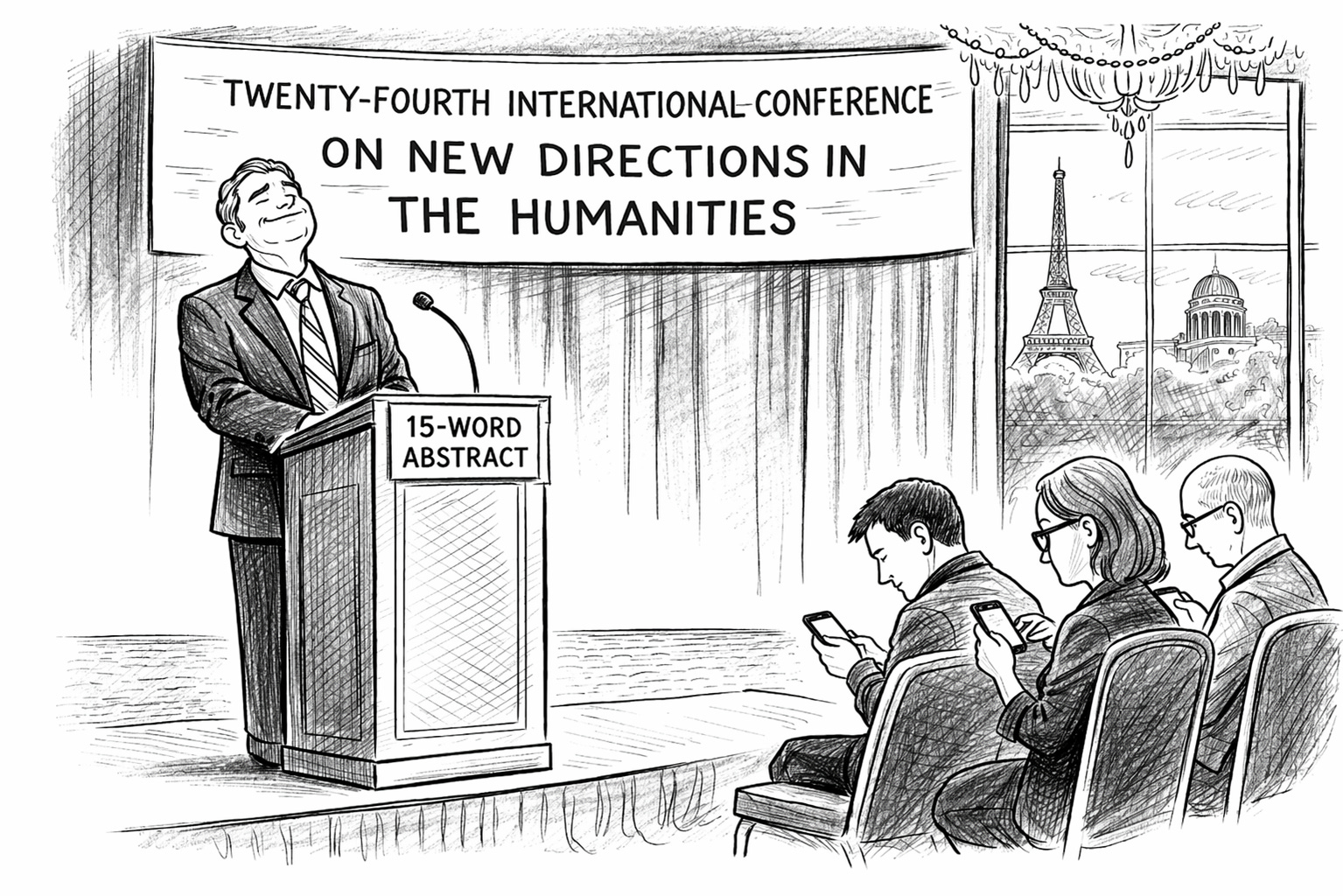
The email arrives on a Tuesday, or a Thursday, or a random Wednesday in March. Then it arrives again. A reminder. Then another reminder. The deadline has been extended. There is still time.
A conference. International. Prestigious-sounding. The subject line mentions climate change, or diversity, or new directions in the humanities — something broad enough that almost any paper fits. The location is Rhodes, Greece. Or Lisbon. Or Copenhagen. Or Osaka. The submission deadline is six weeks out. All you need is a title and a short abstract. You don’t even need a finished paper yet. A couple sentences will suffice.
You’ve been meaning to get to Lisbon anyway.
Here’s what most people outside academia don’t know: in my experience, a significant portion of the “international conferences” that appear on faculty CVs are not what they appear to be. They are not rigorous peer gatherings where scholars pressure-test ideas and elevate their work. Many of them are, in my view, destination travel businesses dressed up in academic language — organizations that charge hundreds of dollars in registration fees, appear to accept a very high percentage of submissions (in my experience), convene briefly in desirable cities, and send participants home with a line on their CV that says “presented internationally.” The attached journals, in many cases, publish almost as freely as the conferences accept. Nobody audits any of it. Universities pay for all of it.
Predatory journals have been well documented for years — Beall’s List, library guides, warnings in academic forums. The conference equivalent has received far less attention — which is part of what makes it so lucrative.
A researcher who studies the phenomenon told the Times Higher Education that predatory conferences now outnumber legitimate ones put on by scholarly societies — and that scholars “seem to spend more time considering the timing and location of a conference than doing basic research into the organisation behind it.” The demand is real. The supply has risen to meet it A major report by the InterAcademies Partnership, a global network of national science academies, found that predatory conference practices are a serious and growing problem, but naming specific operators has proven harder than cataloguing predatory journals. Academic forums have been warning about Common Ground specifically for years, but no central authority has stepped in. This version of the grift comes with a university-funded flight and hotel room in some exotic location.
I know because I’ve been there. Literally. Prague was beautiful.
What a Real Conference Looks Like
Before we go further, let me be precise about what I’m not saying.
There are genuinely valuable academic conferences. I’ve been to those too. A regional conference I attended early in my career charged around $50 — which included membership in the organization and access to its publications for a year. It was held in the kind of city that does not appear on anyone’s travel bucket list. Toledo. Birmingham. Harrisburg. The sort of mid-sized American city with a perfectly adequate convention hotel and no particular reason to extend your stay. My university covered the registration fee and meals. I presented a paper that wasn’t quite ready. The conference chair had written out detailed, handwritten feedback on my paper — not a form letter, not a generic “interesting work,” but specific, pointed observations about my argument and methodology. I went home and rewrote the paper substantially. It was eventually published in a peer-reviewed journal that people actually read and it’s been cited many times in other academic research and even mainstream news stories.
I’ve also attended a faculty development conference that didn’t charge me anything. They paid for my travel. Not a stipend — actual reimbursement, flights and hotel, in exchange for my participation. The conversations were substantive. The people I met became collaborators. One of them co-authored a textbook with me that is still in print.
These conferences exist. They tend to share a few characteristics: they are run by scholarly organizations rather than businesses, they require completed papers rather than a title and short abstract, they have genuine submission deadlines because actual peer review takes time, and they are cheap or free because their goal is advancing scholarship rather than generating revenue.
Not all conferences outside this tier are outright fraudulent — some are simply low-value, which is its own problem. But the model I’m describing has a specific logic.
The conferences I’m about to describe are something else entirely.
Common Ground and the Destination Conference Industry
Go to cgnetworks.org and look at their conference calendar. Take a minute. I’ll wait.
Rhodes. Athens. Lisbon. Copenhagen. Singapore. Osaka. Antalya. Perth. Paris. Split, Croatia. Galway. Hong Kong.
Now look at the conference names: “New Directions in the Humanities.” “The Arts in Society.” “Global Studies.” “Sport & Society.” “Technology, Knowledge and Society.” “Tourism & Leisure Studies.” “Interdisciplinary Social Sciences.” “Religion & Spirituality in Society.” “Health, Wellness & Society.” They are broad enough to accommodate virtually any paper in any field. That is not an accident.
Common Ground Research Networks is one of the largest operators in what I’ll call the destination conference industry. They announce conferences years in advance — not months, years — and accept submissions until weeks before the event. Sit with that for a moment. Legitimate conferences close submissions early because peer review takes time. When an organization appears to be accepting papers until a couple weeks before the conference begins, it is difficult to see how meaningful peer review could be happening on that timeline. What there is, as best I can tell, is a rented conference room in Rhodes, 24 other presenters who also needed a CV line, and a registration fee of $500 or more that your university is going to pay.
This is not a hypothetical. As of this writing, Common Ground is accepting submissions for a climate change conference in Rhodes, Greece, beginning April 20th. The late submission deadline is April 13th — seven days before the conference opens. Someone reading this could submit a 50-word abstract this afternoon, receive an acceptance by Thursday, book flights and be standing on a Greek island in two weeks, all on their university’s dime. The submission deadline, for all practical purposes, is whenever you decide to go. That is not how peer review works. That is how vacation planning works. And this operation has been running for over 40 years, funded in part by the U.S. Department of Education and the Bill and Melinda Gates Foundation.
This is not a fringe observation. On Reddit’s AskAcademia forum, a thread flagging Common Ground as potentially problematic has been circulating for seven years. A post in a Facebook group for academics described Common Ground as “the ultimate predatory conference and proceedings generator” after receiving a solicitation email. One attendee, recounting a conference in Vancouver, noted that he found some fellow presenters so unwelcoming that he skipped the organized city tour and went for pancakes instead. He did not seem to regret this. A PhD student who attended a Common Ground communication conference described it afterward on Reddit as “super small and disorganized” with little to show for the experience.
Perhaps most tellingly, the Chief Social Scientist of Common Ground Research Networks — the person who signs the solicitation emails — has accumulated, after nearly 20 years of publishing, 76 lifetime citations. This is the organization determining whether your conference presentation is accepted.
An academic in the Reddit thread summarized the general rule neatly: “If they email you, they’re a scam.” Another noted that the broad, unrelated subject areas — climate change, e-learning, religion and spirituality, tourism and leisure, all under one organizational roof (as is the case with Common Ground) — is a reliable red flag. Genuine scholarly organizations develop expertise in a field. Organizations that will host conferences across unrelated fields begin to look less like disciplinary bodies and more like service providers.
The warnings have been out there for years. A successor to Beall’s List — the anonymous site that kept the index alive after Beall himself was forced offline — added Common Ground Research Networks in March 2019. Two months later, without explanation, they were removed. The list’s changelog records the addition and removal but offers no reason for either.
The lack of explanation is less mysterious when you understand how Beall’s List actually ended. Jeffrey Beall, the academic librarian who created and maintained the list, explained that he shut down the entire blog in 2017 — not because his work was wrong, but because he was facing intense pressure from his own university and feared for his job. Publishers had learned to fight back by targeting the institution rather than the argument: sending orchestrated email campaigns to university chancellors and administrators, making false accusations, and simply being as relentless as possible until someone in a position of authority told Beall to stop. The heckler’s veto, applied to academic watchdogging. By 2019, when Common Ground briefly appeared and then disappeared, the person making those calls was an anonymous postdoctoral researcher somewhere in Europe — someone who won’t even reveal their name, for exactly the reasons Beall described.
Despite the warnings, the organization is still running conferences in Osaka and Split and Galway and charging up to $595 a head. Nobody in any position of authority has done anything about it, as far as I can tell, because nobody in any position of authority is paying close enough attention.
From what I and colleagues have experienced, sessions are sparsely attended. Almost all of the audience is also presenting. The feedback, if any comes, is polite and generic. You collect your certificate of participation, snap a photo in front of the Acropolis or the Eiffel Tower or whatever landmark the city offers, and fly home.
The website photographs tell a different story than the one I’ve experienced. Packed rooms. Engaged audiences. Scholars leaning forward in animated discussion at prestigious university venues. In practice, the sessions I and colleagues have attended looked rather different — a handful of people, half of them waiting to present next, the other half checking their phones while someone reads directly from their slides. The photos are aspirational. The reality is a Saturday afternoon in a conference room that was rented to the highest bidder.
To be fair, most of these conferences are held at universities rather than hotels, which adds another layer of apparent legitimacy. Genuine institutions whose names appear on the conference program and, subsequently, on faculty CVs. What that affiliation actually means, in many cases, is that someone paid the facilities rental fee. Universities routinely rent their conference spaces to outside organizations as a revenue stream, with no vetting of the event’s scholarly merit.
On your annual faculty activity report, this becomes: “Presented at the Twenty-Fourth International Conference on New Directions in the Humanities, NOVA School of Social Sciences and Humanities, Lisbon, Portugal.”
It sounds impressive. It means almost nothing. Many faculty don’t list Common Ground Research Networks anywhere on their CV at all — they list the university venue instead. The conference organizer’s name disappears. What remains is The Sorbonne. St Andrews. The University of Hong Kong. The building launders the credential.
Common Ground describes their conference format, with apparent sincerity, as “living knowledge ecosystems — spaces for shared inquiry and multiple ways of presenting research and creative work.” Participants engage in “Talking Circles” featuring “reciprocal listening and shared insight.” These Talking Circles, the website explains, are “rooted in Indigenous pedagogical traditions” and “honor multiple ways of knowing” while fostering “an ethics of exchange that challenges hierarchical modes of academic communication.” A climate change conference in Rhodes is, apparently, challenging hierarchical modes of academic communication. The website says so. The registration fee is $595.
There are also “Cultural Site Visits that highlight the local context of the host institution.” This is the Acropolis. This is the thing. It is listed as a conference format.
The most revealing detail is buried in the FAQ: you can participate entirely online, asynchronously, by uploading a video. No travel required. No live presentation. No room to stand in. You upload a file and people — theoretically — engage through discussion boards. The CV line is identical to the one you’d get standing in that rented conference room in Rhodes. Which raises an obvious question: if the scholarship is the point, why does anyone go in person at all?
The answer, of course, is Rhodes.
Common Ground also runs attached journals — publications where conference participants can publish their papers. The journals are indexed, which gives them a veneer of legitimacy. In my assessment, the peer review appears to operate on a similar model to the conference acceptance process.
Some journals in the network publish no acceptance rate data at all. The most telling omission is the Diversity in Organizations, Communities & Nations network. Its flagship journal, International Journal of Diversity in Organisations, Communities and Nations, vanished from Scopus in 2019, one of the main databases universities use to track legitimate academic journals. The only public explanation is the vague phrase “continuous curation.” The journal was discontinued that same year, and none of the replacement journals now publish acceptance rate data.
The journals that do publish their numbers tell a more complicated story — but not a more reassuring one. Across the Common Ground network, acceptance rates on their own pages range from 14% to 66%. Some journals post numbers that approach legitimate territory: 14%, 16%, 17%. Others are harder to explain away. Design Principles and Practices: An International Journal accepts 66% of submissions and publishes them in an average of 75 days — faster than many journals complete peer review alone. The International Journal of the Arts in Society accepts 58%. The International Journal of Sport and Society accepts 46%. Information, Medium, and Society: Journal of Publishing Studies — edited by the organization’s own official, the same person who runs the conferences — accepts 47%. For context, serious academic journals typically accept 5-10%.
As someone who has reviewed for serious journals, I can tell you what those numbers mean in practice. Any journal receives a significant portion of submissions that are immediately unpublishable — poorly structured, riddled with typos, submitted to the wrong field entirely, failing to follow basic submission guidelines, citing Wikipedia as a scholarly source, or simply without a discernible argument. A legitimate journal rejects those on arrival, which is part of why acceptance rates stay low. A 58% or 66% rate suggests a journal publishing essentially everything that clears a minimal bar of coherence. Not good scholarship. Just passable. (For context: I once worked at an institution with a 73% acceptance rate for graduate admissions. The only applicants who didn't get in were the ones who failed to complete their applications. That is the company a 66% acceptance rate keeps.)
The wide range is itself part of the story. A network that produces both 14% and 66% acceptance rates under the same roof, the same brand, and the same conference infrastructure does not appear to operate as a single coherent scholarly system. It is running a portfolio. Some journals are aimed at scholars who need real credentials. Some journals function in ways that may appeal to scholars just seeking a CV line. The conference system does not appear to distinguish between them in practice, and annual faculty activity reports often do not either.
To be fair: Common Ground has real institutional affiliations and claims to follow standard publishing ethics guidelines. None of it explains acceptance rates reaching 66%, a flagship journal that disappeared from Scopus, a two-month appearance on the successor to Beall’s List, and an organizational structure in which the person running the conferences also edits a journal that publishes his own work. That person is worth examining more closely.
The editor of that journal is the organization’s own Chief Social Scientist — the same person who signs the solicitation emails inviting institutions to host Common Ground conferences. He runs the conferences. He edits the journal that publishes the conference papers. According to his Google Scholar profile, he has published four times since 2017, with nothing after 2023. Three of those four publications are in the specific journal he personally edits — and two of those three are introductions to journal issues, the brief editorial notes that appear at the front of a volume rather than peer-reviewed research contributions. The fourth publication, the only one to appear in an independent journal, is titled “Good and Bad Actors in Digital Space.” He is, in the most literal sense, filling the pages of his own journal with his own work — including work that isn't really research at all. The one time he published elsewhere, he wrote about digital ethics. Make of that what you will
There is one more detail worth highlighting. Common Ground Research Networks was founded in 1984 — over 40 years ago — by his parents. According to their own website, it began in a converted horse stable behind the founders’ home, where a small printing press became the heart of what they called “a new kind of educational publishing.” It has since grown into an international conference empire running events on six continents, charging hundreds of dollars per registration. It has since grown into an international conference empire running events on six continents, charging hundreds of dollars per registration. In 2016, their son took over leadership. This model has been running continuously for over 40 years. It did not slip through any cracks. It has been in plain sight the entire time.
Common Ground describes itself as an Illinois not-for-profit corporation. That is a state-law corporate status. In the materials I reviewed on its website, I did not see any specific statement about federal IRS tax-exempt recognition. The organization was not always a not-for-profit of any kind — it operated as a for-profit business for over three decades before the son converted it when he took over in 2016. Not-for-profit status means profits cannot be distributed to shareholders. It says nothing about salaries, travel budgets, or conference expenses. The organization hosts dozens of conferences a year in desirable cities around the world. Someone is going to those cities. Not-for-profit is a tax classification. It is not a character reference.

The organization explicitly states it offers no financial aid or travel grants to attendees. The not-for-profit dedicated to advancing human knowledge will not help you get there. It will, however, accept your $595 registration fee once you do.
The organization’s CGScholar platform was developed with funding from the U.S. Department of Education and the Bill and Melinda Gates Foundation. Your tax dollars and some of the most prominent philanthropic capital in American education helped build the infrastructure for an organization that many academics consider questionable.
The organization’s own platform description is perhaps the most candid thing on the website: it describes itself as “a trusted marketplace for knowledge work” that “rewards participants.” A marketplace. That rewards participants. In a not-for-profit dedicated to the advancement of human knowledge. Over 40 years. Make of that what you will.
Host the conference, publish the papers, edit the journal, publish your own work in the journal you edit, inherit the organization from your parents, describe it all as a mission-driven knowledge ecosystem. It is an apparatus perfectly designed to generate the appearance of scholarship without requiring any of the substance.
Two Sentences Will Do
Here is the actual barrier to entry for many of these conferences: a title and an abstract. Not a paper. Not a draft. Not a literature review or a methodology section. A title and a text box. I recently looked at the submission form myself. The abstract field says “Summarize the purpose, methods, and implications of your research as a concise description.” There is no word minimum. You could type two sentences. You could type one. The field allows up to 5,000 characters, which suggests they are more worried about people writing too much than too little. You can write your entire submission in under a minute on your phone and be on a plane to Rhodes by Friday. You can recycle a paper you’ve already published by giving it a slightly different title. Some faculty do exactly this — the same paper, presented at three or four conferences over several years, each time listed as a distinct scholarly contribution on their CV. The conferences don’t know. The universities don’t check. There is also this: each co-presenter must register and pay separately. Two people presenting together means two full registration fees — at up to $595 each. The university pays for both. One presentation. Two CV lines. Two trips to Rhodes.
A graduate student on Reddit recently described submitting a single abstract and receiving acceptances from five different “international conferences” simultaneously. Five. The abstract had not been peer reviewed. It had not been evaluated for scholarly merit. It had been received, processed, and accepted by organizations that needed bodies in conference rooms in five different cities. The student was confused about which one was credible. The answer, unfortunately, was probably none of them.
I have also, more than once, been accepted to such conferences and then simply not gone. The acceptance email arrives, you mark it as something to deal with later, and later never quite comes. No follow-up from the conference. No concerned inquiry. I learned quickly not to pay the registration fee until I was certain I was actually going — because the conferences, it turns out, are not particularly invested in whether you show up, and they do not issue refunds. The system is not built around participation. It is built around processing.
And if coming up with a short abstract is too demanding, there is this: a food studies conference in the Caribbean — since apparently sustainable agriculture requires a tropical setting — whose submission form included, alongside the usual panels and workshops, an option to host a social reception. A happy hour. As your scholarly contribution — not a sponsor package, not a publisher’s networking event, but a listed mode of academic participation available to any registered attendee. The conference organizers had determined that standing around with a drink in hand counted as a mode of academic exchange. They are not entirely wrong. It is, at minimum, more honest than a Talking Circle.
I know how this system works because I used it.
Prague
I attended one of these conferences early in my career. It was in Prague. I was an assistant professor making a salary that did not go far, and Prague seemed like a reasonable consolation prize. I submitted my 50 words, got accepted — as everyone does — and the university paid for the flight and the hotel.
I should mention that it was a senior colleague who first pointed me toward these conferences when I was a new tenure-track professor. He had been assigned as my faculty mentor. He recommended Common Ground the way you’d recommend a good restaurant: enthusiastically, from experience, with full knowledge of what he was ordering. He had been working the destination conference circuit for years. The trips, the easy publications, the CV lines — he understood the system perfectly. He just didn’t mention that part when he mentioned Prague.
I was young and impressionable. He knew exactly what it was. That’s the difference between us.
The paper I presented was real work. I’m not going to pretend otherwise. There was no feedback. No questions. The sessions were politely attended and quickly forgotten. The conversations over dinner were more memorable — but then, so was the architecture.
I understood, even then, that I was gaming a system designed to be gamed. I told myself it was a victimless transaction. The university got a faculty member who came back with a CV line. I got Prague.
I’m not sure that reasoning holds up. The transaction was not victimless. It just took me a while to understand who was paying for it.
What the Price Tells You
Here is the simplest way to evaluate any academic conference: look at what it costs to attend.
Legitimate scholarly conferences are cheap or free because they are run by academic organizations whose purpose is advancing knowledge, not generating revenue. The registration fee covers logistics — the venue, the program, maybe a dinner. The goal is participation, not profit.
Destination conference businesses are expensive because they are businesses. The registration fee — sometimes $500 or more, not including flights or hotel, which the university pays separately — is the product. The certificate, the journal publication opportunity, the laurel graphic — these are the deliverables. Add it all up and a single destination conference can easily cost a university $2,000 to $3,000 per faculty member. The scholarship is incidental.
A regional conference that costs $50 and includes organizational membership is trying to build a scholarly community. A conference that costs $500 to attend and announces its dates two years in advance is trying to fill a conference room in a desirable city on someone else’s dime.
The difference is not the quality of the scholarship. It is who is making money.
The Taxonomy of the Full Grift
The destination conference is just the entry level. Once you understand how lightly audited academic travel is, the options expand.
The Ghost Attendee. Register for the conference, get reimbursed for travel, attend day one. Spend days two through four at the beach, or the museums, or visiting someone you’ve been meaning to see. No one takes attendance. The certificate says you were there for the full conference. The receipt says you were at the hotel. Nobody checks.
The Recycled Paper. Present the same research at multiple conferences, each time with a slightly different title and framing. “Media Literacy in the Digital Age” becomes “Digital Citizenship and Media Competencies” becomes “Information Literacy in Contemporary Society.” Three conference lines on the CV. One paper, or maybe just an abstract. Zero new ideas.
The Miles Hustle. Book your flights on personal miles or credit card points accumulated over years of university travel. Submit a receipt for the cash equivalent. Pocket the difference. This violates most university travel policies. It is also almost never caught, because the receipt looks right and no one is comparing it to your frequent flyer account.
The Falsified Receipt. The logical endpoint of a system with no real auditing. AI image generation tools can produce a convincing hotel or airline receipt in under a minute. A University of Connecticut professor was arrested in 2025 after allegedly disguising 19 personal trips — including three visits to Disney World — as academic research, submitting edited and photoshopped receipts totaling over $58,000. She wasn’t caught by any auditing mechanism. She was caught because someone filed an anonymous tip. I am not saying falsified receipts are common. I am saying that in an environment where receipts are submitted electronically, reviewed by administrators with no way to verify them, and never audited against actual booking records, the incentive structure is not exactly discouraging. The UConn case is the exception. The anonymous tip is what made it one.
Who’s Actually Paying for This
It’s worth pausing on where the money comes from.
Every dollar spent flying a professor to Rhodes for a conference that nobody serious attends is a dollar that came from somewhere. It came from tuition. It came from student loan debt that will take decades to repay. It came from families who were told that the price of a university education reflects the quality of the institution and the seriousness of its faculty. Some of it paid for a 50-word abstract and a photo in front of the Eiffel Tower. That’s not a metaphor. It’s a budget line.
I’ll add a dimension to this that I didn’t have as an assistant professor: I now sit on the other side of the desk. As a department chair, I see these funding requests come across my desk regularly. A faculty member submits a travel request for a conference in Bali, or Paris, or Rio de Janeiro. I recognize the organization immediately. I know what it is. And I approve it anyway — because the collective bargaining agreement gives faculty the right to request conference funding and gives me essentially no grounds to deny it on the basis of conference quality. The union negotiated that right. It is now, in practice, a contractual entitlement to spend tuition dollars on a junket to Rhodes.
Some faculty do three of these a year. Three conferences, three CV lines, three trips to cities they wanted to visit. Their annual activity report looks globally engaged. The scholarship produced is, in my assessment, essentially nil — and you can verify this yourself. Go back and check the CV a few years later. The paper presented at the international conference in Lisbon never became a journal article. Never became a book chapter. Never became anything. It just sits there on the CV as a permanent line item, generating no subsequent scholarship, citing nothing, cited by no one. Real conference presentations are the beginning of something. Destination conference presentations are the end of the road. The CV line is the excuse. The free vacation is the point.
The research that resulted from any given destination conference, in many cases, will never be read by anyone. This is not an argument against the humanities; some of it is genuinely valuable, and the people who produce it generally aren’t the ones presenting in a rented conference room in Rhodes. It is a specific critique of the scholarship that gets presented at destination conferences, which was not selected for quality. It was selected because someone needed a CV line and had a university travel budget. The destination conference system doesn’t produce bad research by accident. It selects for it. Serious scholars with serious work get invited to serious conferences. I suspect what fills the Common Ground calendar is often work that found its way there because the bar is low and the location is appealing — dressed up in the language of international collaboration and interdisciplinary dialogue.
Tuition has tripled in real terms over the past 40 years. Nobody can fully account for where all that money went. Some of it, at least, went to Rhodes.
The Film Festival Version
The same psychology operates in the arts.
A colleague of mine had accumulated an impressive-looking collection of film festival credentials: Award of Merit, Certificate of Merit, Special Jury Prize, from festivals in Jakarta, Madrid, Los Angeles, Warsaw.
What he did not advertise was that these came from what filmmakers bluntly call award mills. Organizations that function less like curators and more like vanity publishers. Submit a film, pay a fee — usually $30 to $60 — receive a laurel graphic suitable for posters and promotional materials. The “festival” may or may not involve actual screenings. The “jury” may or may not exist in any meaningful sense.
He listed these on his CV and annual faculty review reports as evidence of scholarly and creative achievement. Nobody looked closely enough to ask whether the “World Documentary Awards” in Jakarta was the kind of festival that screens films, or the kind that processes submission fees. Filmmaker communities and forums like FilmFreeway have long documented the existence of so-called award mills — festivals that collect submission fees and distribute hundreds of laurels with little or no actual curation. The deans and tenure committees evaluating his CV were not filmmakers. They had no way to distinguish a Sundance selection from a pay-to-play laurel mill in Jakarta. They saw “Award of Merit, International Film Festival” and counted it.
His films were largely unedited footage shot by students and assembled without apparent structure. The awards were essentially purchased. The reputation was highly embellished. The institution validated it for years because validating it was easier than examining it.
What Good Looks Like
The new faculty hire who replaced this colleague is doing it the right way. He’s submitting his documentary work to festivals with real acceptance rates. Sundance. Places that actually curate. The rejections come more often than the acceptances. He doesn’t seem bothered.
That’s what the system is supposed to look like. Rigorous, occasionally humbling, worth the effort.
The destination conference industry exists because we built an incentive structure that doesn’t reward distinguishing between real scholarly activity and the appearance of it. When the system can't tell the difference — and doesn’t try to — the grift fills the gap.
Fix the incentive structure — audit the travel, scrutinize the CV lines, ask what the acceptance rate was — and the market for 50-word abstracts in Rhodes dries up on its own.
Until then, the emails will keep arriving on a random Wednesday.
Prague is still beautiful, I’m told. But scholarly treats deserve better than a scenic backdrop.
More dispatches from the campus that’s lost the plot: subscribe below.
Even worse, and you alluded to this, is that some disciplines have such low standards that their faculty actually marvel at these Potemkin villages of academic discourse until, maybe, the bubble is burst during an awkward interview with a tenure committee.