


FacultyLeaks.com is an anonymous dispatch from inside higher education. Some identifying details have been changed. The dysfunction has not.
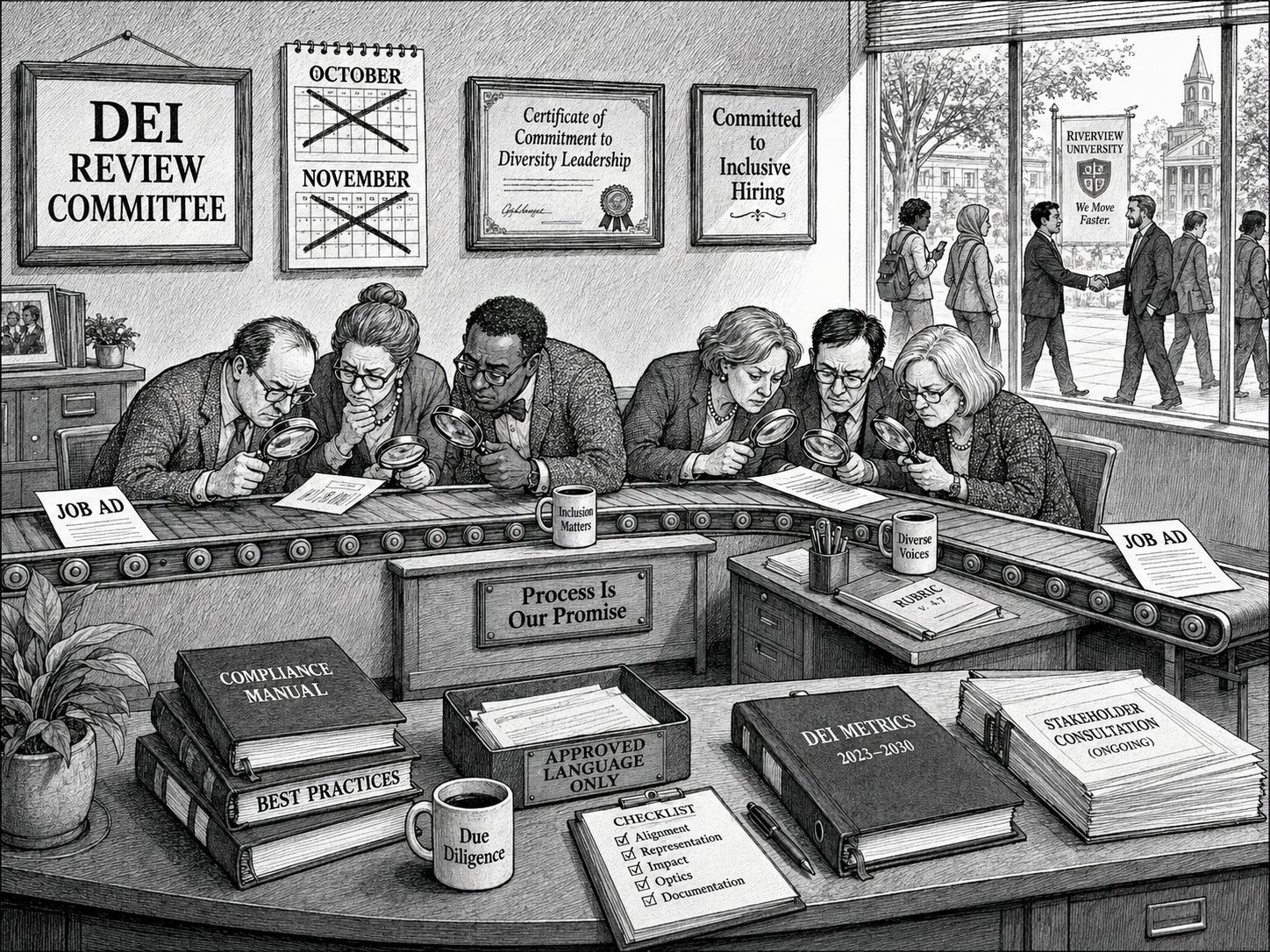
The DEI apparatus that’s a staple throughout higher ed isn’t just legally dubious. It’s also a layer of red tape that can undermine its own goals. A FacultyLeaks.com reader at a large public university recently shared with us an anecdote that illustrates this.
Their social science department needed to hire a professor. The job ad was ready to post. Under normal circumstances, it should have gone live within days.
It didn’t. First it had to clear a DEI review committee run by the college’s new Associate Dean for Diversity, Equity, and Inclusion, which took about two weeks. Then it went to a second DEI committee, this one created by a newly hired Vice Provost, for another two weeks.
What were they reviewing? Boilerplate stuff — the same equal-opportunity language that appears on every faculty job posting at the university, which had already been approved by legal, already approved by HR. Yet, it took two committees four weeks to rubber-stamp a form that should have been pro forma.
The Window
In this field, timing matters. While this department’s ad sat in a queue for a month, competitors were already scheduling interviews. Three or four strong candidates of color had accepted jobs elsewhere during the delay. The math was simple: a four-week holdup in a fast-moving job market means the best candidates are gone before you’re allowed to even evaluate their CV.
What remained, according to a committee member, was a pool of highly qualified white men and a handful of less-qualified white women — the stronger female candidates, like the candidates of color, were already gone. One went to an Ivy.
The Spreadsheet
So, the committee worked with what remained. Candidates were rated on a simple 1-2-3 scale: top, middle, bottom. The search chair rated most white male candidates as a 3: bottom tier, across the board. In most cases, she was the only committee member who scored them that low.
The rest of the committee saw qualified scholars. She saw the wrong people studying the wrong things — white men whose research didn’t touch on The Current Thing™. Those assessments were then shared with the full department.
The Pitch
When the faculty met to make a decision, she made her pitch: let the search fail. Hire nobody, repost the ad earlier next year, and hope for a more diverse pool. Better to lose a year than hire a white man.
Nobody argued the top candidate was unqualified. By several accounts, he already had a record strong enough for tenure. The question wasn’t whether he was good enough. It was whether he was the right color.
The department overruled her and hired him.
The Chain
But think about what just happened.
The university created two new DEI positions. Those administrators created two new committees. The committees delayed a time-sensitive search by a month. The delay cost them every diverse candidate in the pool. And when the remaining pool was too white, the search chair tried to kill the search entirely.
The machinery built to increase diversity made diversity less likely. When the machinery failed, a human tried to rig what was left.
A committee member reported the search chair’s conduct. Nothing happened.
The Incentive
The search chair wasn’t freelancing. She’d been told this position was earmarked for a candidate of color. She had institutional permission, maybe not a direct order, but something close, to deliver a demographic outcome. When the process made that impossible, she improvised.
The DEI committees were doing what they were created to do: review things. So they reviewed things. Nobody asked whether a month mattered.
This is how institutions eat themselves. You hire administrators to promote diversity. They create committees. The committees create delays. The delays eliminate the candidates you wanted. Then someone on the ground, under pressure to hit a demographic target, tries to fix it by rigging what’s left.
The machine sabotaged its own purpose. But, unlike many of our stories, this one has a happy ending.
The DEI committees have since been dissolved. The white guy who got hired? He’s doing fine.
More dispatches from the campus that’s lost the plot: subscribe below.
I have seen something like this happen over and over. We are a "research 1" land grant state university in a geographically undesirable location: smallish town, severe winters, flat ag landscape all around for 100s of miles. The land grant mission is all about serving the people of the state, so we are not selective with enrollment.
This means we are not an elite university, and typically not the first choice for hiring anyone greatly in demand--such as an accomplished and talented POC candidate, or even a really great white woman candidate. The best ones all get hoovered up by elite universities and/or universities in desirable locations (near the oceans, in places with mild climates, in or near large urban centers that feature cultural coolness, etc.)
And so we tend to get second-tier or third-tier POC candidates. But we have hired them over better-qualified/more capable non-POC candidates, because of the desperate need for "visible diversity". This process has a terrible unintended consequence, besides the obvious one of racial discrimination against non-POCs: because the POCs we hire are not top-tier scholars/teachers, they rarely stand out in their performance—and more often than non-POCs, they fail to thrive as scholars. Not because they are POC, but because they were not sufficiently qualified or capable as their fellow POC who got scooped up by the Ivies et al.
And then another odd effect that this race-conscious distortion of the hiring process gives us: Since nobody anywhere wants to hire white males because they are white males, but everybody wants to hire POC because they are POC (and as noted, we never get the best POC), our white males tend to be the strongest academics and best teachers. The problematic scholars/teachers tend to be everyone except the white males.
I'm sure students notice this sometimes, even if the institution would never acknowledge it. I think this disparate performance was not at all what DEI-obsessed universities had in mind.
The sorting process which engineered virtually only patrician men in the higher educational system took decades to half a century to fully lock-in because the cycle time is of change incredibly long, and the is virtually no restructuring. The educational shift for women - better attainment, more college-bound - realistically only started in the 70’s. We are at the final phases of that lock-in. For other candidates we are in a re-equilibration cycle, the steady state presence will be high then low then high gradually leveling off. It’s what you see when you disturb a dynamical system.
Once in the system the dynamics change because we are speaking to barriers to entry, not to persistence.
AI will radically change the system dynamics. The focus will change to more reason in disciplines, perhaps philosophy but strongly how you frame problems, and search for a solution since AI will vastly reduce cycle times for certain research which traditionally went to the worker bees in the educational food chain.
In industry the cycle time for jobs movement is around 2 years, and there is no tenure. In that, there is no academic year, no accumulation of good or bad over several years towards tenure. In 100 days you must create positive change or work products, within a year people want you in their department, and within 2 years you take on new responsibility. At that point either the company changes or you do.
Higher education rarely restructures the way companies do. For most of my adult life it was every 6 months.