


FacultyLeaks.com is an anonymous dispatch from inside higher education. Some identifying details have been changed. The dysfunction has not.
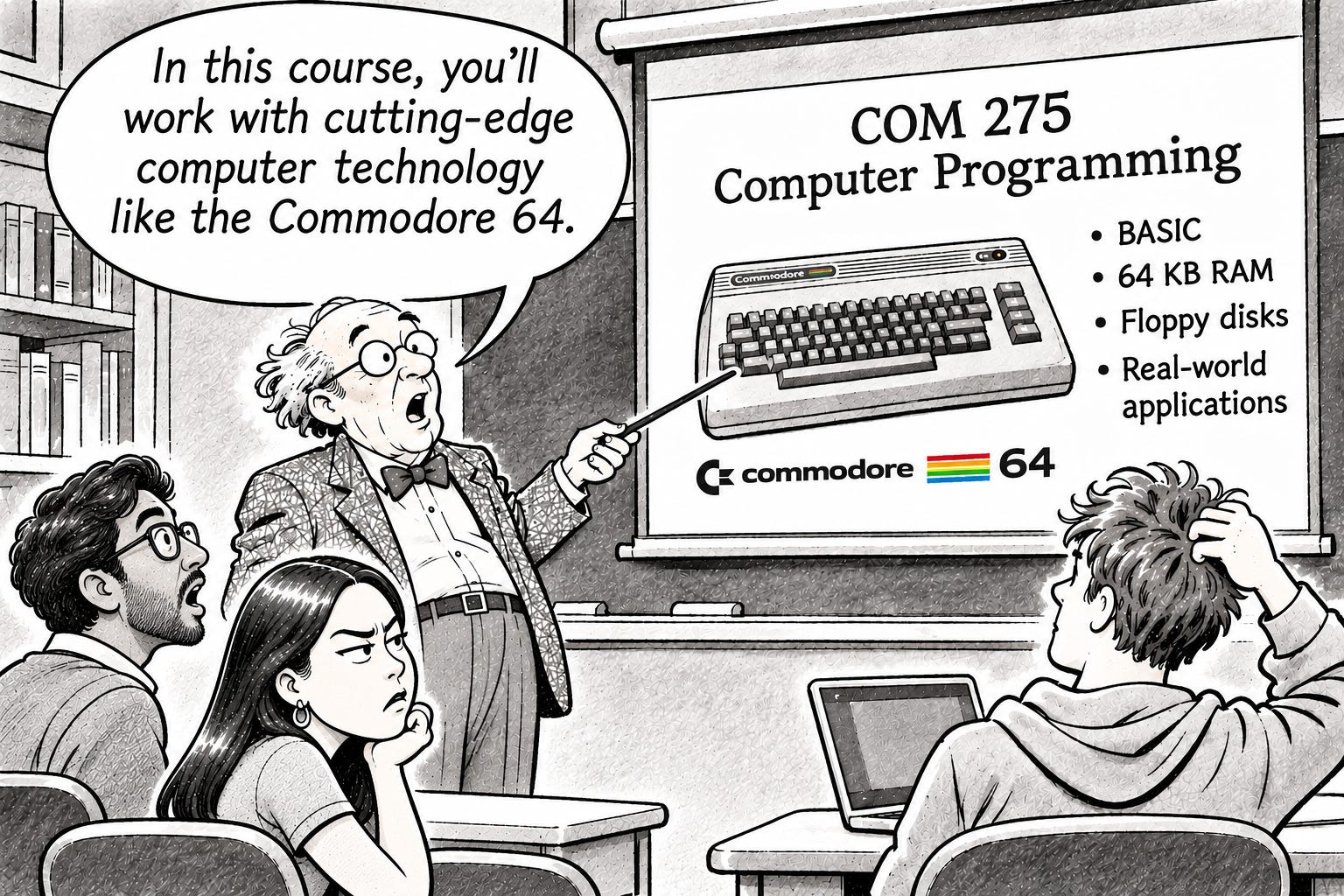
One of the first things I did when I became a department chair was review our course descriptions.
It was embarrassing.
Some descriptions referenced technology that had long since fallen out of everyday use. One course referenced “new” trends that hadn’t been a thing in over 20 years. Others barely resembled what students needed to learn.
I asked faculty to send me updated descriptions of their own courses. Many couldn’t be bothered to respond, even after multiple requests. I ended up drafting most of the revisions myself. Apparently, asking professors to explain what they teach was asking too much.
This isn’t just my experience. An article published by the Higher Education Leadership Learning Online Community acknowledged the same problem.
I also stopped offering some courses that had become antiquated and were struggling to attract students. One adjunct pushed back after their course in a dying field failed to meet minimum enrollment. They explained that they had already factored the anticipated teaching assignment into their personal budget.
I understand wanting the income. But students were counting on something, too: an education worth paying for. My obligation is to the students, not your paycheck.
In my experience, the faculty responsible for some of our most outdated descriptions often fell into two groups: those who had checked out, and those who had plenty of energy for political activism but little interest in keeping their courses current. Students deserved that same energy and attention.
A Curriculum Stuck in the Past
With the help of an AI research agent, I found plenty of other universities with the same problem. Some of this is happening at prestigious institutions where the annual cost of attendance approaches $100,000.
For example, Northwestern’s 2026–27 catalog describes a course called “Digital, Social and Mobile Marketing.” Students are supposed to develop marketing programs for actual companies using tools that include Google Plus. The problem: Google shut down the consumer platform in April 2019. Reaching customers there would be an impressive assignment.
At Carnegie Mellon, the Human-Computer Interaction Institute’s public description of “Social Web: Content, Communities, and Context” still opens with “the growth of online environments like MySpace, Second Life.” The page is undated, but it remains the university’s public description of the course. The last time MySpace was popular, current college freshmen weren’t even born yet.
And Shorter College’s 2024–25 catalog, on printed page 129, tells students to save homework “on a floppy disk or flash drive.” Well, at least there’s a choice.
Teaching the history of technology is legitimate. So is using older tools for specialized purposes. These descriptions deserve scrutiny because they promise contemporary preparation or present outdated facts as current.
Schools aren’t just out of the loop on technological developments, but also major geopolitical developments.
Occidental’s 2026–27 catalog describes a “European Politics” course covering the region through the “present day.” According to the description, the European Union still has 28 members, and Brexit appears among the challenges ahead. Meanwhile, Suffolk University Law School’s 2025–26 description of its “European Union” course also gives the organization 28 members. But British voters chose to leave the EU in 2016, and the country officially withdrew in January 2020. The news apparently hasn’t crossed the Atlantic.
The problem extends to health education, where outdated information carries considerably higher stakes.
The University of Arizona’s catalog entry for “Sex and AIDS in the 21st Century” begins, “As we enter the third decade of the HIV/AIDS epidemic there is still no cure.” The course remains relevant, but its description hasn’t kept up. The epidemic was first recognized in 1981, making that opening roughly 25 years out of date. And while there is still no widely available cure, advances in treatment have transformed HIV from a frequently fatal diagnosis into a manageable chronic condition for many patients.
The University of Utah School of Medicine’s 2026–27 catalog describes clinical psychiatry subinternships that teach diagnosis using DSM-IV criteria. The American Psychiatric Association published DSM-IV in 1994 and replaced it in 2013. One published description concerns an adult psychiatry subinternship at the Huntsman Mental Health Institute; another concerns a Veterans Affairs medical center.
The University of Pittsburgh School of Medicine’s 2026–27 catalog is similarly behind. Its “Psychiatric Assessment” course promises to teach students to formulate diagnoses using the DSM-IV multiaxial system, which was eliminated in 2013.
And Indiana University Southeast’s 2025–26 bulletin describes a medical coding certificate that emphasizes ICD-9-CM, a system replaced for covered U.S. healthcare transactions in 2015.
These aren’t courses on the history of medicine. They’re programs intended to prepare students for contemporary professional practice. Let’s hope the actual instruction is more current than the descriptions. But if professors actually teach something different, why doesn’t the official description say so?
Unfortunately, there’s reason to suspect that some courses are just as outdated as their descriptions. Outdated course descriptions are often just the tip of the iceberg. Look at the syllabi, assigned readings and course materials, and you’ll find an even bigger problem. I’ve reviewed courses that relied on ancient textbooks, ignored major developments in their fields or recycled assignments that hadn’t kept pace with the real world.
There’s nothing wrong with teaching foundational material. But some courses treat information from 10 or 20 years ago as though nothing important has happened since. If universities can’t keep their course descriptions current, imagine what students are encountering in the classroom.
Who’s Responsible?
And it’s not just a pedagogical issue. Misleading course descriptions can also have legal consequences. In Rynasko v. New York University, a federal appeals court recognized that specific promises in university publications could support a breach-of-contract claim. Some states also impose specific requirements. Texas law requires public universities to post detailed course syllabi, update the information when it changes and designate an administrator responsible for compliance. Florida regulations require public universities to publish current syllabi at least 45 days before classes begin.
But beyond the legal requirements, there’s a basic ethical obligation to students. A university selling career preparation should be able to explain how its courses prepare students for work that actually exists. Students commit years of their lives and substantial money to these programs. Many borrow huge sums to do it. They deserve faculty who keep up with their fields, chairs who review what their departments offer, and administrators who make sure the institution delivers what it advertises. Universities expect students to read requirements carefully and faculty to follow approved curricula. In return, universities have a responsibility to ensure those documents are accurate and up to date.
I don’t expect every professor to chase every new app or trend. I do expect someone to notice when a platform in an official course description has shut down, a political event has already happened or a sentence has been announcing the same new decade for 25 years.
Before asking students to invest in their future, universities should check which year they’re preparing them for.
More dispatches from the campus that’s lost the plot: subscribe below.
I am the point person in my department for curriculum matters. I don't want to dispute the fact that a lot of professors check out or let activism crowd out scholarship; that happens. But let me offer this counterpoint. At my institution, the process for revising a course description has become so bogged down in bureaucratic paperwork and activist meddling ("oh, the new syllabus for the course on maximum likelihood estimation etc. - does not have a land acknowledgment or consider the ethics of non-parametric estimation as a counterpoint!) that my colleagues and I often just give up. So, many of us simply teach our revised courses under standing special topics course numbers, and leave the old course descriptions to moulder on the university website. It's far from optimal, but when the university essentially taxes faculty in time and patience for updating their courses... well, then faculty will respond accordingly. This is the nature of large bureaucracies.
Simple, delete 20% of course descriptions every year for 5 years, then start over again. Updating course descriptions once every 5 years shouldn't be too much of a burden for professors. For those who refuse to provide updated descriptions, simply supply the default "NO COURSE DESCRIPTION AVAILABLE." That should tank course attendance, and even the most obstinate and irascible profs need students to teach.