


FacultyLeaks.com is an anonymous dispatch from inside higher education. Some identifying details have been changed. The dysfunction has not.
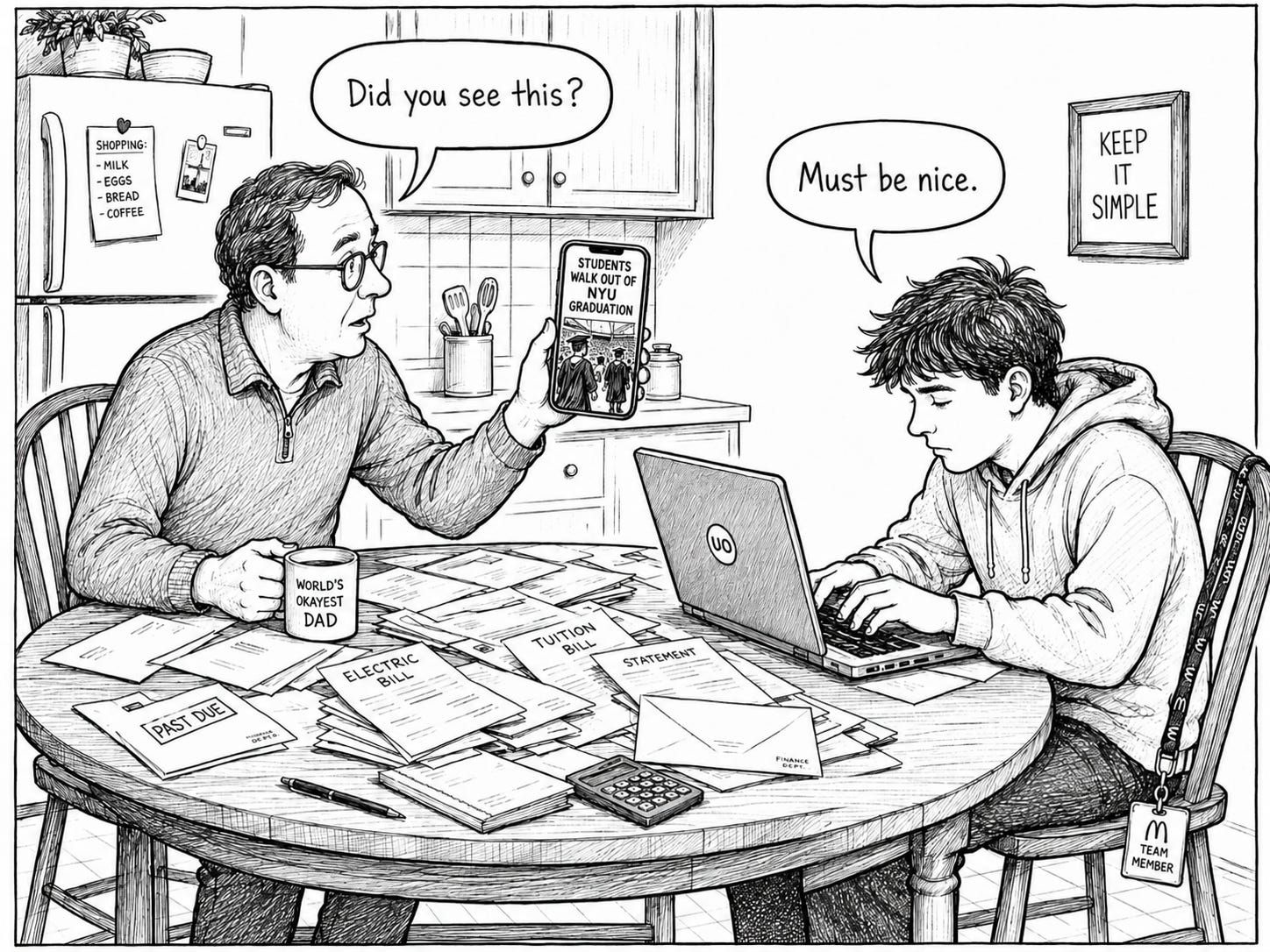
A few days ago, about three dozen students booed and walked out of NYU’s commencement ceremony when Jonathan Haidt took the stage. Haidt is a social psychologist at NYU’s Stern School of Business, founder of Heterodox Academy, and the author of bestselling books arguing that smartphones, social media, and overprotective parenting are damaging young people. The Student Government Assembly had urged administrators to reconsider, calling Haidt’s platform “misaligned from graduates’ experiences.”
The takes arrived on schedule. The New York Post called them “woke students” who “whine” about a speaker who “calls their generation coddled.” MSN framed it as a story about “generational divides.” The students themselves said they were being “misunderstood.” Everyone agreed: this was a story about Generation Z. It wasn’t.
The easiest story to tell is that a few dozen NYU students proved Jonathan Haidt right about Gen Z. The more accurate story is that they proved something else: elite campuses are terrible proxies for a generation.
It was a story about money.
Protest as a Luxury Good
NYU’s total cost of attendance is roughly $92,000 a year. The students who staged that walkout are among the most economically privileged young people on earth. They are not representative of Generation Z. They are a very specific, very expensive slice of it.
The data is unambiguous. Research compiled by the Foundation for Individual Rights in Education and analyzed by Brookings and The Economist found that even among selective universities, schools with wealthier students were more likely to mount protests against speakers, and more likely to succeed in blocking them. A study of more than 13,000 campus protests found that activity concentrates overwhelmingly at elite research institutions: Michigan, Berkeley, Stanford, and every member of the Ivy League sit at the top of the list.
Protest, in its current campus form, is a luxury good. It requires leisure, safety nets, and the confidence that walking out of your own graduation will cost you nothing. Most college students do not have those things. Nearly two-thirds work while enrolled. 40% work full time. Half are financially independent from their parents. The underemployment rate for recent graduates is above 40%. These students are not walking out of anything. They showed up. They’d probably like to get through the ceremony and go to dinner with their families.
The Wrong Generation
The narrative that Gen Z is fragile, coddled, and ideologically captured rests on a shakier foundation than most people realize. Haidt’s work has become one of the main reference points for that narrative. The Coddling of the American Mind was published in 2018. The Anxious Generation came out in 2024. Haidt defines Gen Z as those born after 1995. That cutoff may be defensible in a broad demographic sense, but it creates confusion when applied to today’s college students. Someone born in 1996 is 30 today. That person may be Gen Z on some charts, but they are not the student walking across a commencement stage in 2026.
Defining exact generational boundaries is inherently imprecise, and reasonable people disagree on the cutoffs. But from the classroom, I saw a clear shift around students born in 2000 or later. A different temperament, a different set of expectations, a different relationship to institutions. That is the cohort we are actually talking about when we talk about Gen Z in college today. Haidt’s core teen mental health data does substantially capture Gen Z, especially from 2013 onward. But the early inflection years he highlights are mixed-cohort, the college-student data from the early 2010s includes many Millennials, and the broader cultural story he tells, helicopter parenting and the collapse of free play, reaches back 25+ years.
The problem is not Haidt. The problem is what pundits do with Haidt. They take a complicated argument about technology, parenting, childhood, and mental health, and flatten it into a cartoon: Gen Z is anxious, fragile, censorious, and spoiled. That is not analysis. It is branding. The deeper point is one scholars like Neil Postman observed decades before the smartphone era: technology reshapes every society it touches. That is not a generational defect; blaming the youngest people for being reshaped the most is scapegoating, not insight.
The students graduating this month were born around 2004. The ones entering college now were born in 2008 or 2009. They came of age in a different world: pandemic schooling, AI, inflation, housing costs, institutional distrust, and a labor market that feels increasingly unstable. They are not who the pundits think they are. I know because I teach them. I have been teaching college students long enough to watch generational cohorts turn over, and the data matches what I see in the classroom.
Gallup and the Walton Family Foundation found that Gen Z teens are twice as likely to identify as more conservative than their parents compared to Millennials at the same age. Ipsos, surveying 31 countries, found that younger generations are more conservative on gender issues than older ones. Deloitte’s 2026 global survey of more than 22,500 respondents found that Gen Z overwhelmingly favors gradual career growth over rapid advancement. Only 25% prefer fast-paced progression. More than half say they are delaying major life decisions because of financial pressure.
These are not the coddled children of anyone’s imagination. These are realists.
From the Classroom
Here is what I can report from the classroom, where they actually live, as opposed to the op-ed pages, where they do not.
Gen Z is more clear-eyed than previous generations. Realistic, maybe even a little cynical, but grounded. Many Millennials arrived with inflated expectations, assuming success was basically owed to them. Many of them were coddled. I had friends in corporate hiring who told me about Millennial candidates who brought their parents to job interviews, and whose parents called their bosses when issues arose at work. Try to imagine a Gen Z student doing that. You can’t. Gen Z has shed that entirely. They are practical, unassuming, and under no illusions about what’s waiting for them.
Before you fill the comments with your worst student stories: save it. We all have them. Every generation produces its share of nightmares. But in my experience, the entitled, impossible students are rarer in this cohort than in any I’ve taught.
Yes, their reading and writing skills are weaker than previous cohorts. This is real and measurable. But it is not their fault. COVID-19 took away key developmental years. Learning losses between pre-pandemic benchmarks and 2022 amounted to decades of lost progress. Reading skills dropped to their lowest point in 30 years. As one senior writer at the Chronicle of Higher Education put it, students are struggling with fundamental skills “through very little fault of their own.” These students had their educations bisected by a pandemic and handed back a world that had moved on without them.
And yes, they use AI. Extensively. Three-quarters of Gen Z workers report using it daily. They were handed a tool that does a passable impression of thinking, at the exact moment the institutions around them were failing to teach them how. Blaming them for using it is like blaming someone for taking the elevator when you removed the stairs.
Here is the thing I keep coming back to. For 50 years, every older generation looked at college kids with some version of envy. The freedom, the possibility, the sense that the road was wide open. You wished you could go back.
I don’t feel that anymore. For the first time, I think a lot of people my age look at today’s students and think: I would not want to be them. They are entering a job market being reshaped by automation, carrying debt loads unthinkable a generation ago, trying to build lives in cities where housing costs have decoupled from wages, and navigating a media environment designed to make them anxious. They lost formative years to a pandemic. The institutions that were supposed to prepare them have filled their course catalogs with irrelevance, replaced rigor with ideology, inflated their costs beyond recognition, and gradually stopped delivering a return on the investment. And then we call them soft.
The Real Story
The NYU walkout is clarifying, but not in the way either side wants. It does not tell you that Gen Z is broken or that they are brave. It tells you that a small number of privileged students at an expensive school did something dramatic, and much of the media treated it as a generational portrait.
The actual generational story is not dramatic. It is a 21-year-old at a state school grinding through a nursing degree. It is a financially independent student trying to figure out financial aid. It is someone who lost half of their high school education to a pandemic and pursued higher education anyway. And most of them, if they are even paying attention to this nonsense, are rolling their eyes at the NYU walkout harder than any Fox News host. By some accounts, even many NYU students were.
That story doesn’t get told, because it doesn’t perform well on anyone’s timeline.
But it’s the real one.
More dispatches from the campus that’s lost the plot: subscribe below.
At a anonymous university graduation a group of about a dozen students started shrieking and waving banners, showing their immense gratitude and respect for the school, staff and parents who had traveled far and wide for the event. I asked a student about it and he said they were wealthy banker's kids from NYC. It needs to be called it out for the elitist performative bullshit that it is.
There was a protest at my disowned undergrad alma mater not long after I was Alumna in Residence. The large banner of Charles Krauthammer (this was 2013) unfurled, then re-furled, the last day I was on campus. My experience with the students at my prestigious, high-priced women's college was that they were nowhere near as intellectually capable, enthusiastic, and ambitious as the students in my community college classes. I watched the generations coming through, and I agree with you as to what has happened. There's such a mismatch in our society. I think the problems in higher ed are much, much deeper than too much DEI. Perhaps you could broaden your lens to encompass "intellectual incapacity" of faculty and administrators or something of that nature.