


FacultyLeaks.com is an anonymous dispatch from inside higher education. Some identifying details have been changed. The dysfunction has not.
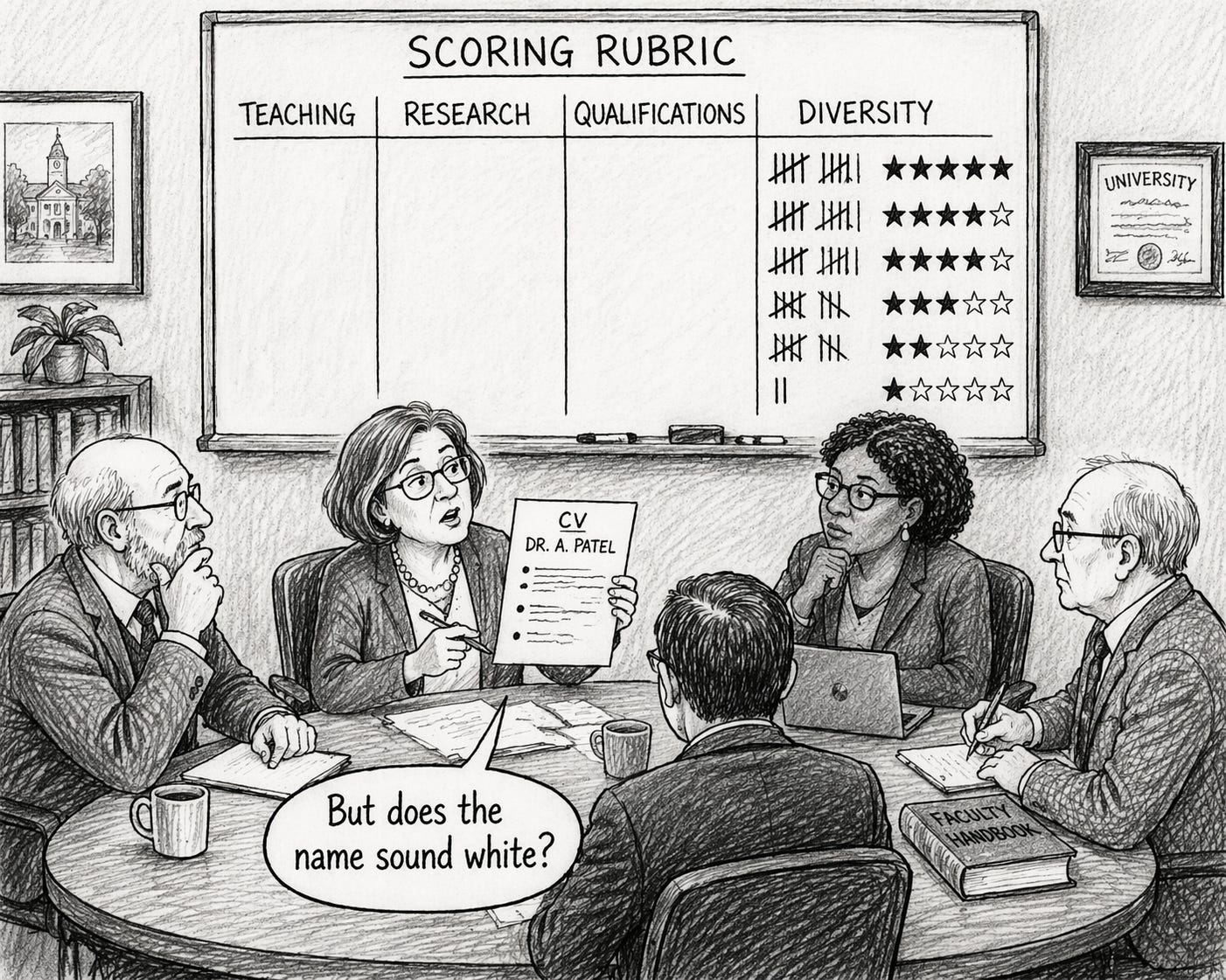
Let me tell you about The Candidate.
Before I do, some context. Every faculty hiring committee I’ve ever sat on has operated on an official premise: find the best person for the job. What actually happens in the room is another matter entirely. But this search was something else — even by the standards of a process that has never been as neutral as advertised.
The Spreadsheet
It started before the first application was reviewed. A colleague — one of the committee’s true believers — laid it out plainly: any new hire “must not be white.” Not “diversity is a priority.” Not “we should broaden our search.” Must. Not. Be. White.
This wasn’t a suggestion. It became the operating framework. The committee created a scoring matrix: teaching, research, terminal degree — and diversity. Except “diversity” didn’t mean what the university’s official policy said it meant.
The committee’s original definition of “diverse” meant non-male — excluding white men while allowing white women. When I pointed out that women are not exactly underrepresented in academia, and that excluding white men specifically would constitute gender discrimination, the definition was revised. The solution: expand the discrimination. It now meant non-white. All white candidates, men and women, were out. Progress.
White applicants were filtered out in the first round. Not evaluated and found lacking. Filtered. Pre-screened by name before anyone read their application. If your name sounded WASPy — think Milford C. Wellington III — your CV went in the trash unread. No one checked your teaching record. No one looked at your research. The name was enough. Ivy League PhDs, Emmy Award winners, Fulbright Scholars — an enormous swath of the applicant pool, gone before anyone read a word.
The methodology was so crude it almost certainly cut both ways. Promising minority candidates with Anglo-sounding names were likely never considered either. A black applicant with a name like Cortland Finnegan — look him up — would have been screened out before anyone read a word of his file. The committee wasn’t actually advancing diversity. It was advancing the appearance of diversity, as filtered through name-based racial guesswork.
One white female, Blair, made it through, courtesy of a colleague in another department who lobbied for her interview as a personal favor. She was also, by the committee’s informal calculus, somewhat diverse-adjacent — a self-identified LGBTQ+ member, which apparently counted for partial credit. Still, after her interview, a committee member summarized her candidacy in an email: “incredible” and “a perfect fit for us... but she is white.” The “but” doing considerable legal work in that sentence.
But not all non-white candidates were created equal. It was, effectively, a Diversity Olympics. The informal hierarchy rewarded intersectionality — the more identity boxes checked, the stronger the candidacy. Race, religion, national origin, gender identity: each one added points. Qualifications were a distant second. Political and ideological alignment was an unofficial but very real tiebreaker — the right kind of diverse, with the right kind of politics.
One candidate was advanced by a committee member despite not teaching anywhere near the subject area we were actually hiring for. The identity profile was exceptional. Enough boxes checked to make the missing qualifications feel beside the point.
And ideological screening cut in unexpected directions. I supported a minority candidate I thought was genuinely strong. A committee member objected. His reasoning: the candidate was “from Texas — and you know how they are!” He didn’t elaborate. The same committee member who would later accuse those of us who objected to the hire of racism.
One finalist, Marco, slipped through the racial filter because his last name sounded Hispanic. The committee was briefly excited. Diversity! But when he showed up in person and appeared to be white, the mood shifted. The committee chair wrote that despite Marco’s qualifications, he “doesn’t offer anything from a diversity perspective” — a Spanish-sounding name, she noted, doesn’t change the fact that someone is still white. She wrote this in a university email. The kind that can be subpoenaed. In fact, pretty much everything in this dispatch is documented — emails, text messages, voicemails, and official records. Just so we’re clear on that.
They had accidentally interviewed a white person. They were not pleased.
I raised concerns throughout the process. I told the chair directly: “This is discrimination. Someone is going to sue.” Her response was dismissive. She had a legal obligation to escalate. She didn’t.
Instead, a committee member sent an email to the entire group accusing anyone with reservations of racism. The department “desperately needs a voice from a person of color.” Anyone who disagreed was, by definition, part of the problem.
That wasn’t the only pushback. When I raised concerns during the meeting where finalists were being selected, I was shouted down. Not disagreed with — shouted down. As the meeting ended and one colleague headed for the door, he turned, wagged his finger at the room, and made it clear: no one was to go telling the dean about this and derail the process. Then he left.
That’s how the vote went unanimously — everyone but me for The Candidate.
The Candidate
So who was The Candidate?
A doctoral student — nearly seven years into a soft interdisciplinary degree he had not yet completed at the time of our offer, with a publication record consisting almost entirely of activist writing and left-wing arts journalism — the kind of work that counts as a "publication" if you squint and want it badly enough. So many publications for a young scholar, the chair gushed. When you’ve decided someone is the answer before you’ve read their file, everything looks like evidence you were right. It didn’t matter that he founded an anarchist group with a documented public record of violence, vandalism, and incitement against certain ethnic and religious groups.
His group had organized a coordinated rampage through a city’s public spaces and buildings. Equipment destroyed. Property vandalized. Multiple arrests. Significant property damage. The group’s own social media had urged followers to come out and cause destruction. The city’s own left-wing elected officials — not exactly a law-and-order crowd — condemned it publicly as criminal activity.
This was not obscure information. It was covered extensively — newspapers, local TV, viral social media posts. The Candidate was named. The group was named. The Candidate was identified as the group’s founder. All of it was searchable on Google at the time of the hire.
The committee’s response: hit pieces. Right-wing smears. He’s just an activist. A colleague who taught photojournalism dismissed the video evidence as a coordinated “far right” witch hunt. And besides — this was about viewpoint diversity. Academic freedom. Free speech. Never mind that the committee had spent months filtering applicants by race. Never mind that the anarchist group’s activities — coordinated property destruction, guides on harming police, threatening journalists — sit rather outside the boundaries of protected expression. The search committee members pushing hardest for this hire were, in their own estimation, moderates. Pragmatists. The reasonable center. People who had never voted for a conservative in their lives but considered anyone to the right of themselves a fascist. From that vantage point, yes, hiring the founder of a government-flagged anarchist group probably did look like a bold centrist move.
The anarchist group’s website, available to anyone with internet access, featured tactical guides for street protests including instructions for overpowering opponents and shutting down public spaces. Other leaders associated with the anarchist group had publicly boasted about past acts of political violence and were reportedly banned from entering certain countries. Members had been documented ejecting journalists from events they organized and declaring political opponents unwelcome. The Candidate himself appeared on video doing exactly that.
I flagged the video to the committee before the hire was even interviewed. Actions speak louder than words, I wrote. We have conservative students. Journalism majors. A professor who ejects people from public spaces for their political views and threatens journalists is a problem — particularly for an institution that publicly prides itself on free expression. The irony of invoking academic freedom to protect someone who practices that kind of selective tolerance appeared lost on everyone.
The committee offered him the job anyway.
The Visa
Here is where it gets interesting.
The Candidate couldn’t come. He was abroad, and the U.S. government would not let him back in the country.
Initially the committee chair blamed processing delays. Backlogs. Paperwork. It happens.
Then the real reason emerged, in pieces, over months of emails.
The U.S. government had flagged his work visa application. Nobody knew which agency — FBI? Homeland Security? State Department? — but something had triggered a hold. His own lawyer was trying to find out what.
And then, almost in passing, buried in an update email: when he had departed the United States the previous year, he had been stopped at the airport. Authorities had confiscated his cell phone and laptop. A bomb squad had been called.
A bomb squad.
Governments don’t call bomb squads over minor activism. And they don’t call them by accident — this person had clearly been on someone’s radar for a while.
The committee chair reported this the way you’d report a flight delay. “Ugh, what a headache. Anyway.”
Mind you: this was not a Trump-era immigration crackdown. The bulk of this — the years of security holds, the visa flagging, the final ban — happened during an administration that prided itself on welcoming immigrants and dismantling exactly the kind of restrictions its opponents were accused of building. Which makes you wonder what else was going on that we didn’t know about. Even colleagues who had initially supported the hire started quietly asking the same question.
The committee was baffled by the security hold. Baffled, despite the fact that a basic Google search would have explained everything — a Google search I had already done for them, links and all, which they had dismissed as right-wing hit pieces. The university’s official background check found, per their own account, nothing out of the ordinary. Just your average faculty candidate. Bomb squad and all.
The Workaround
A normal institution, at this point, would have moved on.
This institution did not move on.
The committee chair — a colleague known for her books on crisis communications, using her personal email account because, she noted, some of this “shouldn’t be on university accounts” — continued coordinating on The Candidate’s behalf. The first rule of crisis communications, of course, is transparency. She chose a different approach. She held regular update calls with The Candidate directly. She lobbied administrators. She strategized with the committee about how to keep the position open.
And then, in a moment of creative institutional problem-solving, someone came up with a plan.
The Candidate would teach. Remotely. From abroad. Without work authorization. Three courses that required hands-on, in-person instruction, delivered online from another continent.
To make this work legally — and I use that word loosely — the university listed another professor as the instructor of record. The Candidate taught the courses. The Candidate was paid as a “guest lecturer.” No benefits. No official employment. Just a tenure-track hire teaching university courses under someone else’s name.
The committee chair had previously written, in her own email, that this arrangement would be “not legal.” She did it anyway.
The university’s union was eventually consulted. HR eventually pumped the brakes. After one semester, the arrangement ended. Not because anyone decided it was wrong — but because the visa situation kept dragging and it became untenable.
The Provost’s office was later asked about this arrangement. The official explanation: they didn't want non-union personnel doing union work. The union, apparently, was the problem. Not the unauthorized foreign national teaching under a false name.
The Vote
Two years had passed. The Candidate had not set foot on campus. His initial appointment had technically expired.
A new interim department chair — reasonable, decent, trying to do things right, and newly responsible for both the undergraduate and graduate programs — called a full department vote on whether to continue the appointment. This was appropriate. Standard procedure.
The vote was tied. The reappointment had not been approved.
Then the pressure campaign began.
Search committee members threatened to sue the university if the appointment was rescinded. They warned the administration of potential litigation — not just from The Candidate, but from within the institution itself. They argued that expanding the vote to include non-committee faculty was procedurally improper. They got a U.S. Senator’s office involved in lobbying for the visa. They pursued every available legal avenue — including options that cost thousands of dollars and put them in direct legal confrontation with the federal government. They solicited letters of support from academics and activists in his network and deployed them as leverage. They made calls. They sent emails.
The administration caved.
I cannot recall another hire in my career that received this level of accommodation. Repeated deadline extensions. A legally dubious employment arrangement. Administrative override of a faculty vote they did not win. A chair-for-hire bargain. The university’s own legal counsel working the case. Years of institutional resources devoted to a single position for someone who had never set foot on campus (though he had, technically, taught there once — illegally, remotely, under someone else’s name).
The Coverup
Nearly four years in, with The Candidate’s lawyers filing a final legal appeal to force a government decision on his entry ban, the committee chair sent an urgent email: everything about the legal proceedings must be kept confidential. Do not share this outside the committee.
I replied: a lot of this stuff — government proceedings, communications with senators, agency decisions — might be public information, subject to FOIA.
Her response: panic. She mentioned that journalists had already been asking the Dean very specific questions about department activities. Phone calls during dinner. Stress for everyone. (The journalists were almost certainly tipped off by allies of The Candidate who thought they were generating a sympathetic story. They were not wrong that there was a story. They were wrong about which one.)
Another committee member followed up with his own confidentiality demand: “There is a great deal at stake, and we must ensure that sensitive information is not leaked.”
Huh? Normal hiring disagreements don’t require NDAs. “We thought the candidate’s research was thin” doesn’t make the news. But “No whites allowed” might. And they knew it.
These are the same people who spent years lobbying a U.S. Senator, joining a legal petition against the federal government, threatening colleagues with lawsuits, and coordinating directly with The Candidate’s legal team. Suddenly very concerned about leaks. They had watched enough legal dramas to think they understood how this worked. They did not.
For what it’s worth: they were right to be nervous. Government records have a way of becoming public. This post exists.
The Escalation
I went to the Provost. In writing. Twice. I laid out the discriminatory hiring process, the illegal employment arrangement, the national security concerns, all of it. I recommended the university seek guidance from the relevant federal agencies.
The chair of the search committee — the one who had written the “not legal” email, the one who had organized the workaround, the one who insisted we keep everything confidential within the committee — found out I’d gone to the Provost and sent an email to the entire department faculty calling me out. She claimed this was the first time I had raised any such concerns. Why now, she wanted to know — years after the fact.
It was not years after the fact. I had raised concerns during the search itself, before a single interview had taken place. I had raised them directly with university leadership years earlier. The paper trail existed. She knew it existed.
Moreover, she insisted the process had been perfectly fair — proof being that they had interviewed a white finalist. She appeared to have forgotten that her own emails explained how that finalist had slipped through only because his Hispanic-sounding name had temporarily fooled the committee into thinking he wasn't white.
The alibi and the confession were in the same inbox.
I replied, to the whole group and to the Provost, with the receipts. Here is the email I sent you years earlier in which I told you directly that I believed we engaged in discrimination and could face a lawsuit. Here is your non-response. Here is the hostile work environment that followed.
The Provost’s response to all of this: she sent an email telling everyone to stop discussing it.
The Ending
Almost four years after the original hire, The Candidate was still appealing his visa and travel ban. Still technically employed by the university. Still never having worked there.
A judge denied his final appeal.
The Provost wrote to me. She informed me the university had consulted with lawyers and, notably, the university’s own DEI office. That’s right: the investigation into whether the hiring process had been improperly diversity-driven was conducted by the diversity office. The background check had found nothing unusual. The matter was now concluded.
Nothing to see here.
I won’t pretend I wasn’t relieved when it was finally, definitively over — door closed, no more appeals. I’d learned not to celebrate early. After all, these people had lobbied a senator, threatened to sue their own employer, and held out hope through years of government rejections. I half expected a presidential pardon.
When the dust settled, the university’s administration quietly reassigned the faculty position to a different department entirely. No announcement. No explanation. Just: that line belongs somewhere else now. Make of that what you will.
Then came the grief emails. One committee member announced she was resigning from the university in protest — a principled stand against an institution that had, through no choice of its own, failed to employ someone the federal government had permanently barred from the country. She turned up at another university shortly afterward. The protest, it seems, had a soft landing already arranged.
Other committee members sent long, distraught emails — late at night, because they were, in their own words, “sick over what happened” and “it’s going to take me a long time to get past this” — to the department about how this young person’s dreams had been crushed. How his life had been derailed. How they would never understand — never forgive — what had been done to him. By us.
I want to be precise about something: the department didn’t end this. Colleagues who raised concerns didn’t end this. The United States government ended this. Homeland Security. The State Department. Federal law enforcement — the same agencies that stopped him at the border, confiscated his electronic devices, called a bomb squad, and ultimately barred him from returning to the country. The implication, never quite stated but very much felt, was that somehow we had engineered all of this — as if a few dissenting faculty members had the pull to get someone deported by the federal government. As if we had Mayorkas on speed dial.
The people weeping about ruined dreams were blaming academic colleagues for a decision made by the national security apparatus of the United States government. Not the bomb squad. Not the security hold. Us.
The colleagues who raised concerns about an anarchist group that organized coordinated attacks on public buildings and property, promoted violence against certain groups, published guides on harming police officers were, it turns out, correct. Vindicated. Not by a vote, not by an HR complaint, but by the government itself.
For the record: other figures associated with the anarchist group faced consequences at their own jobs — including one fired from a notoriously liberal organization. Apparently even they had a threshold our spineless institution lacked. Meanwhile, our university was actively fighting the United States government to keep The Candidate employed while simultaneously demanding that everyone involved keep quiet about it.
He came, incidentally, from a wealthy family — the kind with a compound back home, household staff, the works. The staff, it should be noted, were not there by choice in any meaningful sense of the word. The Candidate’s social justice activism did not extend to them.
Oh, and a candidate the committee never even bothered to consider the first time around because his name read as white? He was hired through a position that opened when one of the committee's most vocal members resigned in protest — and with the ideologues gone, a fair process ran. Took about five minutes for everyone to agree he was the obvious choice.
Funny how that works.
More dispatches from the campus that’s lost the plot: subscribe below.
Now we all understand how someone with Claudine Gay's résumé wound up as president of Harvard.
I worked in higher ed admin (yes, part of the bloat) for 25+ years before I retired. I wish I could say your story is unbelievable but, well, I have a few stories of my own. Three years before retirement a faculty member invited me to apply for a department position answering to the chair, i.e. a high-level slot with a number of responsibilities. I prepared packets for each member of the hiring committee containing a CV and a thick pile of recommendation letters including one from a state senator and a previous university president. A USB stick containing a slide deck of a proposed re-org for greater output with estimated cost savings. When I sat down before the committee they had only one question, which I can still remember: "What have you done to advance diversity and what are your plans to promote diversity in this department?" I looked at the committee, each member being white, and answered that I thought diversity was a worthy goal but did they have any questions concerning the tasks mentioned in the job posting or my materials? They did not. Interview concluded. They got up and left. A week or so later the faculty member asked if I had been interviewed yet. She was astounded when I said I had and a bit angry they had not communicated the outcome to her. The committee eventually hired a young woman right out of school who was wildly unqualified for the job.