


FacultyLeaks.com is an anonymous dispatch from inside higher education. Some identifying details have been changed. The dysfunction has not.
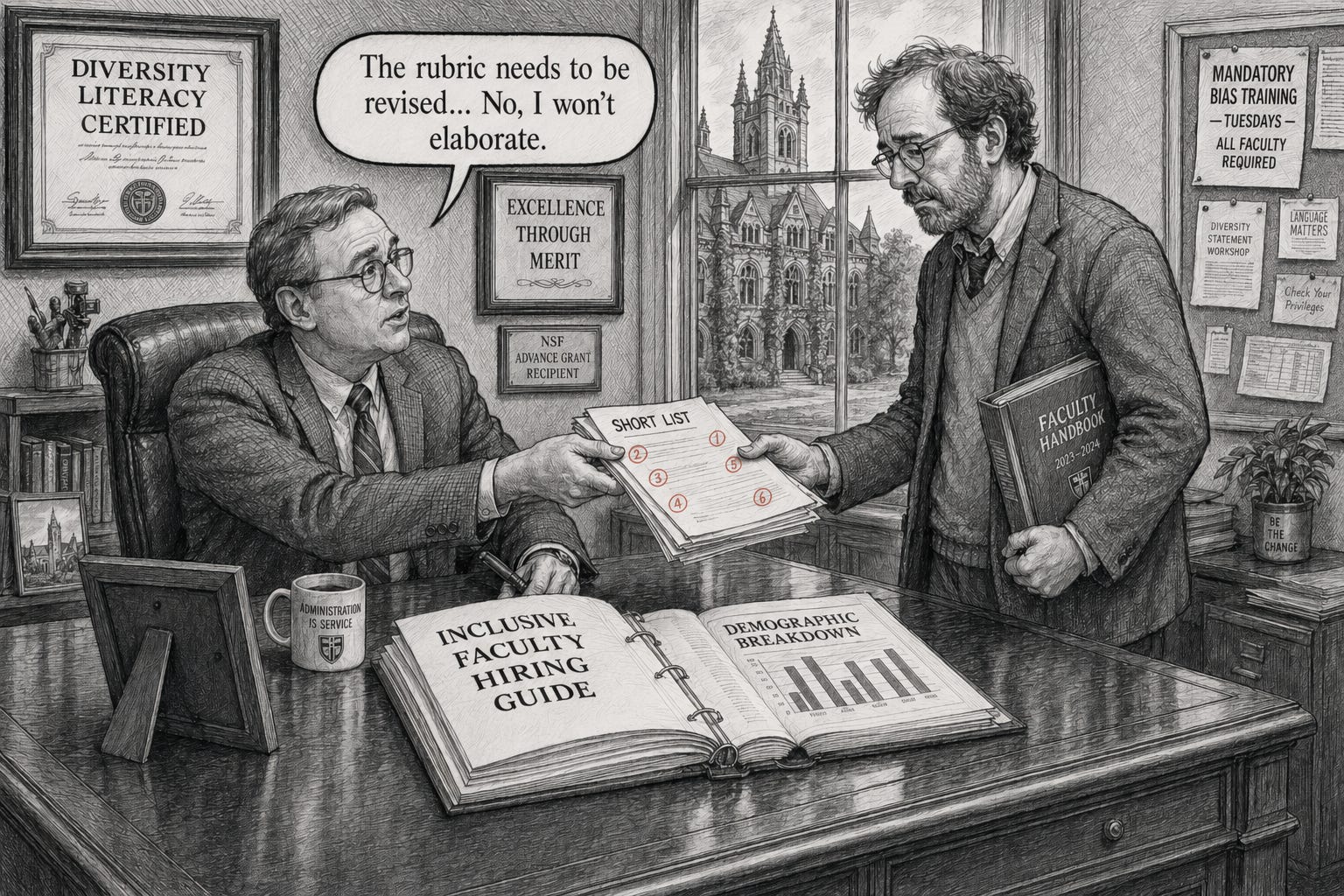
A federally funded program at a Midwestern public research university — one known for its engineering and computing programs — trained deans and faculty chairs to keep sending hiring shortlists back for revision until the demographic breakdown satisfied the institution’s preferred benchmark.
We have the document courtesy of a FacultyLeaks.com reader.
It is a 42-page institutional guide titled “Guide to Inclusive Faculty Hiring.” Produced by the campus’s NSF-funded ADVANCE program, it was circulated to search committees, department chairs, and deans. It is a roadmap for proxy discrimination in faculty hiring, detailing exactly how to evaluate candidates, what training faculty must complete, and how to intervene when the demographic outputs of a search don’t match a predetermined target.
The Mechanism of Proxy Discrimination
The guide defines a “diverse” candidate pool as one that “reflects the current demographics of the field.” Before a search even begins, leadership is instructed to set a benchmark drawn from the NSF’s Survey of Earned Doctorates (SED).
The process is coldly mathematical: if a field like Health Sciences is 67.44% female nationally but your applicant pool is lower, the search is flagged. But the most revealing part of the document is the “Short List Audit.” When a dean receives the demographic breakdown of finalists, they are instructed to compare those percentages to the original pool.
Crucially, this audit is asymmetrical. The guide only mandates a “pause” and a “redo” if the shortlist is “not as diverse” as the pool. If a shortlist significantly over-represents the demographics the guide is designed to increase, no such audit is required. This is not a search for “neutrality”; it is a one-way ratchet.
The Mind-Reading Protocol
The guide includes a legally significant instruction. Deans are told not to identify specific candidates by race or gender and demand their addition. Instead, they are told to send the rubric back for re-evaluation until the results change.
The guide explicitly advises: “You shouldn’t be telling them, you need to add X type of person... Instead, try to convey that the two pools don’t match and the selection needs to be revisited.” It is a game of institutional charades. The dean essentially tells the committee: I cannot legally tell you to hire based on race, so I will keep rejecting your work until you spontaneously arrive at the racial breakdown I want. This is the definition of proxy discrimination.
The Scoring of Ideology
Beyond demographic counting, the document reveals how candidates are screened for ideological alignment. The guide provides a “Contributions to Diversity” rubric (Appendix B) that treats DEI statements as a technical competency on par with research excellence.
Candidates are scored on a scale. A high-achieving researcher who provides a generic or “vague” statement on diversity can be ranked lower than a less-productive candidate who uses the correct institutional lexicon. This effectively functions as a political litmus test, allowing committees to penalize applicants who do not affirm the institution’s diversity framework under the guise of standardized scoring.
A Total Institutional Siege
The guide ensures demographic accounting touches every stage of the professional lifecycle:
Job Postings: Descriptions must be run through a “gender decoder” to scrub “masculine wording.”
Committee Formation: No faculty member may serve without a “Diversity Literacy Certification.”
The “Bias Interrupter” Scripts: The guide provides scripts for committee members to “interrupt” colleagues during deliberations. It encourages members to challenge their peers’ professional judgments with scripted prompts like: “Are we assuming he is more productive because he is a man?”
Negotiations: Deans are instructed to monitor “start-up packages” (lab equipment and funding) to account for “gendered” communication patterns, potentially adjusting financial offers based on the candidate’s sex rather than the negotiation itself.
The Federal Connection
The ADVANCE program is not a rogue operation. It is a long-standing initiative of the National Science Foundation. Since 2001, it has funded programs at over a hundred institutions—typically through multi-million dollar awards.
While the NSF archived the ADVANCE program on January 31, 2025, and active grants were terminated in April 2025 under the current administration, the infrastructure remains. Once these guides are baked into the bureaucracy, they become the default setting for HR departments. The document we obtained cites similar materials from Yale, Columbia, Maryland, Michigan, Wisconsin, Arizona, and Penn State. This does not appear to be a localized glitch; it looks like part of a national blueprint that continues to function even after the federal funding has been pulled.
The Post-SFFA Landscape
In Students for Fair Admissions v. Harvard (2023), the Supreme Court clarified that race-conscious practices violate the Equal Protection Clause. Chief Justice Roberts famously noted: “What cannot be done directly, cannot be done indirectly.” By mandating that committees “re-discuss the rubric” until they achieve a specific demographic output, universities are attempting to do indirectly what the law now forbids. Justices Thomas and Alito have specifically highlighted that “race-neutral” plans adopted with the intent of achieving racial outcomes constitute unconstitutional proxy discrimination.
Check Your Own Campus
We have one 42-page document. There could be hundreds more like it — perhaps a university you’re familiar with as an employee, alum or tuition-paying parent. See for yourself: search for the “ADVANCE guide” or “Search Committee Handbook” at your own institution. Look for the “shortlist audit” requirements and the “diversity literacy” mandates.
If they wrote it down, the receipts exist. If they have since deleted them, the Internet Archive remembers. The quota was never supposed to be written down. But here it is.
More dispatches from the campus that’s lost the plot: subscribe below.
I looked for ADVANCE and any other such documents at my university, even the Wayback Machine, didn't find anything. However I do recall being on search committees a few years back and having to report to the Provost office about race.
For example, if 50 people applied for the opening, you would first exclude all the applicants who didn't meet the minimum qualifications, and then you'd have 40. From the 40, you'd create your "long-short" list of maybe 10, and these people would be Zoom-interviewed. Then you winnow it down to the 3 finalists who would be invited for campus visits.
At that point, you had to provide the Provost with documentation about why you excluded any non-whites who were among the 10 (whose race you now knew due to the Zoom meeting) from the finalist trio. It wasn't enough to make a good-faith assumption that the search committee had already evaluated everyone fairly; you had to offer extra "proof" that the excluded minority candidates were unequivocally less-qualified than the final three. The effect was sort of chilling—as in, you knew that the Provost really really wanted you to hire minorities, and you get this extra bad-faith scrutiny if you fail to do that.
One thing that always struck me about dealing with the Provost all these years is how bad-faith everything was, and ironically so. Basically everyone I work with wants to actively discriminate in favor of minorities—to create "visible diversity"—and yet the required trainings and their implications always assumed that we were all a bunch of thoughtless prejudiced white people who had to be trained and goaded to not reflexively prefer to hire people who look like us.
Out of curiosity, why not post the document? Or the name of the school? I know there is a need for some anonymity, but without the evidence made public it is kind of all hearsay.