


FacultyLeaks.com is an anonymous dispatch from inside higher education. Some identifying details have been changed. The dysfunction has not.
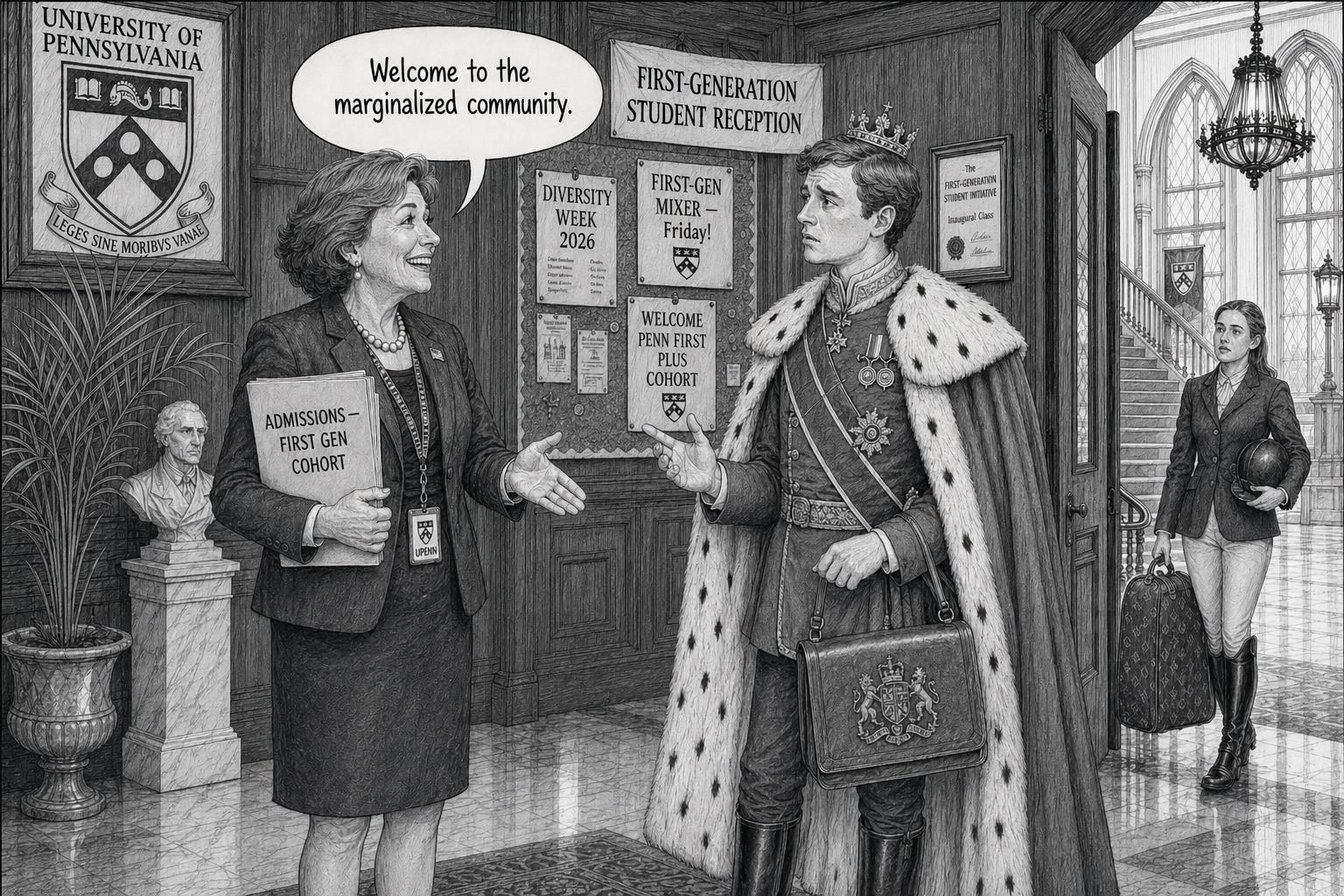
Open the admissions page of any American university and somewhere on it you’ll find a percentage: first-generation college students, X%.
Schools advertise the number the way they advertise SAT averages and student-to-faculty ratios. The higher the figure, the better the optics. There are reasons why deans beam about this statistic — and one of them they would likely not name out loud.
Nobody asks the obvious follow-up: First-generation compared to what?
The category only makes sense if college attendance is the exception — something unusual, something that marks you as having overcome a hurdle. But somewhere between 38% and 54% of current undergraduates are first-generation, depending on which definition you use. The National Association of Student Personnel Administrators (NASPA) puts the figure at 54%. That’s more than half of all undergraduates in the country.
A diversity category that describes half your student body isn’t a diversity category. It’s just college. In fact, a generation ago, when two-thirds of American undergraduates actually were first-generation, nobody called them that. The category became a category only once it became useful as a legal blind.
The Box
What that looks like, on the ground, is something else.
Every spring, my department awards scholarships, many of which require the recipient to be first-generation. And every spring, financial aid emails me back to tell me my first pick isn’t eligible.
The disqualifying credential is sometimes a parent who briefly attended college, or a parent who graduated decades ago in a country the student has never lived in. Whatever it is, the rule is the rule. The category, it turns out, rarely tracks the hardship it claims to.
This isn’t just local dysfunction. In 2017, the New York Times reported on a high school senior whose mother had never enrolled in college and whose household was low-income. His father had earned a degree but died when the boy was a toddler. The school still said no. The father had a bachelor’s, and the rule was the rule. The credential lived on after the man holding it did not.
The category itself is a checkbox on an application. Some students don’t even know what the term means — “first-generation” is admissions-office jargon, not common usage, and the definition can vary significantly by school. But others are very aware that answering “yes” can be the difference between a rejection and a scholarship. If you Google “lying about first generation college student,” the top results are Reddit and TikTok threads of kids workshopping how to game the box. When a system rewards gaming, gaming becomes the rational move.
The Performance
The whole thing is bizarre because everyone is the first in their family to do something. This is a distinction only out-of-touch administrators could invent.
I’m the first in my family to earn a terminal degree. Nobody adjusted the expectations, and nobody gave me extra credit for showing up without a legacy. I was expected to perform at the same level as colleagues whose parents held endowed chairs, because that’s what the job requires.
My brother was the first in our family to earn a Division I athletic scholarship. The coach didn’t give him sympathy points for it. He cared about one thing: what he could do for the team. Performance was the metric. It still is, in every high-stakes field except this one.
The hardship-marker logic assumes credentials still determine outcomes, but that hasn’t been entirely true since the first dorm-room startup became worth a billion dollars. Mark Zuckerberg dropped out of Harvard. The Thiel Fellowship pays talented kids $250,000 to skip college entirely. Pro athletes routinely sign multi-million dollar contracts at 18. The deans bragging about their first-gen numbers are, in many cases, bragging about something close to the median American experience. They’ve mistaken the ordinary for the remarkable.
The Proxy
None of this is an accident. First-generation status is useful precisely because it sounds class-conscious while functioning as something else entirely. It’s a demographic proxy — a way to sort by race without sorting by race.
The numbers tell the story. According to federal data analyzed by NASPA and Forbes Advisor, 60% of Hispanic undergraduates and 59% of Black undergraduates identify as first-generation, compared to 36% of white students. By recruiting aggressively for first-gen status, an institution can produce racial diversity outcomes nearly identical to race-conscious admissions without ever actually checking a race box.
After the Supreme Court’s 2023 decision in Students for Fair Admissions v. Harvard, universities began treating first-generation status as a safe harbor. They aren’t exactly hiding it. In early 2025, one law school dean explained that while they can no longer sort by race, they can launch “innovative pipeline programs” open to first-generation students.
But this safe harbor may be an illusion. Justices Thomas and Alito have already signaled a shift toward the theory of “proxy discrimination” — arguing that race-neutral plans adopted with the specific purpose of achieving racial diversity are themselves unconstitutional. As The Atlantic noted back in 2016, first-gen and low-income are not the same thing, and conflating them isolates the very students the category is supposed to help. Many first-generation students are middle-class. Their parents are tradespeople, small business owners, immigrants whose foreign credentials don’t transfer. The student is the first to finish a four-year American degree. They are not the first to make rent. The institution wants the categories to be one and the same. Universities are racing to build infrastructure around a category that may not survive the next round of litigation, and they are doing it anyway.
The Fierceton Case
The most public collapse of this fiction was Mackenzie Fierceton, the University of Pennsylvania student whose Rhodes Scholarship was rescinded in 2022. Most outlets reported it as a story about a student who lied about being first-generation. The actual record, as documented in The New Yorker, suggests Penn’s own incoherent definitions were the real culprit.
According to Penn’s own criteria, you are first-generation if one of your parents took more than six years to complete their degree. Under that rule, if your parent paused their MIT degree to run a billion-dollar startup, you are first-generation. You also qualify if your parents didn’t complete their degree in the United States — meaning Prince William’s children meet Penn’s definition of a marginalized community.
Most tellingly, you qualify if you have a “strained relationship” with the parent who holds the degree. Penn wrote a definition broad enough to capture foster kids, Oxford legacies, and every teenager who has ever had a moody adolescence. When a student like Fierceton walked through the loophole they created, the institution pretended it had been duped. The category cannot mean “no parental degree” and “low income” and “cultural mismatch” and “no embarrassing edge cases” all at once. Eventually one goal collides with another, and the student standing in the collision gets blamed for the institution’s incoherence.
The Outcome
The completion data tells a more honest story than the admissions brochures. If the goal were actually helping these students, the conversation would center on the fact that only about half of first-generation students have earned a credential six years after enrolling. Even an analysis of NASPA data acknowledges that institutions invest heavily in first-gen swag and celebrations while their tutoring, transportation, and scholarship resources for those same students go unused.
Instead, the conversation centers on the enrollment number — the stat that looks good in the annual report and the fundraising materials. The institution loves the first-gen student on move-in day. They are remarkably quiet about them on graduation day.
Count the students coming in. Don’t look too hard at whether they make it out. Brag about the pipeline. Ignore the leak.
The Students
The institution sees a demographic category; I see a recurring tragedy of paperwork.
Every spring, my department processes scholarship applications. Many of the awards we administer require the recipient to be first-generation. The donors who established them are mostly dead, which means we cannot ask them what they actually meant by the term, so we use the institution’s definition.
The minimum GPA on most of these scholarships is 3.0. The average GPA in the department is much higher. The threshold was set decades ago when the average was lower. Nobody has revised it. Functionally, “3.0 minimum” means “everyone.” The selection criterion that matters is the first-gen box.
Every spring, I see students who would be transformed by these awards passed over because of a technicality in the parental-credential rule. Every spring, I see students who do not need the money receive it because the category — as the institution defined it — applies to them. Every spring, I write the same emails to financial aid, and every spring, I get the same response.
The category was supposed to capture something real. It captured something else. Now the institution depends on the confusion.
More dispatches from the campus that’s lost the plot: subscribe below.
On one level, I see this as another example of using convoluted language to identify some people as members of designated victim groups. A recent alumni magazine highlighted a student who was "indigenous." She had grown up in New Jersey, and had no American Indian ancestry. Her parents were Amazigh (I had to look that one up). But she had been taught to see herself (or maybe the University found it convenient to see her) as a victim by virtue of her parents' status in a far-away land.
On another level, this seems like another example of universities working very hard to hide their actual practices because their actual practices are ludicrous and would be unpopular if they were known. And these practices may be actively harmful for their intended beneficiaries. I think it's sad, and ultimately harmful to the schools' credibility.
I agree that "first generation" is a wooly category that encompasses all sorts of things, and could indeed be used as a cover for illegal racial preferences. But that might be a reason for tightening the definition and using it more rigorously, not abandoning it. Because there is - as has been well documented - a problem in the US of elite reproduction: people with successful parents are able to join the elite themselves, and fit in more comfortably once they are there. Finding GENUINE first-generation students (not the children of Prince William!) and helping support them would be a good step to correcting that.
One question I would have is what percentage of true "first generation" students are at "elite" universities: on the site you link to, that gives you the "38-54% of undergraduates are first generation" statistic, it also notes that 43% of those are at two-year institutions, that 12% are at private for-profit institutions. I wonder what the percentage of first-generation students is at Harvard, for example. (Harvard claims it's 20% or so - but of course you can't trust that statistic, for the reason you explain!)