


FacultyLeaks.com is an anonymous dispatch from inside higher education. Some identifying details have been changed. The dysfunction has not.
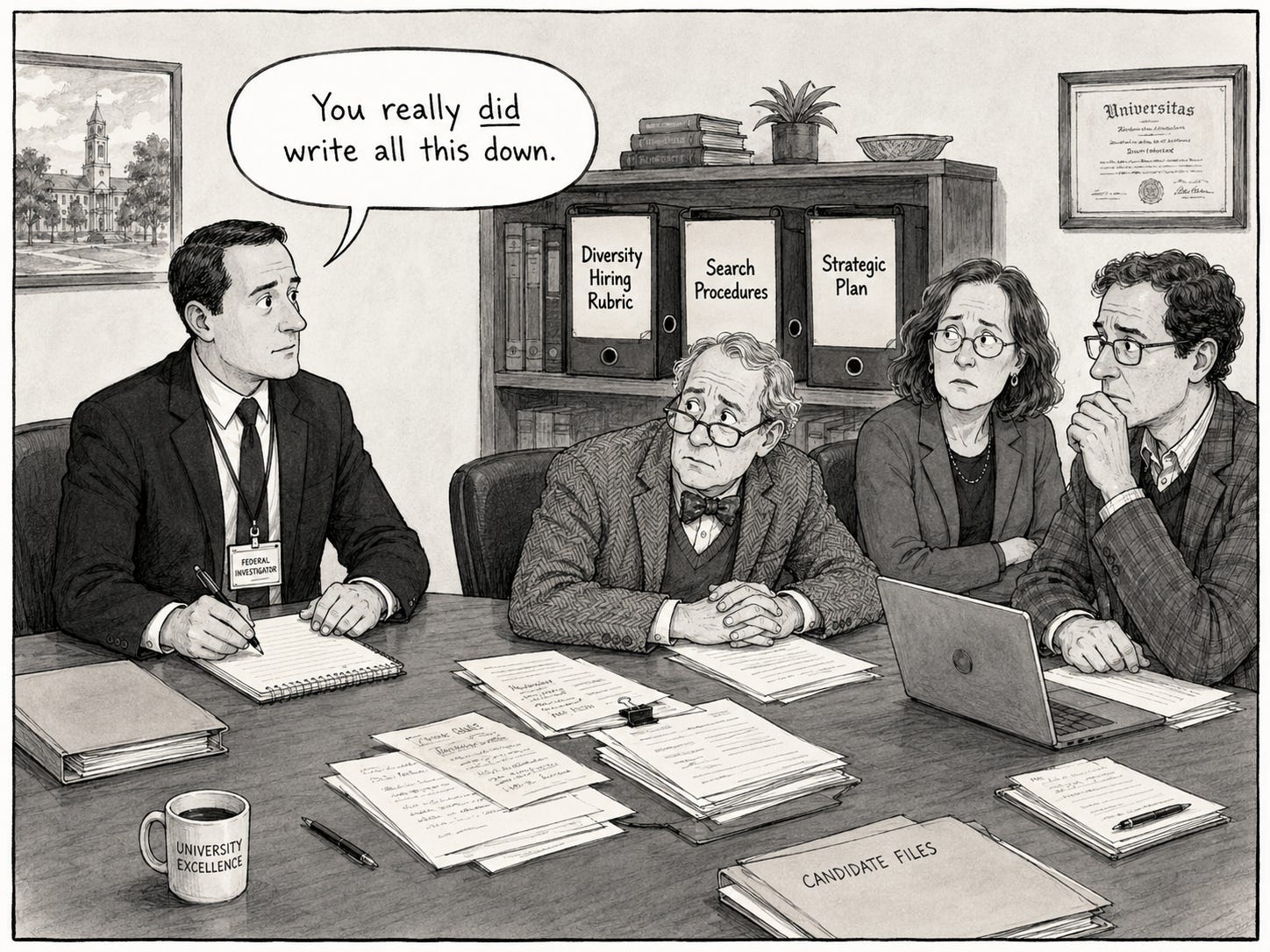
Universities that built faculty hiring around DEI just entered code red.
The EEOC has rescinded its Biden-era enforcement plan and replaced it with a new National Enforcement Plan that makes DEI-related race and sex discrimination a top enforcement priority. Signed on June 4, it took effect on adoption and stays in force until the Commission votes to change it.
You can read the new plan here.
For higher education, the danger is obvious. The plan names “prominent universities,” alongside large corporations and other elite institutions, and identifies many of the practices that now define faculty hiring: “diverse slate policies,” “diverse hiring panel policies,” “diversity statements,” race- and sex-conscious rubrics, identity-based fellowships, and “aspirational goals” that function as quotas. The same documents universities created to justify DEI hiring may now look more like Exhibit A in a Title VII case.
If you have sat through academic hiring in the last decade, none of this is abstract. You have seen the training, the rubrics, the dean who sends a pool back as not diverse enough. The EEOC did not have to invent a theory out of thin air — it just had to read the faculty search file. Or this Substack.
The Standard Faculty Search Is Now in the Crosshairs
For years, universities insisted there was no quota, just an aspirational benchmark, a strategic priority, a commitment to increase the number of underrepresented faculty by some date in some plan approved by some board committee. The new EEOC plan goes straight at that defense. It targets “aspirational goals” that function as proxies for quotas. If the number drives the decision, the government may treat it like a quota.
The plan also names “diverse slate policies” and “diverse hiring panel policies,” meaning the rules that shape who gets into the finalist pool and who sits in judgment of them. It names “diversity statements.” It names candidate-evaluation methods that consider protected characteristics. It names the pipeline: fellowships, internships, mentorships, apprenticeships, training programs, benefits, and advancement opportunities that screen or sort people by race or sex.
If your school runs a diverse scholars postdoc or a fellowship open only to certain identities, that is on the list too. So is the rubric that awards points for a diversity statement, the dean’s email sending back a pool because it is not diverse enough, and the search chair told to think more broadly when everyone in the room knows exactly what that means.
None of this is theoretical to me. I’ve watched committees refuse to seriously consider qualified white men because the optics were wrong. I’ve seen deans blow up a finalist pool for not being diverse enough, with little visible interest in whether their preferred candidates could actually teach the courses or even had the necessary terminal degree.
That is not a neutral rule producing an unlucky result. It is a choice, often made by people careless enough to put it in writing.
And I am not the outlier. In 2024, Yale history postdoc David Austin Walsh, a prominent progressive polemicist, went viral after saying on X that being a white man helped make him “unemployable as a 20th-century American historian.” He quickly deleted the post and apologized, which tells you the quiet part is not supposed to be said out loud. In 2021, physicist Lawrence Krauss wrote in the Wall Street Journal that colleagues’ white male postdocs “aren’t getting interviews or have chosen to seek jobs outside academia.”
None of this is secret. It is just unspeakable. And the evidence is all written down, sitting in .edu inboxes across the country right now.
Why Intent Matters
The new enforcement plan also changes what kind of discrimination the EEOC pursues. It’s pivoting from unintentional patterns to intentional acts.
Discrimination law has two basic theories: disparate impact and disparate treatment. Disparate impact involves a neutral rule that falls harder on one group. Disparate treatment involves intentional discrimination: treating someone differently because of race, sex, religion, national origin, or another protected characteristic.
The new plan does not repeal disparate impact, but for EEOC enforcement purposes it comes close. The agency says it will prioritize disparate-treatment theories, eliminate the use of disparate-impact theories in investigations “to the maximum degree possible,” and “will not commence, develop, or continue to pursue litigation advancing disparate impact claims.” In plain English, the EEOC is shifting its enforcement muscle to intentional discrimination.
That matters because intent is usually the hard part to prove, and universities may have solved that problem for the government. You cannot easily argue that a diverse slate mandate was an accident. You cannot easily argue that a diversity-statement rubric was race-neutral when it rewarded race- and sex-conscious commitments. You cannot easily argue that a dean’s demand for a more diverse pool was just an innocent statistical observation.
The courts have moved in the same direction, though not in exactly the same way. In Ames (2024), the Supreme Court rejected the extra hurdle that had made it harder for majority-group plaintiffs to bring Title VII claims. That is the case that matters most for the rejected white, male, or straight applicant who says he lost out because of a DEI-driven search.
The Court’s 2023 Muldrow ruling matters too, but for a different reason. It makes it harder for employers to dismiss lesser employment actions as too trivial to count. A faculty member passed over for a plum assignment, steered away from a career-building role, excluded from a funded opportunity, or pushed into a worse track because of race or sex may now have an easier time showing legally cognizable harm. The rejected applicant did not need Muldrow; failure to hire was already actionable. But Muldrow expands the pressure around the edges of the DEI system, where universities often make decisions that affect careers without calling them hiring decisions.
Put it together and the university’s position gets much harder. The applicant has Ames, the sidelined employee has Muldrow. And both may have a search file, rubric, email chain, or strategic plan showing that race or sex helped shape the decision.
A university lawyer will say the EEOC plan creates no new private right, and that is true. But enforcement plans still matter. They tell a federal agency where to spend its time, and this one spends its attention describing the contents of the modern faculty hiring file.
The first item on EEOC Chair Andrea Lucas’s priority list is “remedying DEI-related race and sex discrimination.”
If universities keep running searches this way, they should assume the next reader of the file may not be the provost. It may be a federal investigator.
More dispatches from the campus that’s lost the plot: subscribe below.
I don’t think this is something that’s really fixable institutionally. Thus I advocate lawsuit after lawsuit with the goal of basically bankrupting and hence destroying such institutions. Think of it as the sequel to the dissolution of the monasteries. Fine them several hundred billions, and when they keep offending, fine them three times as much next time. I suppose it’s conceivable that they’ll genuinely repent, but frankly, I’d rather they didn’t.
About three years ago, our faculty had a discussion about an upcoming search, for which I was the committee chair. This was in the early stages when we were talking about what we wanted and needed in a new hire. We are a majority-female faculty, but everyone was white at that point (we have since hired an Asian woman).
Several women said "We can't hire another white person". I said, "So you want to discriminate by race?" They said "Yes", enthusiastically.
But I'm sure that didn't make it into the meeting minutes.
Nobody in academia seems to care at all about this problem. After all, it was a "remedy". I couldn't help think: now YOU'VE got your safe white-person job, but to hell with other white person job-seekers. Didn't cost them a thing, but it cost others hugely.