


FacultyLeaks.com is an anonymous dispatch from inside higher education. Some identifying details have been changed. The dysfunction has not.
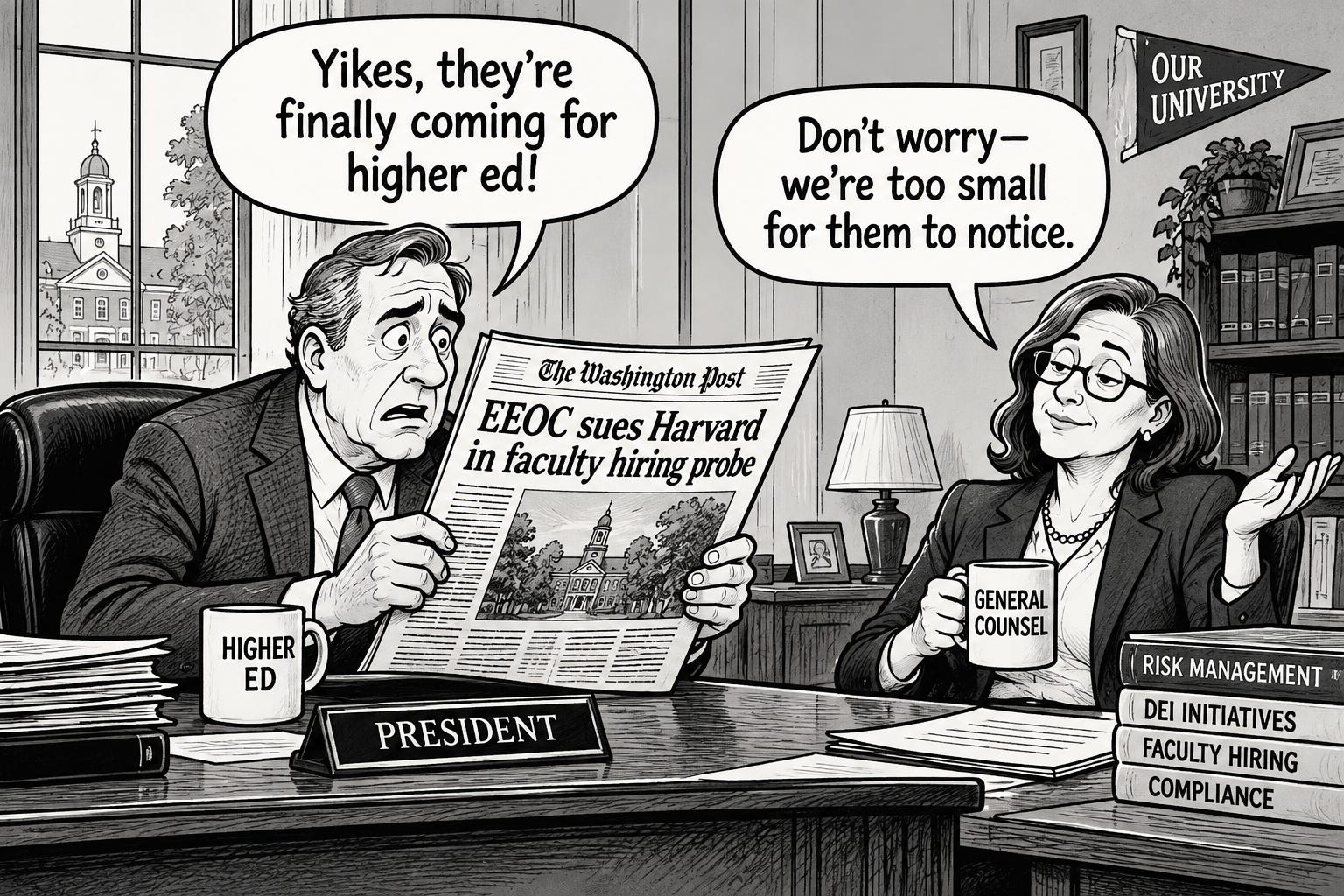
The reckoning over some of higher ed’s blatantly illegal hiring practices has begun.
For years, universities seemed insulated from serious federal scrutiny of race- and sex-conscious practices adopted in the name of diversity. That has changed. The EEOC’s new National Enforcement Plan calls for strong, evenhanded enforcement of Title VII and names potentially discriminatory DEI practices at “prominent universities” and other elite institutions as an enforcement priority. The agency is now digging into faculty hiring at Harvard while pursuing DEI-related cases elsewhere.
On Sept. 29, the EEOC went to federal court to enforce a subpoena in its Harvard investigation, which stems from EEOC Chair Andrea Lucas’s April 2025 Commissioner’s Charge alleging systemic discrimination against white, Asian, male and heterosexual applicants and employees. Harvard denies the allegations and says the investigation is politically motivated.
The agency wants faculty applicant data going back to 2018, plus demographic information, hiring procedures, diversity-program materials and other records showing how Harvard’s faculty hiring system worked. Nobody asks for eight years of applicant data to settle one disputed hire.
Harvard isn’t the only encouraging sign. In August, the EEOC sued Washington University in St. Louis after an employee alleged she was fired for complaining about race discrimination connected to mandatory DEI training. She filed her charge in July 2025, and the Commission was in federal court on her behalf little more than a year later. The allegations remain to be litigated.
The EEOC has also gone after antisemitism at elite universities. Columbia agreed to a $21 million settlement resolving EEOC charges, including a Commissioner’s Charge Lucas filed on behalf of Jewish employees, and the agency went to federal court to enforce a subpoena against Penn arising from another Lucas charge. Those are different kinds of discrimination cases, but they show the agency is willing to take on big-name schools.
DOJ’s Civil Rights Division has been moving in the same direction. Under Harmeet Dhillon, the department has scrutinized race-conscious practices at prominent universities and professional schools, opened investigations into 15 additional medical schools and recently found that UCLA Law discriminated against white and Asian applicants.
We’re glad to see it. A few years ago it was hard to imagine federal civil-rights agencies digging this deeply into elite universities. We also know there’s a lot more out there.
We’ve Seen the Receipts
Faculty Leaks has reviewed records from several pending university discrimination matters involving schools that will never generate a Harvard-sized headline. We’ve seen contemporaneous emails, hiring records, candidate evaluations, employment data, university policies and other documents offered in support of the allegations. Professors involved in these disputes often send us the material themselves because they’re frustrated and want somebody else to look at what they have. In some cases the documentary record looks every bit as worthy of investigation as what has become public in the marquee cases.
That doesn’t mean every charging party is right. Universities get to respond, documents need context, and ultimately the EEOC or a court decides whether the evidence proves unlawful discrimination. But these aren’t people who missed out on a job or promotion and decided discrimination must be the reason.
Some of the cases we’ve reviewed have been pending well over a year, including matters that were already in the EEOC pipeline when the current administration took office. EEOC investigations are confidential, so we don’t know everything investigators may be doing behind the scenes. What we do know is that some well-documented individual cases remain unresolved while newer, high-profile matters move forward in public.
The EEOC’s recent San Francisco action shows how an individual charge can grow into a broader investigation. That matter began with one former city government employee’s race-and-sex discrimination charge involving DEI practices. The agency sought information on mandatory DEI training and related complaints, issued an administrative subpoena and, when the city didn’t hand over everything requested, went to federal court to enforce it. We’d like to see that same energy reach the strong university cases already sitting in the pipeline.
Title VII Doesn’t Have a Prestige Threshold
There’s a perception at some less prominent schools that the federal government just isn’t going to care as much. Someone familiar with one case we reviewed made essentially that argument: his university wasn’t important enough for the feds to bother with.
We hope he’s wrong. Most faculty and staff don’t work at Harvard, Yale or UCLA. If a regional university or small college violates Title VII, its employees shouldn’t get less protection because the school isn’t famous enough to make national news. In fact, a strong case against a university most Americans have never heard of would do a lot of good. It would tell every school in the country that the rules apply to them too, headlines or no headlines.
Are the New Priorities Reaching the Field Offices?
It’s important to understand that there’s some bureaucracy between Washington and an individual EEOC charge. Most charges are handled through the agency’s network of field offices, where investigators receive and develop cases, conduct mediation, request records and, in some instances, pursue litigation. Headquarters can set national priorities, but much of the day-to-day work happens in those local and district offices.
That matters because people involved in some of these cases worry the new priorities aren’t being carried out evenly around the country, particularly in some large, heavily Democratic cities. The publicly available statistics give them at least some reason to wonder.
The employment law firm Seyfarth Shaw reviewed FY2026 EEOC litigation and found that Chicago filed 12 lawsuits and Philadelphia 11, while New York and Los Angeles filed four each and San Francisco five. Seyfarth described several historically active districts as unusually quiet.
Those figures count lawsuits, not investigations, so they don’t tell us how many charges an office handled, how many subpoenas it issued or how many matters were resolved without litigation. Nor do they prove politics explains the gap. But when Washington is announcing major new enforcement priorities and historically active offices are producing relatively little public litigation, it’s fair to ask whether those priorities are reaching every part of the agency with the same urgency. Attorneys involved in some of these matters have privately raised the same concern with Faculty Leaks.
The Harvard, Washington University and Columbia actions are encouraging, and that’s exactly why older, well-documented cases already sitting in field offices shouldn’t get lost in the shuffle. The National Enforcement Plan itself calls for more coordination between headquarters and the field, and contemplates shifting priority matters between districts or bringing in headquarters personnel when necessary.
One other development is worth watching. The EEOC has sued The New York Times on behalf of a white male employee who alleges race- and sex-conscious preferences cost him a promotion, and the Harvard investigation puts alleged discrimination against white men squarely into a university faculty-hiring probe. However, based on the public record we reviewed through early October, we haven’t found a completed public resolution of an individual white male employee’s own race-and-sex charge alleging DEI-related preferences cost him a job or promotion, and certainly not in higher education. Recent developments suggest that could change.
In short, we’re encouraged by where the EEOC and DOJ are heading. Federal agencies are finally asking hard questions at universities that long seemed untouchable. We’d like to see the same attention reach strong cases at less prominent schools, including some that have been waiting a long time. Those charging parties aren’t owed a win, but they are owed a serious look at their evidence and, eventually, an answer.
More dispatches from the campus that’s lost the plot: subscribe below.
Well done, keep up the great work…
great article