

FacultyLeaks.com is an anonymous dispatch from inside higher education. Some identifying details have been changed. The dysfunction has not.
Something has shifted in higher education.
I felt it this past fall when I did something I hadn’t done in years: I threw my hat in the ring for an elite academic job.
I’d stopped applying a long time ago. The pattern was clear enough: strong publication record, good teaching, relevant expertise — none of it mattered. I knew what they were screening for, and I wasn’t it.
The last time I applied for a job, they made me interview on Zoom with my video off so they wouldn’t be “biased.” When I made it to the finalist round, they asked me to define social justice. They didn’t like my answer. They’d also seen my published work and disagreed with it. They suggested I educate myself by reading White Fragility and Ibram X. Kendi.
I stopped browsing higheredjobs.com after that.
Then Trump won again and suddenly universities were under pressure. The White House was threatening funding, state legislatures were investigating, the EEOC was cracking down on discrimination in academic hiring, donors were pulling back, public trust was collapsing, enrollment was declining.
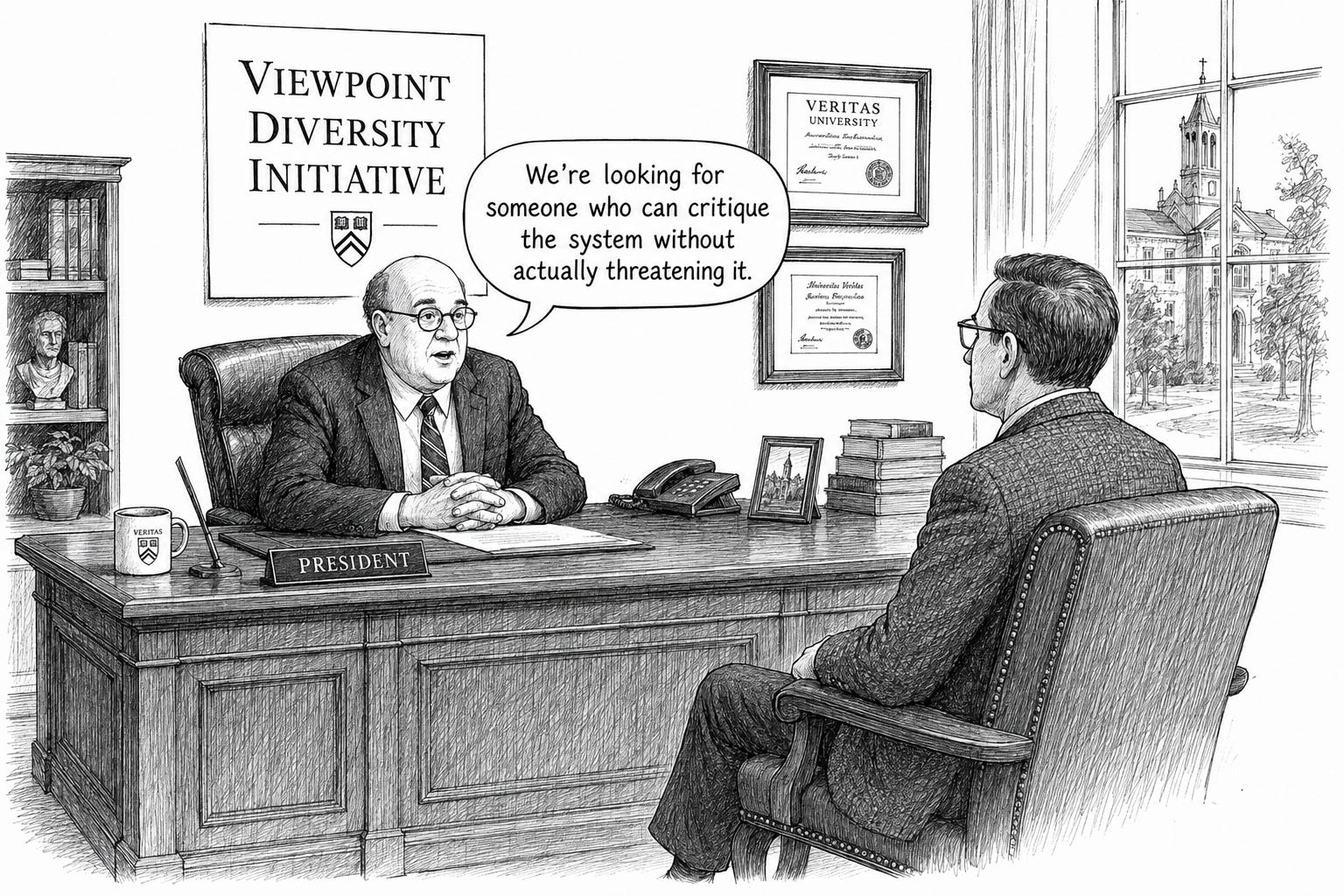
There was a mea culpa in academia — or whatever passes for contrition among elite administrators. Columbia reached a $221 million settlement with the Trump administration and accepted outside monitoring. Brown reached a $50 million agreement. Cornell later reached a $60 million agreement. Harvard has been reported to be discussing a possible $500 million settlement, though school officials have disputed that figure. Harvard is also reportedly soliciting $10 million donations for endowed professorships under a “viewpoint diversity” initiative that could bring dozens of ideologically heterodox faculty to campus.
But even still, when a dean at an Ivy League school contacted me saying I was very impressive and invited me to interview for a professorship, I was genuinely shocked.
Me?!
Imposter syndrome kicked in hard. This was the kind of position that goes to people with major national awards and towering reputations. They must not have Googled me. I must have fooled them somehow.
I was anxious. When I was first entering academia, I had so many interviews it became second nature, like riding a bike. But that was a long time ago and now I was out of practice.
The interview was surprisingly pleasant. I was braced for a hostile environment, but everyone was professional and polite. I met with faculty, deans, administrators. I met so many people I couldn’t even send them all thank-you emails afterward because I couldn’t recall everyone’s names. Everyone seemed normal. No weird vibes. No one asked about my politics at all. They focused on scholarship, teaching, research agenda.
It was surreal. After years of feeling like a pariah in academia, here was an elite institution treating me like a serious candidate.
I told my dad about it. He gives praise sparingly, but he was genuinely impressed and excited. He kept asking for updates on whether I got hired.
Even my liberal white male friend — a professor who constantly posts anti-Trump memes on social media — admitted it: Trump has opened opportunities for guys like us. It was now “okay to be white” — a phrase that got students expelled in 2019.
This shift isn’t just ideological. It’s demographic too. Elite institutions overcorrected for more than a decade, and now they’re correcting the correction.
The Shift is Real
This isn’t just happening at elite private schools. The shift is everywhere.
Diversity statements in faculty job ads dropped from 25% to 11% between 2024 and 2025. State legislatures allocated tens of millions of dollars in taxpayer money to conservative-leaning civics centers during the 2025-26 school year, with the University of Texas System setting aside $100 million for a School of Civic Leadership. Ohio alone allocated $24 million to establish civics centers across campuses.
The National Endowment for the Humanities announced $75 million in grants for conservative-aligned projects, including $10 million each to UNC Chapel Hill and UT Austin for hiring conservative faculty.
Even non-elite institutions like Bentley University created a new endowed professorship, the Bartlett Chair of Free Speech and Free Enterprise, to support research and teaching on free expression and free enterprise.
Money is flowing and positions are opening. After a decade of being told we don’t belong, suddenly everyone wants the heterodox/conservative guy. We’re the “It girl/boy” now.
But It’s Still Tokenism
But here’s what you need to understand: this is still tokenism, just tokenism with better funding.
It’s like when The New York Times hires a conservative columnist. Never a firebrand, just someone slightly center-right who’s tolerable to their audience. As one pundit put it recently about auditioning at the Times: they wanted “the apologetic, white conservative guy who knows it’s our fault.”
Same in academia. They don’t want a firebrand. They don’t want a Matt Walsh or a Chris Rufo. You have to be a genteel heterodox, someone like Jonathan Haidt who critiques from within the norms of academic discourse. Meanwhile, they hire far-left extremists routinely without a second thought. Here are just a few examples: Trinity College cleared a professor who shared content about letting white people die. Rutgers cleared a professor who wrote “I now hate white people” and “Fuck these people.” Penn State administrators reportedly told white faculty they needed to “feel the pain” George Floyd endured. All faced no consequences, often explicitly protected under academic freedom.
To be clear, genuine extremists on either side — those who prioritize activism over scholarship or substitute invective for argument — probably lack the temperament for serious academic work. But the enforcement has been radically lopsided. Academia has spent years treating far-left extremist rhetoric as protected “punching up” while subjecting even mild dissent from the right to investigation, social ostracism, or professional ruin. Given the Overton window that has long prevailed in most departments, meaningful balance would require voices considerably to the right of someone like Walsh or Rufo just to offset the baseline.
The bias isn’t just about who gets hired — it’s about who gets where. A study in the Harvard Journal of Law & Public Policy found that conservative and libertarian law professors tend to have stronger credentials and higher publication rates than their liberal peers, yet end up at noticeably lower-ranked institutions than their records would predict. In other words, you don’t just have to be good. You have to be measurably better just to get in the door.
One hire won’t fix systemic monoculture. Let’s be honest about what this is. I’m the acceptable heterodox voice who proves they’re “open-minded” without changing departmental hiring practices or intellectual culture.
But a prestigious token position with real resources beats being marginalized at a worse institution. So take it if it’s real. Just don’t mistake it for institutional change.
The culture that spent a decade screening us out remains intact. We’re ornamental, proof they tried. And in a couple years, when Trump leaves office and if a Democrat takes the Oval Office, they’ll do a 180.
The Committee Trap
Meanwhile, back at my current university, the president wanted to meet about “speech policies.”
I told her I was only interested if we were expanding protections — adopting the Foundation for Individual Rights and Expression’s (FIRE) model, creating a real marketplace of ideas. If she wanted new speech codes or restrictions, I’d pass.
She replied within minutes, eager to meet before the next full faculty meeting, where she planned to announce her initiative. Translation: she needed cover.
I laid out the facts: faculty speech is union territory; student speech belongs to the student conduct office (which I’ve already worked with — no more punishing off-campus tweets). But a faculty committee? Guaranteed failure. Campus is full of “I love free speech, but…” professors who want protections for themselves and carve-outs for views they dislike. When I previously pushed to align the CBA’s academic freedom statement with the First Amendment, they preferred vague caveats about “harmful speech.” Only when the administration started punishing their own pro-Palestine activism did some suddenly discover the value of robust speech protections.
So, what exactly did the president want from this initiative? She didn’t have a clear answer. Just something on campus speech. Classic administrative box-checking.
No thanks. I declined.
A toothless report that gets ignored — or worse, used to justify new restrictions — helps no one. And my name would be attached to it. “Look, even our free speech guy agreed!”
The fact that I’m known as “the free speech guy” on a campus of more than a thousand faculty says everything. That label shouldn’t be distinctive; it should be baseline. At elite places, you might find a small cohort of conservatives. Here, I’m it. The others who think like me stay quiet for career survival. That’s why I’m visible —and suddenly valuable.
The president doesn’t want viewpoint diversity. She wants a shield. During 2020-21, when anything less than exuberant progressive orthodoxy could get you cancelled, she was nowhere. Now she needs the token heterodox professor for the photo op. Convenient.
I told her I’d rather spend that time where I can have an impact: my department. Where I can hire faculty who want to educate, not proselytize. Build courses that teach students marketable skills instead of activism. Make an actual difference.
How to Tell the Difference
Right now, there are real opportunities: endowed chairs at places under genuine pressure, civics centers with actual budgets and faculty lines, positions with resources and autonomy.
But there’s also lots of performative theater: committees with no authority, task forces that produce reports nobody reads, “dialogue initiatives” designed to check a box.
The performative stuff comes with vague mandates and no resources. “We’d like you to assess the landscape.” “Engage in dialogue with faculty.” “Make recommendations.”
Translation: spend your time producing a document that gets filed and ignored, while we use your participation to claim we consulted the conservative/heterodox/viewpoint-diversity hire.
Your job is to tell the difference fast. We’re in a brief window where we have leverage.
After more than a decade of being told we don’t belong, they finally need us.
Don’t be so grateful you waste it. Make them pay for it with real resources and real authority, or tell them to find someone else.
The shift is real. The opportunities are real. But most of what’s coming your way is a performance designed to let them say they tried.
Choose carefully.
More dispatches from the campus that’s lost the plot: subscribe below.
good piece. but remember that guys like Haidt are still center left. Pseudotokens. And, the selection pool for hiring true conservatives will be hamstrung by having driven out or disincentivized true conservatives from graduate schools, post docs and junior faculty jobs for the past 20 years- the ones left have learned to be quiet amd closeted (e.g. hardly consrvative at all). They can do what Hamilton center at UF did, and hire old boomers from harvard into a retirement gig, but that too is only seating the kind that permitted this all to happen politely for decades. that is, a huge Selection Bias problem still exists, and will for a decade or so. as you noted well, Their recruiters could reach oit to some of us bona fide scholars and scientists with true conservatives credentials, but they are not doing that.
I hope you are right but I have not noticed the change you describe in faculty positions in the arts. Also, last fall at the Columbia Academic Freedom Council’s award event, faculty presented different perspectives than yours. I wrote about it here https://whiterosemagazine.com/the-inflating-cost-of-artistic-freedom/