

FacultyLeaks.com is an anonymous dispatch from inside higher education. Some identifying details may be changed. The dysfunction has not.
Some years ago, a young staff member who handled social media for the university came to me with a problem. We knew each other from a committee, and I guess he thought I was someone who would take his concerns seriously. He had been hired to create content for the university, which was what he actually liked doing. Increasingly, though, that wasn’t how he spent his days.
More and more of his time was going toward monitoring what students and faculty said online.
The Watch List
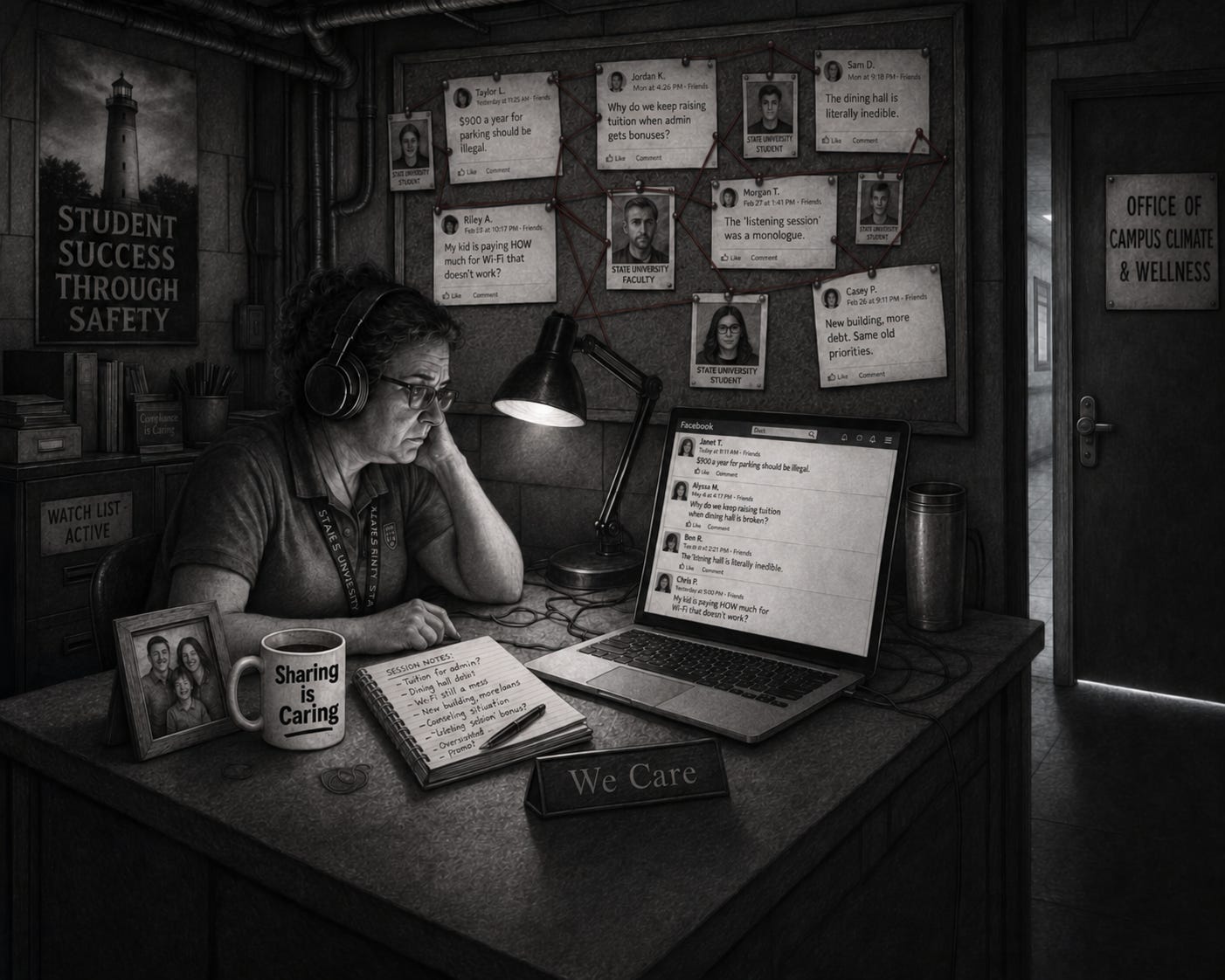
The monitoring went well beyond university accounts and publicly available content. He told me his office tracked the personal social media of students, including locked accounts and private group chats, and sometimes recruited and paid students to friend other students and pass along screenshots of whatever appeared behind the privacy settings.
There was also a “watch list.” The students on it weren’t necessarily threatening anyone or breaking university rules. Some were simply critics of the administration. A Facebook post complaining about a tuition increase could attract attention. (As I said, this was years ago, when students still used Facebook.) So could the wrong kind of tweet.
This also happened during the tenure of a president who was intensely concerned with image and public relations and unusually sensitive to criticism. In that environment, even fairly mundane complaints from students could be treated as something the administration needed to know about and manage. The watch list made more sense once you understood the culture at the top.
What finally pushed the staffer to talk was what the office was finding. Once material from locked accounts and private groups started coming in, employees inevitably saw things that had nothing to do with the university, let alone campus safety. Some of it was deeply private material the university had no business collecting. You can probably imagine the kinds of things college students share in supposedly private DMs and private group chats. He began wondering whether the university was creating legal problems for itself as well as ethical ones.
I wondered, too, and raised the issue with the head of our faculty senate — in general terms, without identifying my source. The senate chair told me he would look into it. His investigation consisted of asking the administration whether it was doing what I had described. The administration said no, so he considered the matter closed. (Incidentally, that guy left for another university shortly afterward. It turned out he had one foot out the door the entire time.)
Unsatisfied with that response, I raised my concerns directly with the chair of the university’s Board of Trustees when I happened to bump into him at a campus event. He seemed genuinely surprised, said he knew nothing about the surveillance and told me he wouldn’t approve of such practices. I believed him.
My suspicion was that the administration had little interest in telling the board that university resources were being used to monitor students over a few mean tweets. In retrospect, maybe the administration’s paranoia wasn’t so mysterious. It later generated some rather damaging headlines without any help from the students.
Surveillance For Sale
At the time, I found the whole thing bizarre and outrageous. Eventually, after my objections gained no traction with higher-ups, I filed it away with the long list of higher-ed practices I thought were wrong but had no power to stop.
The episode came back to mind recently as a wave of stories about Flock cameras — including their use on college campuses — put campus surveillance back in the spotlight. Inside Higher Ed reported about a week ago that students at universities around the country are pushing their schools to get rid of Flock license-plate readers. A recent study identified at least 150 colleges and universities using the technology.
It turns out what my school was doing was an early version of intrusive surveillance practices that have since spread across higher education.
The thing is, Flock is easy to notice. The cameras sit on poles and photograph cars entering and leaving campus. Online surveillance is much quieter — and more questionable. Universities aren’t necessarily monitoring public spaces. They may be watching what students say behind locked accounts and inside private groups.
Universities have also been buying tools to automate online monitoring for years. A 2022 investigation by The Dallas Morning News and UC Berkeley’s Investigative Reporting Program found that at least 37 colleges had used Social Sentinel, software that’s marketed as a way to identify threats and students at risk of hurting themselves or others. But in practice, universities used it in much more intrusive ways. Kennesaw State campus police used Social Sentinel to track protesters before a town hall with a U.S. senator. UNC-Chapel Hill used it during demonstrations over a Confederate monument. The company also gave clients the ability to upload lists of individual Twitter accounts they wanted watched.
What my school’s staffer described to me years earlier was the hand-cranked version of that.
It makes me wonder how much never comes to light. Most of these practices are invisible unless somebody gets caught or an insider decides to talk.
Mission Creep
I doubt many universities ever hold a meeting where someone proposes creating a surveillance apparatus. It probably starts with something reasonable: keeping an eye out for threats or students who may harm themselves.
One office begins monitoring a few accounts. Another buys software. Someone creates a reporting form. Information gets retained because it might be useful later. Each step can be justified on its own. Years later, the university is monitoring people and collecting information in ways that would have sounded unthinkable if anyone had proposed the whole system at once.
And universities don’t always need to do the watching themselves.
For years, colleges have rescinded admissions offers over material circulated in private online groups and opened disciplinary cases after somebody sent administrators screenshots of a student’s posts. The admissions office doesn’t have to stalk applicants on social media if somebody else does it for them.
The same principle applies to students already on campus. Bias-reporting systems, anonymous complaint forms, conduct hotlines and online portals make it easy to send another person’s speech to administrators. Some reports go nowhere. Others result in meetings, investigations or discipline. Either way, the university can end up with information that began as a private conversation among students.
Like Yale and plenty of other universities, we had our own Halloween costume controversy. Students found photos on other students’ Instagram accounts and sent them to administrators. The students in the photos were called in, required to issue an apology and sent for “training.”
The university didn’t need anyone in an office scrolling through Instagram. Other students did the monitoring for them. Then again, maybe one of the informants was on the payroll.
And Now There’s AI
Like surveillance more broadly in the post-9/11 era, campus surveillance has only grown more pervasive — and AI is likely to make it easier and cheaper to automate, and harder for students to know when they’re being watched. This year alone, there have been surveillance controversies and allegations involving the University of Michigan, a dozen British universities and others — involving everything from monitoring protesters and social media to private security firms compiling intelligence on students and faculty.
The tools are more sophisticated now — with drones, facial recognition and real-time crime centers — but the appeal is the same: more intelligence about what students and faculty are doing and saying, on campus and beyond, and more control over what happens next. Software and outside contractors can do at scale what the staffer at my school once did manually.
Incidentally, my source stayed at the university for a couple more years, long enough to take advantage of the free tuition benefit and earn his MBA. Once he graduated, he left. I assumed he was off pursuing the career he wanted.
So I was surprised last year when I spotted him across the quad. Turns out he was back — this time as an adjunct professor.
We never spoke about the surveillance again. I have no idea whether it continued under subsequent administrations. I guess, like me, he eventually made peace with the fact that some things in higher education just aren’t going to change.
More dispatches from the campus that’s lost the plot: subscribe below.
Not just limited to student surveillance, at least at my former institution. I had conducted a study on HPV safety, and a conference abstract was posted, not be me, but by an unrelated person on X. I wasn't even aware of the post though I had been tagged by my X handle. My Department Chair CALLED me because IT flagged it due to the anti-vaccine messages comments others (and the poster) had made. She was furious. And asked me for proof it had an IRB (it did). My paper was controversial (which is why I pretty much self-funded it), but to be called less than one hour after the post had launched pretty much assured, to me at last, that my campus was definitely not a free-thinking, anti-censorship kind of place. BTW, it is a flagship medical campus in a well-regarded, state system. Eyes are everywhere... thanks for this post. Peace...