


FacultyLeaks.com is an anonymous dispatch from inside higher education. Some identifying details have been changed. The dysfunction has not.
The Wall Street Journal is out with an editorial on how the ABA uses its accreditation monopoly to mandate DEI coursework in law schools. Worth reading. But it’s not just law schools.
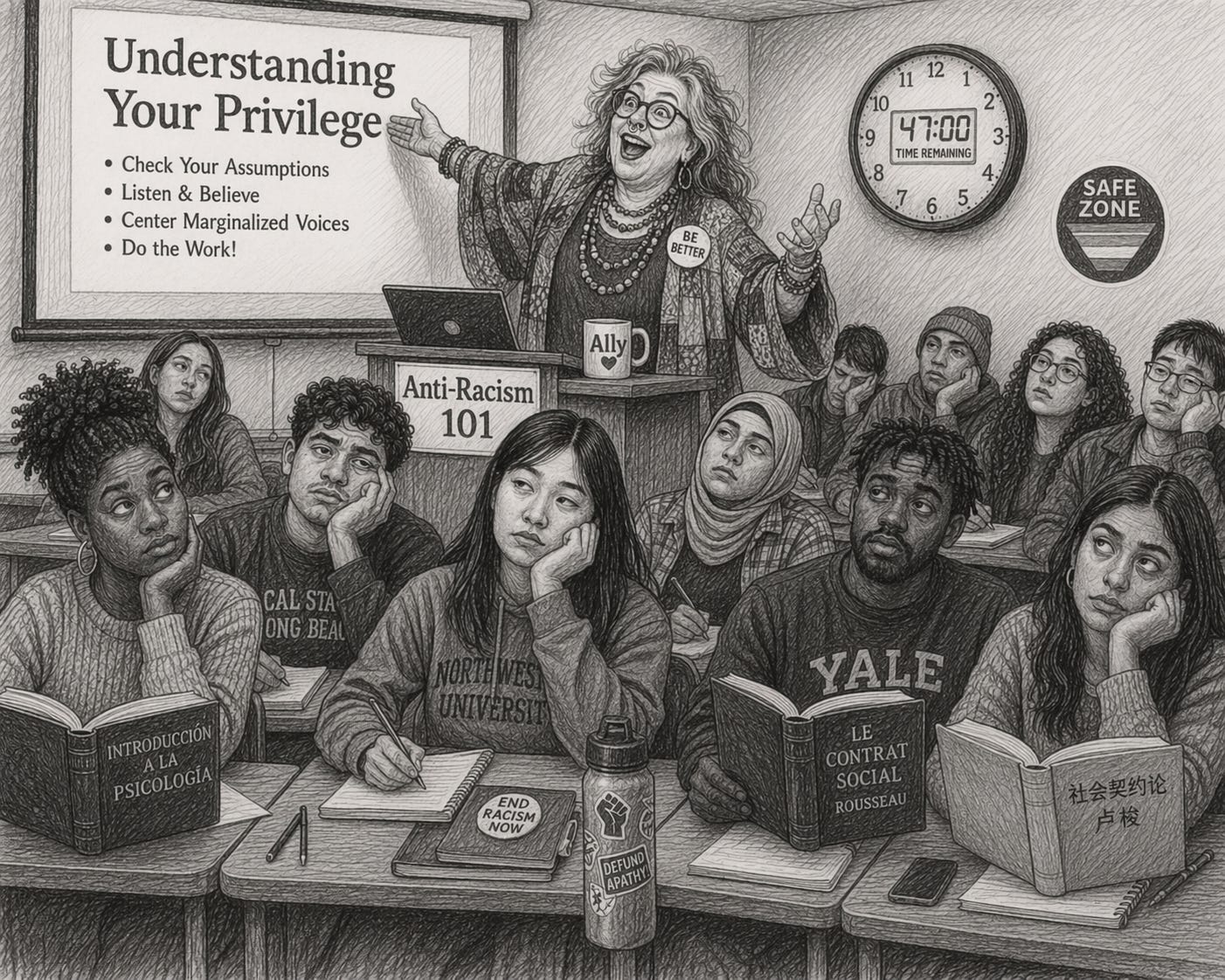
My institution requires all students to take an anti-racism course before they graduate. Not as an elective. As a requirement. They’re not alone — a quick search confirms that dozens of universities have identical mandates baked into their general education requirements. Some institutions are reconsidering. UConn’s faculty senate recently voted to put its mandatory anti-Black racism course on hold after the university’s own legal counsel warned it could be considered illegal under current federal guidance. Not because anyone decided it wasn’t working. Because the funding was at risk.
That tells you everything about why these courses exist in the first place.
Here’s the thing: our student body is majority non-white. Black students, Hispanic students, Asian students, international students from dozens of countries, kids from rural plains states sitting next to kids from New York and LA. The genuine diversity of lived experience in any given classroom would make most DEI consultants weep with joy.
And we’re going to have them sit through a lecture from a 55-year-old upper-middle-class white professor who has never experienced what they’ve experienced — but has definitely read about it.
Students tell me privately they hate these courses. They want waivers. They want out. Nobody has ever asked me to get them out of chemistry.
The actual diversity problem on our campus isn’t ideological. Walk into any cafeteria and you’ll find self-sorted tables. That’s not a diversity failure. That’s human nature. Fix the programming. Fund the social spaces. Create reasons for people to actually mix.
The anti-racism class doesn’t do any of that. It’s not education. It’s a credential. It tells the accreditor that something happened. The students know it. The faculty teaching it know it.
Everyone is pretending otherwise.
Time to stop.
More dispatches from the campus that’s lost the plot: subscribe below.
I wouldn't be opposed to a mandatory anti racism course on a theoretical level. Most Americans think racism is bad and want to live in the world that has less of it. They also demonstrate shocking ignorance of things like Jim Crow and redlining.
But, unfortunately, I've literally never seen DEI or anti racist content written from a normal, sane, middle of the road perspective that doesn't want to punish contemporary whites for attitudes that they don't have and actions that they've not taken. Too many DEI activities are akin to Marxist 'struggle sessions' where white people are forced to confess their ideological errors and beg forgiveness. Treating other human beings in this way is always evil and counterproductive, regardless of how noble the goal is in the abstract.
At my College within this big state university, we invited a speaker in for a struggle session in January 2020 to teach us to "do the work". She was some sort of emeritus sociology prof from another university whose expertise seemed to be centered on racial grievance.
It was like a religious revival, with compulsive hand-waving and chanting of slogans. Excruciating. It was in a big curved auditorium where everyone could see everyone else, so not joining in to the fun was making a statement. I felt very conspicuous.
I was genuinely interested in what the woman had to say about US Civil Rights history, which she was connecting to the present day (basic message: nothing has changed). But I knew enough about that history to know that she was getting basic things wrong. For example she spoke of "David Moynihan" (she meant Daniel Patrick Moynihan), and I knew enough about him to see that she was misrepresenting him and his ideas.
More recently, the state legislature and Board of Regents have outlawed all things DEI here. A welcome change, although I don't know anyone else hereabouts who also thinks so. And of course, DEI lives on in the hearts, minds, and actions of a great many of my colleagues.