


FacultyLeaks.com is an anonymous dispatch from inside higher education. Some identifying details have been changed. The dysfunction has not.
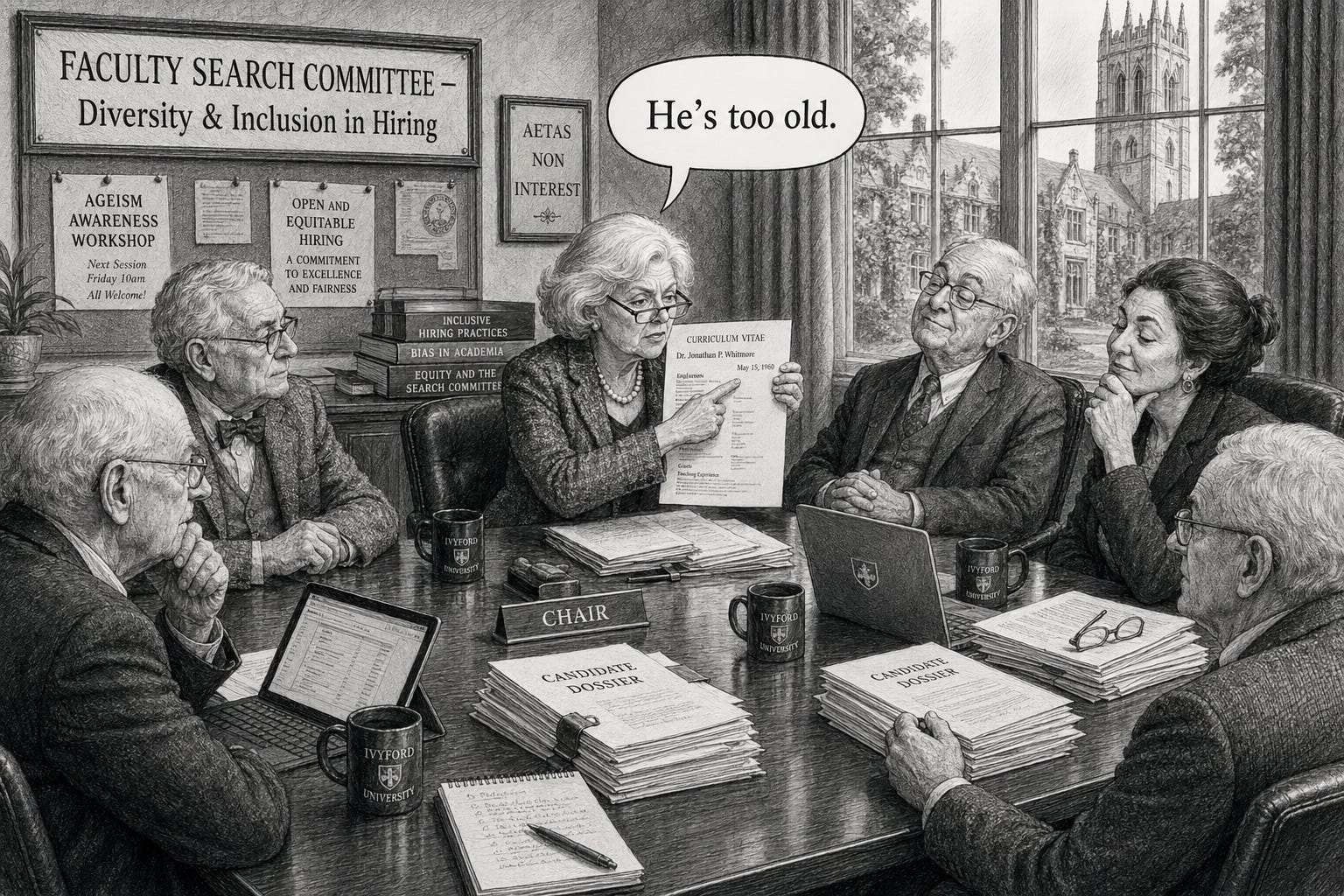
“He’s too old. That guy is older than me.”
The colleague who said this to me — herself well past traditional retirement age — was advising me to reject an adjunct candidate I had just interviewed.
He had been pushed into early retirement at his previous institution by one of the buyout rounds universities use to thin out higher-salary senior faculty in the name of “restructuring.” He still had the itch to teach, plenty of experience, and a strong record. Ultimately, I decided to hire him because he was the best candidate.
What stayed with me was the matter-of-factness. A senior faculty member was casually advising a department chair to discriminate against a candidate around her own age on the basis of age, and the contradiction did not register. The candidate had already been pushed out of his last position by the same logic. He was now, at the next institution down the line, almost being pushed out again before he’d taught a single class.
That conversation has stayed with me because it was not unusual. It was just unusually explicit.
Higher education spends a lot of time talking about discrimination: racial, gender, ideological, religious, reverse, by proxy. Whole administrative apparatuses, vocabularies, and journals are dedicated to identifying and addressing the categories academia has decided are categories.
Age is not on the list. Despite being almost certainly more pervasive in academic hiring than any of the categories that get the speeches and the diversity statements, age discrimination is the one form of bias that nobody puts in their strategic plan, nobody trains search committees about, and nobody apologizes for.
The irony is that the term “ageism” was coined by an academic. Robert Butler used it in 1968-69 to describe systematic stereotyping and discrimination against people because they are old, drawing parallels to racism and sexism. That was almost 60 years ago. Higher education named the phenomenon, then quietly went on practicing it.
Academia isn’t alone in this. Age discrimination is common across many industries: tech, finance, media, the entire white-collar economy quietly screens out 50+. Recent AARP surveys found that 64% of workers age 50 and over have seen or experienced age discrimination at work, and 74% of older job-seekers believe their age will be considered a barrier by hiring managers.
The difference is that academia positions itself as the moral conscience on workplace fairness. Universities run diversity offices, mandate bias trainings, and publish research on exclusion. The institution that named the problem is, in private, doing exactly what it criticizes other industries for doing.
It operates openly, universally, and against both ends of the curve.
The Wall at 50
There is an unwritten rule in academic hiring that nobody states and almost everyone follows. After 50, you are stuck. If you do not have a tenure-track position by then, you will not get one. If you have one, you will not be moved to a better one — unless you’re the rare star hire in law or medicine, where celebrity recruits do still get poached.
This is not a written policy. It is not in the job ad. It is, in many cases, illegal — federal employment law has prohibited age discrimination in hiring against workers 40 and over since 1967. But the rule operates anyway, in the soft tissue of search committees, dean’s office decisions, and the quiet mathematics of “fit.”
A search committee will not say “he’s 56.” It will say he is “overqualified,” or “not a long-term fit,” or “too senior for the rank.” These are the HR-approved synonyms for “too close to retirement.” Everyone in the room knows what they mean, nobody writes it down.
Academia doesn’t need to ask your age to figure it out anyway. The year you earned your degrees is on your CV. So is the date of your first publication, your first faculty position, your last promotion. A search committee can construct your approximate age in 30 seconds without ever asking the question that would expose them to liability.
The result is a labor market in which roughly half of every potential applicant pool is screened out before the first interview. The screening is silent, the legal exposure is invisible, and the pattern is universal.
There is a specific irony in how this plays out. Tenure protects the old who are already inside the institution. The same age that makes you a 30-second screen-out as an applicant makes you untouchable as an incumbent. Higher education has built a caste system in which age is a protected luxury for those inside the fortress and a disqualifying defect for those trying to get through the gate. The senior faculty member who told me an adjunct candidate was “too old” was, without realizing it, describing the rules of the system that protected her.
The Math Doesn’t Work
The “too old at 50” rule is built on assumptions about career arc that stopped being accurate decades ago. People are living longer, working longer, and contributing longer.
A faculty member hired at 50 has, in expectation, 15 to 20 more years of productive academic life. That is a longer runway than most newly minted PhDs will spend at the institution that initially hires them. The person you are dismissing as “too old” will often outwork, in actual years contributed to your institution, the 28-year-old you are about to hire to teach the same courses.
The 28-year-old is, in many cases, planning their next move before they finish unpacking. The first job is a starter position — a line on the CV to be traded for a better one in three years. The institution pays the search costs, the relocation, the startup package, and the onboarding for someone who is, in effect, training at your expense for a job somewhere else. Sometimes the 28-year-old has reasons to stay — a spouse, a family, geographic constraints, a research community that fits. When that’s true, they’re a great hire. When it isn’t, you are training someone else’s future faculty.
The 52-year-old career-changer, by contrast, is often exactly in the place they want to be. They have made their choice. They are not climbing. They are settling in for a long final chapter and want to do meaningful work in it.
The institution that systematically prefers the first profile over the second is not making a coherent staffing decision. It is making a status decision dressed up as a staffing decision.
The Other Direction
The discrimination cuts the other way too, though the law does not protect against it.
Most universities will not hire anyone under 25 for any teaching role. Some of this is structural — many positions require a master’s degree minimum, which most 22-year-olds do not have. Some of it is reasonable — there are real concerns about authority, classroom management, and experience.
But the categorical exclusion is doing work that the credentials alone do not justify. There are courses where the best instructor available may be a 23-year-old.
A university offering an esports course as part of its game-design or media curriculum may genuinely be better served by a recent graduate who competed at a high level than by a 50-year-old faculty member who has read about it. A course on TikTok content strategy may benefit from someone whose intuitions about the platform are not retrieved from a 2022 trade article. Anyone who has sent a child to a summer camp has watched a 20-year-old counselor connect with kids in ways no adult faculty member ever could. There are pedagogical roles where youth is itself the relevant qualification, where proximity to the culture students are actually living in is what makes the teaching land.
Federal law does not protect against age discrimination under 40. So the institution faces no legal pressure to consider the under-25 candidate fairly. But the structural argument is the same as it is for the 52-year-old: you are screening out part of the pool of potential talent on the basis of a number, and the number is not actually the criterion you should care about.
The Legal Asymmetry
To be clear, the two exclusions are not legally equivalent. The 52-year-old shut out of academic hiring has fewer options to pivot, more dependents, less time to recover. Federal age discrimination law treats this differently for a reason.
But both come from the same place: a search committee using age as a stand-in for fit, longevity, manageability, and status. One of those substitutions is illegal, the other is merely incoherent. Both are bad institutional reasoning. The interesting question is not which form of age-based screening is legally protected. It is why an institution that prides itself on rigorous evaluation is making hiring decisions on the basis of birth-year arithmetic at all — especially now, when it can least afford to.
The Relevance Problem
Academia is in the middle of a relevance crisis. Enrollment is down. Public trust is down. The value of the degree is being questioned by a generation that has watched their older siblings carry six figures of debt to work jobs that did not require the credential.
Universities need to be staffed by the most relevant people for what students actually need now. Sometimes that is a 74-year-old teaching 20th-century history because he lived through chunks of it and remembers what the textbooks have flattened out. Sometimes it is a 23-year-old who built an audience of 300,000 from a bedroom on a platform faculty have only read about. The institution that excludes both, and hires only from the narrow band between 28 and 49, is hiring from the band of people most concerned with credentialing optics and least likely to take the risks the institution actually needs.
That is not a hiring strategy. That is a status preservation strategy.
What’s Actually Happening
The senior professor who told me an adjunct candidate was “too old” — older than her — was not malicious. She was repeating what she had absorbed from decades inside the institution. The institution had taught her that there was a window during which a person was hireable, and that the window closed somewhere around 50, even if she herself had been doing fine work past that point.
The institution had also taught her not to notice the contradiction.
This is what makes the discrimination hard to fight. There is no policy to challenge, no diversity statement that says “we do not hire after 50.” There is only a culture, distributed across thousands of search committees at thousands of institutions, that has internalized a screening rule it did not write down and would not defend if asked.
The receipts are not on the website or job ads. The receipts are in the rejection patterns, the unreturned emails, the interviews that don’t happen, the candidates who slowly stop applying because they have figured out what is happening.
The institution depends on those receipts staying invisible.
More dispatches from the campus that’s lost the plot: subscribe below.
Great post. Missed one glaring area: Administrative leadership. Presidents in the pst have been as young as 35. Not any more. They age discriminate to keep deans, procosts, Presidents in the geriatric lane that boxes out real energy and modern leadership insights from thise who used to be given it. And, the institutions suffer greatly for it. Too many at the top beleive they paid their dues and that there is a line they have been waiting in the front of for the next spot available. Search committees suffer the same. So, it ends up in a circlular spiral downwards. The younger faculty are routinely fed up and just move on to other things, further emptying oit the brain drain thatbhas happened for the past 2 decades.
I have two conflicting responses to this. First, the deficits caused by aging are real, especially in an era of rapidly advancing technological change so it's flat wrong to expect that a 55 year old can on average deliver the performance of a 28 year old.
On the other hand, the university's position is disgusting. It's an adjunct position. The university is not making any commitments to the new hire that it cannot immediately revoke at the end of the current semester or academic year. All the risk is on the shoulders of the new hire struggling to demonstrate their capacity to teach well in a new environment. If they don't then the university we'll have to do nothing more burdensome than hire another a replacement in a market with plenty of candidates. It's really sad to see the university stressing these type of decisions when they have all the control and all the power.